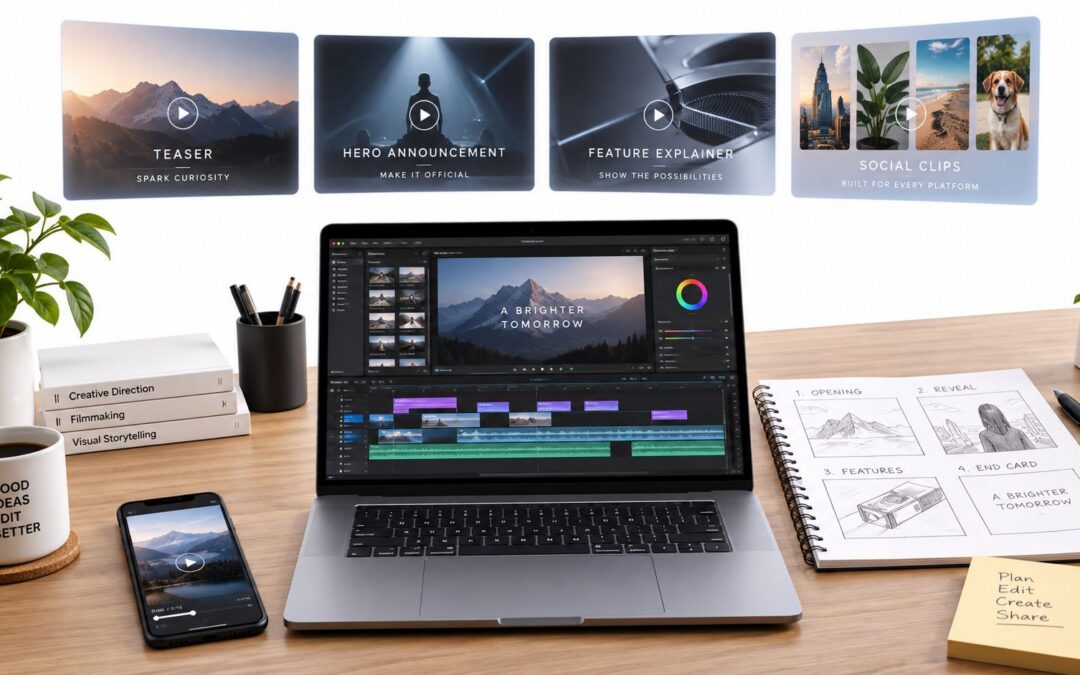
Launch day gets the video. Launch day minus three gets the teaser. Then nothing. The window between announcement and adoption, roughly fourteen days, runs on silence, recycled captions, and a single hero asset that was already burned through in the first 48 hours.
The pattern shows up in every retrospective I’ve read from B2B product marketing teams shipping three or more launches a year. The team treats the launch video as a one-shot deliverable. They script it, shoot it, ship it on the announcement, and then wonder why the second week of the campaign underperforms the first. It underperforms because the video did its job on day one and then had nothing left to give.
A single hero asset cannot carry a two-week sequence. The audiences who see the announcement on day one are not the same audiences you’ll reach on day seven, day ten, or day fourteen. Each of those touchpoints needs its own video, built from the same source footage but cut for a different job. This is the core case for why one launch video isn’t enough for your business: the format is wrong, not the effort.
Here’s the sequencing I’d run with a small team and a tight budget:
- Teaser (T-3 to T-1). 8 to 12 seconds. Hook the problem, withhold the solution. Built from a 5-second clip of the hero video’s opening shot plus a text overlay.
- Core announcement (day 0). The 60 to 90 second hero piece. This is the only asset that gets full production treatment.
- Feature explainer (day 2 to day 4). 30 to 45 seconds. One feature, one screen recording, one voiceover. Pulled from the same demo session that fed the hero video.
- Post-launch cutdowns (day 7 to day 14). Four to six assets, 6 to 15 seconds each. Pull quotes, customer reactions, product UI moments, stat callouts. Re-edited from the hero video’s raw footage.
Total production load: one shoot day, one editing day, one assembly day for the cutdowns. Five assets, fourteen days of coverage, no scramble.
Teams that skip the cutdown phase pay for it in two specific ways. First, the social channels go dark after day three, and the algorithm punishes the gap. Second, the sales team has no short clips to drop into outbound sequences, so they default back to static screenshots. Both problems trace back to the same root cause: the team planned one video when the launch needed a system.
The fix is a template, not a bigger budget. Build the cutdown template once, populate it from every future launch’s raw footage, and the post-launch sequence stops being a separate project. It becomes a Tuesday afternoon task.