The advice to make more video is lazy. Video content fatigue isn’t happening because people hate watching, it’s happening because they keep getting the same dull asset dressed up with a new thumbnail. If your brand sounds like every other brand in the feed, viewers stop distinguishing you from the noise, and the format itself takes the blame.
A better question is simple, and it should make every marketing team uncomfortable. What if the problem isn’t the amount of visual content, but the sameness of the message?
The Real Problem Behind Video Content Fatigue
The feed is crowded, but crowding alone doesn’t explain video content fatigue. The core issue is sameness. Brands keep publishing polished intros, stock-like scenes, broad claims, and safe calls to action, then wonder why audiences scroll past content that looks interchangeable. When every company uses the same pacing, the same openers, and the same generic promise, viewers don’t reject one clip, they reject the whole pattern.
That’s why the usual answer, make more, is backwards. More generic output just trains people to ignore generic output faster. The audience isn’t asking for another cinematic brand reel, another founder talking head, or another “solutions” montage that could belong to any competitor in SaaS, finance, insurance, or ecommerce.
Specificity beats polish
A recorded message that speaks to one situation will travel farther than a broadly professional piece that says nothing useful. A retailer telling a cart abandoner exactly what they left behind feels relevant. A financial services firm explaining a policy step to a real customer feels relevant. A travel brand sending a trip-change update feels relevant. That’s the difference between a message that earns attention and a clip that adds to the pile.
The thesis here is blunt. Video content fatigue is message fatigue wearing a format costume.
Practical rule: If the viewer could swap your logo with a competitor’s logo and nothing in the script breaks, the asset is too generic.
For teams managing online video metrics, this should change the creative brief. Don’t ask whether the piece looks polished enough. Ask whether it speaks to a known customer state, a known milestone, or a known problem that people face in the moment.
Measurable Signals That Audiences Are Tuning Out
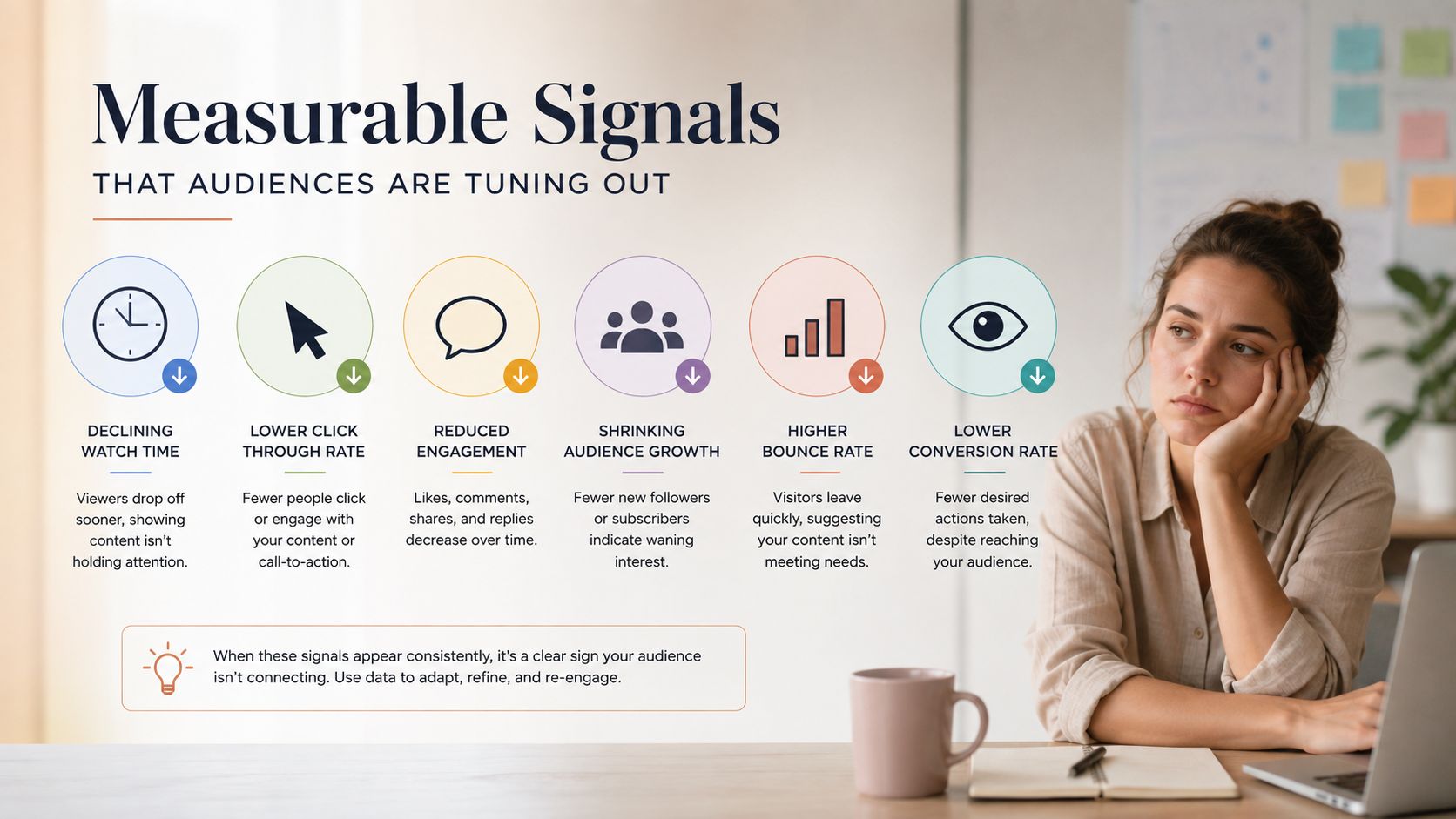
Video content fatigue stops being an abstract complaint once you look at behavior. In a 2025 consumer study, only 11% of Americans said they finish the videos they start, meaning 89% abandon them partway through, and 14% turn them off within the first 10 seconds, according to UserTesting’s stream fatigue report. That isn’t a creative taste problem. It’s a signal that weak openings are costing attention before the message has a chance to land.
The same report found 30% of Americans lose sleep every night because they keep streaming movies, shows, or videos, and 62% of streaming users felt subscription fatigue in 2023, up from 46% in 2020. Those numbers matter because they show a strange mix of consumption and resistance. People keep watching, but they’re less patient, less selective, and quicker to quit when the content doesn’t feel immediately useful.
What fatigue looks like in the wild
A brand team usually sees it in the same places, lower completion, faster drop-off, muted ad playback, and rising disengagement across repeated campaigns. That’s not a call for louder creative, it’s a call for tighter intent. Shorter intros, clearer stakes, and faster relevance matter more than cinematic gloss.
There’s also a cognitive layer. Continuous short-form consumption is linked to attention difficulty, working-memory disruption, and cognitive fatigue in research on scroll immersion published in PubMed. Objective fatigue detection work using eye-tracking found a model could identify fatigue with 91.0% accuracy in 10-fold cross-validation after only 30 seconds of viewing, which is a useful reminder that micro-signals show up early, long before a survey does.
A viewer doesn’t need to say “I’m tired.” Their gaze, pace, and abandonment already said it.
When a customer success team, an HR team, or a B2B marketer sees those patterns, the answer is not to flood the channel with more clips. The answer is to make each clip less disposable.
Why Specificity Beats Polish Every Time
A generic visual asset asks for patience it hasn’t earned. A specific one gets a pass because it recognizes the viewer’s reality. That’s why context-aware content works across ecommerce, insurance, SaaS, and education. A customer who sees their own order status, claim stage, account milestone, or enrollment step doesn’t experience the message as “marketing.” They experience it as useful information.
The problem with polished generic work is that it performs confidence without delivering relevance. A slick opening, clean motion graphics, and a branded outro do nothing if the first five seconds don’t signal, “This is for you.” That’s where video content fatigue gets worse, because people learn to ignore the style before they decode the substance.
Relevance over reach
A user-specific asset can do the job of ten broad ones because it answers a real question faster. A SaaS onboarding clip that names the plan and next setup step. An insurance explainer that reflects the policyholder’s claim stage. A real estate update that references a property viewing or document milestone. These aren’t creative tricks, they’re practical forms of respect.
For teams building this way, personalized video is less about novelty and more about clarity. The point is not to make every asset flashy. The point is to make each one unmistakably tied to the viewer’s situation.
Practical rule: Specificity doesn’t have to be complicated. It just has to be true.
That’s also why restraint matters. If you can say it in one contextual clip, don’t stretch it into three generic ones. Video content fatigue drops when viewers feel seen, not sold.
Generic Volume Versus Relevant Scale in Practice
The contrast is simple. One team keeps pushing out templated assets to every list, every region, and every stage. Another team builds a system that assembles the right message from the right data at the right moment. The first approach creates repetition. The second creates relevance at repeatable volume.
| Dimension | Generic High-Volume | Data-Driven Relevant Scale |
|---|---|---|
| Audience fit | Broad, broadcast-style | Context-aware, one-to-one |
| Production model | Manual and repetitive | Programmed and repeatable |
| Message quality | Same claim across every segment | Different message by stage, role, or event |
| Business use | Awareness only | Acquisition, onboarding, retention, training, updates |
| Viewer reaction | Skipped, muted, forgotten | Recognized, opened, acted on |
For ecommerce, that could mean a post-purchase message that reflects order status instead of a generic thank-you clip. In SaaS, it could mean sending an onboarding update tied to product activation instead of another all-purpose welcome reel. In insurance, it could mean a claim-status message that cuts confusion. In enterprise operations, it could mean stakeholder updates that mirror project stage instead of another static slide deck.
A useful reference point for teams mapping creative ideas is video ideas, not because more ideas solve the problem, but because the right idea has to match the right trigger.
Practical rule: Don’t ask how many videos you can make. Ask how many meaningful moments your system can cover.
That’s the distinction between noise and utility. Generic volume trains fatigue. Relevant scale trains trust.
Building a Fatigue-Resistant Video Workflow
The workflow should be boring in the best way. Start with the data source, CRM fields, product events, HR milestones, ticket status, or shipment updates. Map that into a template with fixed structure and variable fields. Then set the trigger, such as trial signup, policy change, onboarding completion, or manager approval. Finally, distribute through email, SMS, portal, or internal channels.
A tool doesn’t need to be fancy to do this well. Platforms like Wideo can turn structured inputs into repeatable visual content when teams need to generate context-aware assets without rebuilding each one by hand. For teams that also need a wider delivery layer, video support overview is a useful reference for thinking about how clips move through customer communication channels.
The key is discipline. Don’t build a library of “general purpose” assets and hope they stay fresh. Build a system that only produces what the viewer needs next. A retail brand can use that for abandoned carts. An airline can use it for trip updates. An HR team can use it for benefits enrollment. A customer success team can use it for renewal nudges and stakeholder reports.
If the process feels too manual, the problem is usually the template architecture, not the channel. No-code video automation matters because most teams don’t need a bigger creative department, they need a cleaner workflow.
From One-Off Production to Scalable Video Systems
Microsoft Research’s work on enterprise videoconferencing fatigue shows the deeper point, the strain comes from the system, not just the clip. In the workplace, repeated live interaction, missing social cues, and always-on communication create a cost that organizations eventually pay in attention. That’s why internal comms, operations, training, and reporting should move toward asynchronous recorded message workflows whenever the message doesn’t require a live meeting. Microsoft Research’s study on enterprise videoconferencing fatigue makes that case clearly.
The same logic applies to training and onboarding. Research on AI-generated video for corporate learning found no significant difference in adult learners’ ability to retain and recognize information between AI-led and human-led formats. That matters because it gives HR and L&D teams permission to stop treating every module like a custom production shoot and start treating it like infrastructure.
Personalization research summarized in industry sources also points in the same direction, with cited cases showing 164% higher click-through rate and 16x higher click-to-open rates for personalized video. Those figures are a reminder that relevance changes response. A generic asset is a one-time campaign. A dynamic asset becomes part of the operating system.
how to text a video file is another useful reminder that distribution matters as much as production. The best system is the one that gets the right recorded message into the right channel without creating more manual work for the team.
What was the last video you remembered, and did it earn that memory by being specific, or just by being louder than the rest? If your asset can’t answer that question, it’s adding to the fatigue, not solving it.
Wideo helps teams create repeatable, data-driven visual content from templates, so marketing, sales, onboarding, and internal communication don’t have to depend on manual editing every time. If you’re ready to cut the sameness and build a better workflow, visit Wideo and see how context-aware video production can fit into your stack.