
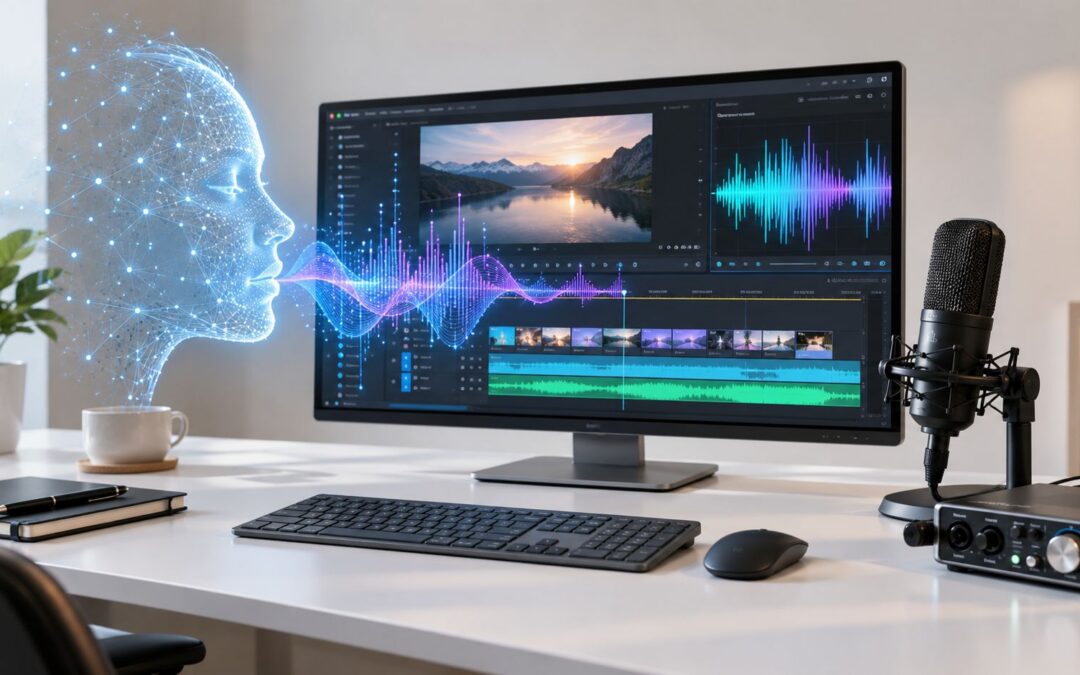
You’re probably sitting on a backlog of recorded messages that all need the same fix, a new product screen, a changed offer, a new compliance line, or a founder who no longer wants to re-record the same script for the fifth time. That’s where AI voice cloning stops being a novelty and starts becoming a production decision. Used well, AI voice cloning lets a team keep a recognizable voice across onboarding, marketing, and internal communication without dragging every update back through a studio calendar.
The market is already treating this as serious infrastructure, not a side experiment. One industry report valued the AI voice cloning market at USD 1.45 billion in 2022 and projected USD 9.75 billion by 2030, with a 26.1% CAGR, and it named North America as the largest market in 2022 Grand View Research. That matters because it tells you where the buying is happening, and why teams are now asking a harder question than “Can it sound real?” They’re asking, who approved it, and can we prove it?
The Video Team’s Voice Problem
A five-person SaaS marketing team opens a spreadsheet and sees forty onboarding clips that all feature the same product manager walking users through setup. The problem isn’t just volume. The pricing tiers changed, three integrations were deprecated, and the original narrator is now in another role and doesn’t want to keep recording fixes. Re-shooting the whole set would mean studio time, calendar churn, and a rewrite of assets that still look fine.

That’s the moment where AI voice cloning earns a seat in the workflow. The team isn’t trying to replace every human performance. They’re trying to update narration in a way that keeps the same speaker identity while the visuals stay intact, which is especially useful in ecommerce product explainers, insurance policy walkthroughs, finance onboarding, and enterprise training libraries.
If you’ve ever had to choose between mismatched audio and delaying a launch, you already know the pain. For teams that document processes in regulated settings, the voice layer matters just as much as the on-screen steps. A useful parallel is voice to ELN for wet labs, where spoken instruction becomes searchable operational record, because the value is not the audio itself, it’s the repeatable workflow around it.
Practical rule: if the script changes more often than the speaker’s availability, cloned narration belongs in the process.
For teams building repeatable onboarding or product education assets, the simplest implementation starts with adding voice over to video where the voice layer can be swapped without rebuilding the whole edit. That’s the operational mindset that matters, not a demo reel.
How AI Voice Cloning Actually Works
The short version a producer needs
AI voice cloning starts with enrollment audio, meaning a reference sample from the speaker whose voice you want to reproduce. Research on voice-cloned translation notes that current neural TTS can mimic vocal characteristics with only minutes of training data, and other work frames the task as synthesizing an unseen speaker from a few samples Chalmers. The practical idea is simple. The system listens for timbre, pitch range, and cadence, then builds a voice profile it can reuse on new scripts.
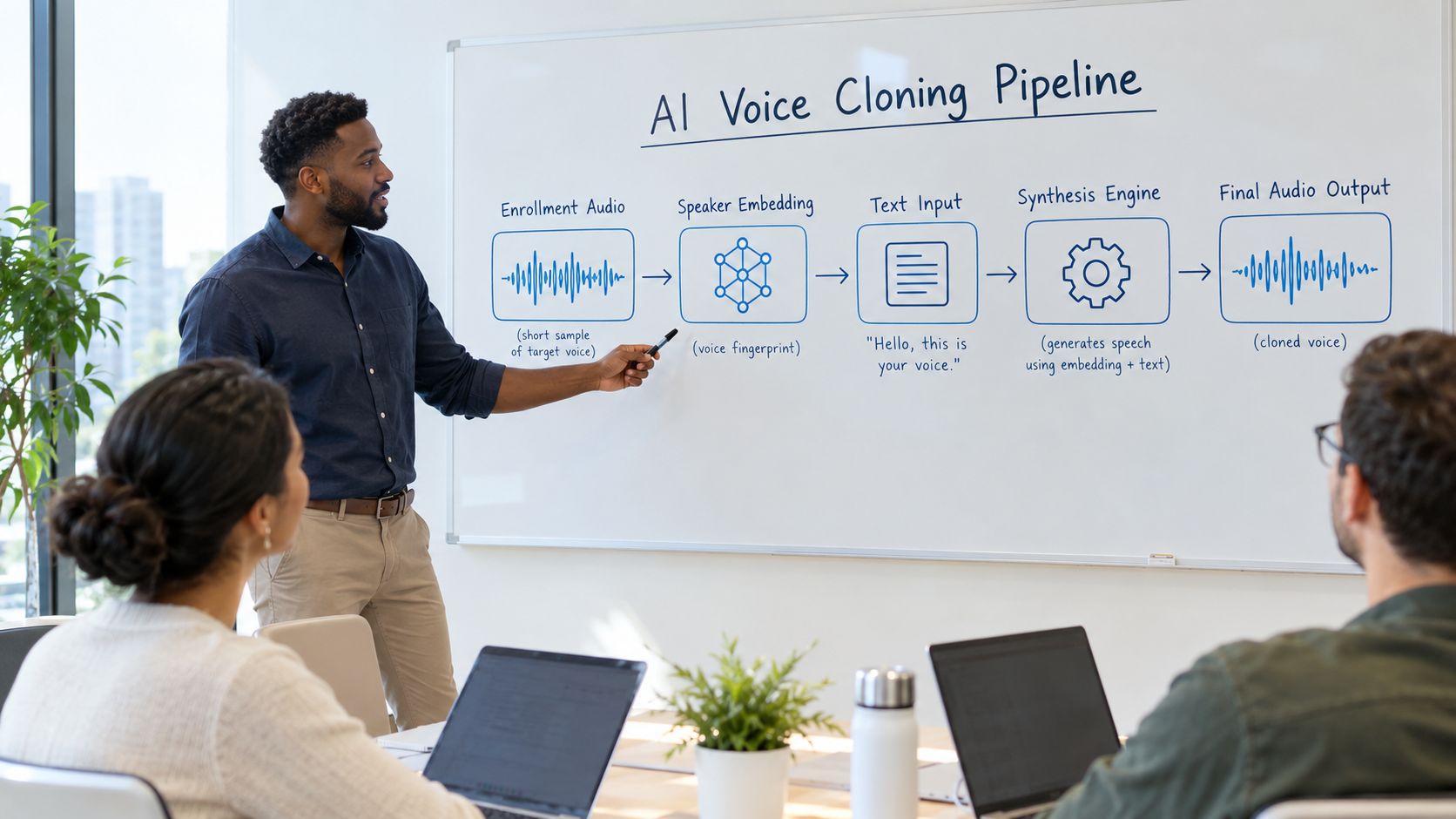
The enrollment sample feeds a speaker representation, often described as an embedding. That embedding conditions either a voice conversion system, which re-renders existing audio, or a neural text-to-speech model, which generates speech directly from script and voice profile. You don’t need to care about the math to manage the workflow, but you do need to know that more clean source audio usually gives the model more to work with, especially for accent and prosody.
What the pipeline means for marketing teams
Think about a founder recording one approved brand read for a launch campaign, then using the same voice for a multilingual cutdown set, internal training snippets, and lifecycle emails turned into clips. The model is doing the mechanical repetition, not inventing the brand tone on each pass. That’s why AI voice cloning fits content systems that need consistency across dozens of assets, like SaaS feature education, real estate listing explainers, travel updates, or retail order notifications.
For marketers comparing tools, compare AI voice chat types if you want to understand how voice behavior changes across product categories. It’s a useful lens when you’re deciding whether a cloned voice should sound like a host, a spokesperson, or a support agent.
The model doesn’t create judgment. It creates a reusable vocal pattern. Your team still owns the script, the approval, and the context.
A useful internal reference is Wideo’s text to speech technology overview, because the workflow mindset is the same, script in, voice out, distribution next. The difference with AI voice cloning is that the voice belongs to a specific approved identity, not just a synthetic narrator.
Where Voice Cloning Earns Its Place
Priya, a fictional founder I’d happily put in front of most marketing teams, used a clone in three places that saved her production calendar. The first was onboarding. Forty clips needed updates after a UI overhaul, and she approved a cloned version of her own voice from a prior clean recording, which let the team edit scripts in an afternoon instead of dragging everyone back into a re-record cycle.
The second was brand narration. Priya recorded one master read, then used a licensed clone to keep the same delivery across English, Spanish, and Mandarin. A native reviewer still signed off on each language, which is how you should do it. AI voice cloning handled repetition, while human review handled tone and pronunciation.
The third was customer proof. A testimonial library needed a wording change months after a customer had already recorded. Instead of asking for a full reshoot, the team used the approved voice pattern to keep the asset current. That’s the cleanest use case I’ve seen, because the source speaker had already agreed to the scope and the edit was narrow.
| Project | Cloning Role | Time Saved | Human Review Still Required |
|---|---|---|---|
| Onboarding refresh | Re-record the narrator without bringing them back in | Script edits and versioning only | Yes, for accuracy and final approval |
| Multilingual brand narration | Keep the same approved voice across languages | Fewer booking cycles | Yes, for native review and context |
| Testimonial updates | Patch small wording changes after the original session | Avoids a full reshoot | Yes, for consent and final signoff |
For teams that need to generate repeatable narrated assets from product or CRM data, personalized video workflows can carry the same logic into customer communication. That’s where AI voice cloning becomes part of the system, not a one-off edit.
Where Synthetic Voices Still Fall Short
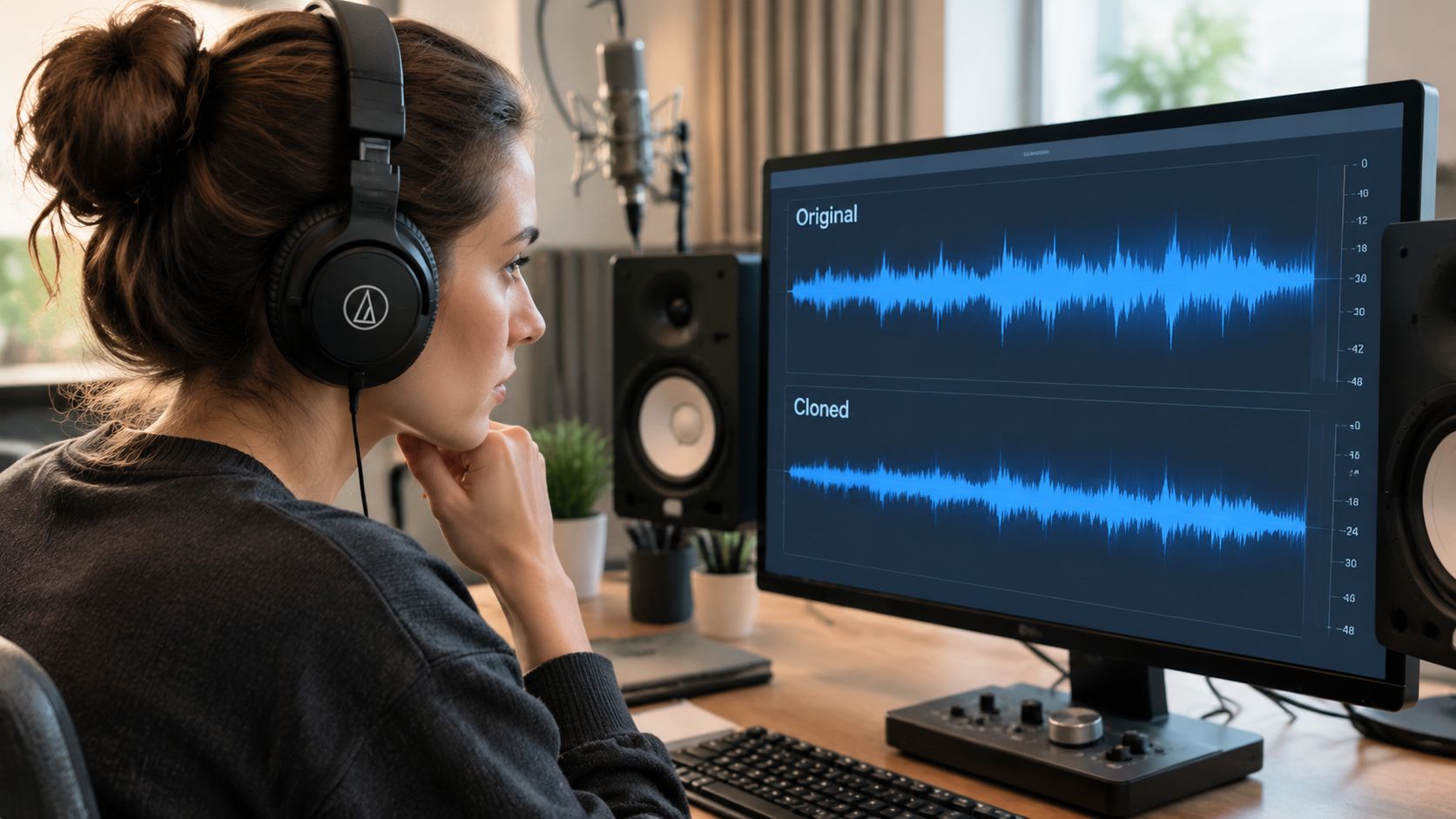
A cloned voice can get identity right and still miss the performance. That’s the part teams keep underestimating. In onboarding, a reassuring pause can land too early. In brand narration, a line that should sound restrained can flatten into something neutral. In localization, pronunciation may be correct, while the rhythm still sounds translated.
The hardest edits are emotional, not technical
Unscripted moments are still a weak spot. Laughter, interruptions, whispering, overlap, and abrupt emotional shifts can expose artifacts, and noisy music beds can make the voice feel detached from the final mix. That’s why a founder apology, a condolence message, or a crisis statement should usually stay human. If the meaning depends on lived authority, a real recording still wins.
If the audience needs to feel that a person is present, don’t hide behind a clone.
You can test any cloned take against a human read for comprehension, emotional accuracy, pronunciation, and listener fatigue. If the synthetic version feels clean but emotionally blank, that’s your answer. How important voice over is in animated videos is a useful reminder that voice isn’t decoration. It carries trust.
The Consent and Detection Reality
This is the part many teams want to postpone, and they shouldn’t. A convincing clone can outlive the campaign that created it, travel into contexts the speaker never approved, and create confusion long after the edit is done. That’s why AI voice cloning is really a governance problem disguised as a production shortcut.
Consumer Reports found that a majority of tested AI voice-cloning products lacked meaningful protections against fraud or misuse, and a separate March 2025 assessment flagged that multiple popular services did not technically verify speaker consent before cloning Consumer Reports. The fix isn’t to rely on detection alone. It’s to build a paper trail and technical traceability from the start.
The EU AI Act’s transparency obligations for synthetic audio are scheduled to apply from August 2, 2026, and the framework points toward machine-readable watermarking and disclosure for AI-generated audio, including deepfakes AnyVoice. That’s a compliance signal, but it’s also a practical one. If you can’t show who approved the voice, where the sample came from, and what the clone can be used for, you’re betting your brand on hope.
| Control | What it supports | Key limitation |
|---|---|---|
| Consent capture | Proves the speaker agreed to the use | Doesn’t cover misuse outside scope |
| Watermarking and provenance | Helps trace synthetic origin | Doesn’t replace permission |
| Detection tools | Flags suspicious audio | Misclassifies real and synthetic clips |
| Review logs | Shows who approved release | Needs disciplined maintenance |
For governance and publishing teams, keep the approval record together with the final export, and treat Wideo’s privacy policy as the kind of documentation your procurement or legal team will ask for when synthetic narration enters the stack.
A Practical Governance Checklist
Start with identity and scope. Record the speaker’s name, the project purpose, the intended channels, the languages, the territories, and the duration of use. Capture explicit consent before you collect reference audio, and store that signed agreement with the production brief so nobody has to reconstruct permission later.
Then control the creative workspace. Keep the source recording intact, document the tool and model version, and create an internal audit record for each asset. Add a synthetic-media label when the platform supports it, and preserve provenance details with the exported file.
Before release, put a real human back in the loop. The speaker, or an authorized reviewer, should verify pronunciation, emotional intent, and context. If something sounds off, pause it. If a complaint arrives later, have a takedown path that names the owner, the response window, and the process for removing the model, the audio, and the published clip.
- Identity and scope: name, project purpose, channels, territories, languages, and duration
- Consent: explicit approval before recording, with reuse terms written down
- Creation record: tool version, model version, source audio kept intact
- Release review: final human approval for tone, pronunciation, and context
- Revocation path: clear contact, clear pause process, clear removal steps
That’s the difference between a random synthetic read and enterprise-ready AI voice cloning. The workflow is strict because the stakes are real.
Choosing Where to Clone and Where to Record
Use AI voice cloning for recurring onboarding updates, ad variants that change often, multilingual versions of approved scripts, and narrated explainers with weekly revisions. Use a real recording for executive thought leadership, crisis communication, condolence notes, and anything where the speaker’s vocal texture is part of the message. If the script changes more than a few times and the speaker isn’t available, clone. If the moment depends on authenticity, record.
The best operating model is hybrid. Clone the volume work, the support work, and the update work. Record the flagship pieces, the moments of trust, and the communications that need a human breath behind them.
Would your next three projects sound better with a consistent voice, or would they lose the one thing your audience needed most? Run that test before you commit, and don’t let convenience decide for you.
If you’re ready to turn voice into part of your content system, Wideo gives teams a practical way to build narrated assets, add voice generation, and keep approvals under control across onboarding, marketing, and internal communication. Visit Wideo to see how consistent, brand-approved narration can fit into your next video workflow.
Related posts:
 Your Guide to AI Video Generator Technology
 A Guide to AI Video Creation for Beginners
 AI Avatars: The New Face of Business Communication
 AI Avatars: The Secret Weapon for Business Growth and Efficiency
 AI Technology: The New Creative and Strategic Core of Business
 12 Powerful AI Tools for Video Creators in 2025


