The loudest advice about the future of video production is also the least useful, because the question is not whether AI replaces editors. The split is narrower and more consequential, repetitive work fades, while judgment-heavy work becomes the center of the job. Cutting templated clips, captioning, resizing, and basic voiceover are moving into machine-driven systems, while creative direction, brand consistency, audience-message fit, and quality control matter more than ever.
That shift changes the job description for producers, marketers, and creative teams. The future of video production is less about making one polished asset from scratch and more about managing a repeatable system that can produce many versions without losing control. For teams in ecommerce, finance, SaaS, insurance, real estate, education, travel, media, and enterprise operations, that difference is not academic. It changes who owns the workflow, what skills get promoted, and where the bottlenecks move.
Why the Future of Video Production Is Not About Replacement
The easiest mistake to make is to treat AI as a blunt substitute for human production labor. That framing sounds dramatic, but it misses how the work is changing. The future of video production is not a binary choice between people and machines, it is a reallocation of effort, where repetitive tasks move out of the editor’s week and into systems, while the editor’s judgment becomes more valuable.
A producer at a SaaS company still decides what the onboarding story should say, which objections matter, and where a customer might drop off. What changes is that the producer no longer needs to manually rebuild the same asset for every audience, region, or channel. An internal comms team in healthcare still needs accurate messaging, but it should not spend its day re-cutting the same update into six sizes for six destinations. That work is increasingly programmatic, while the people work sits higher up the stack.
Practical rule: if the task is the same every time, it should be the first thing you systematize.
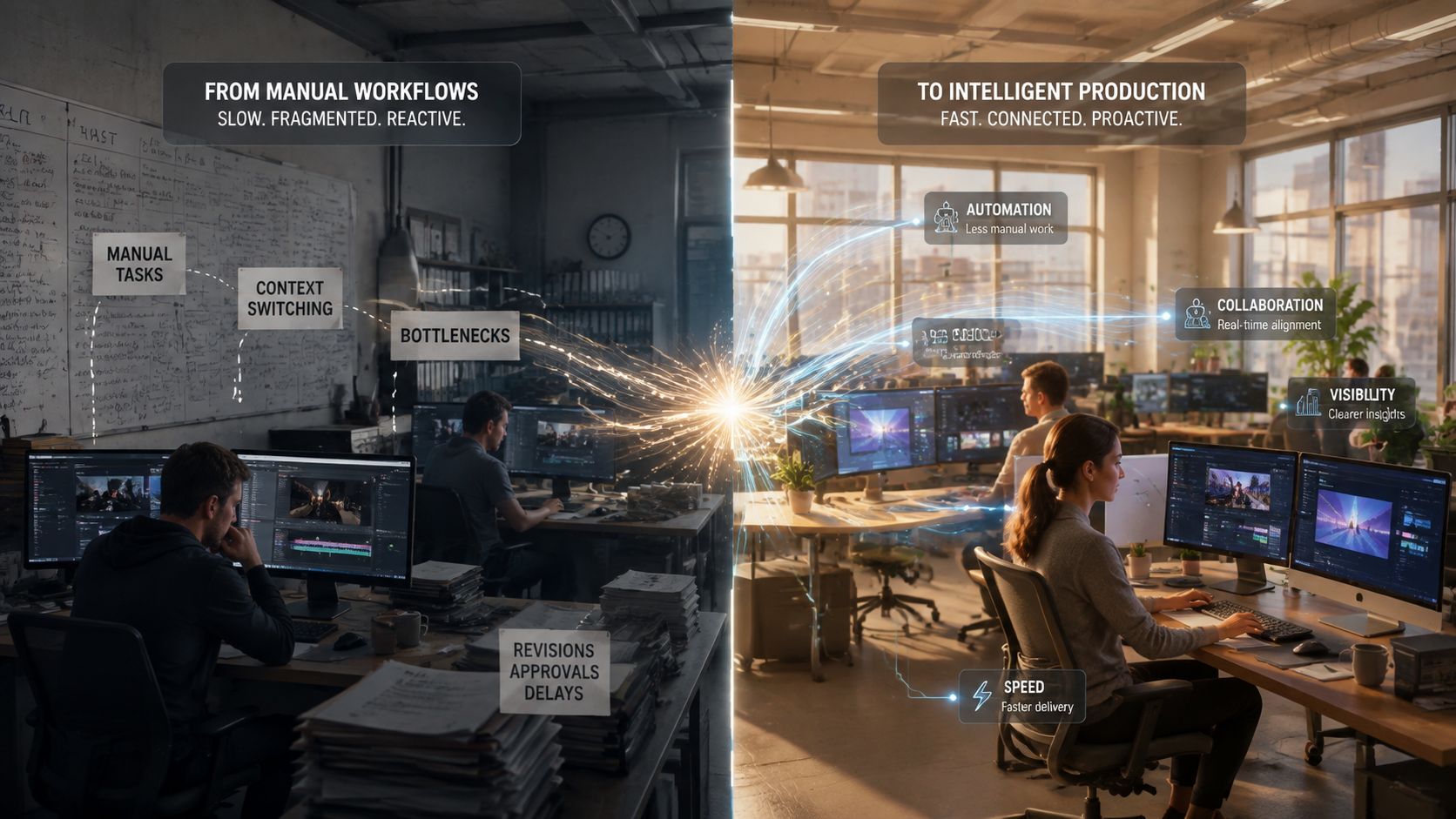
This is why the future of video production is really a story about workflow design. Teams are moving from a craft model, where every asset is treated like a one-off, to an operations model, where the output is governed by templates, rules, and review gates. That matters in ecommerce product launches, insurance explainers, real estate listing videos, and employee training alike, because those categories all depend on repeatability. A good system does not remove creativity, it protects it from being buried under repetitive labor.
For a useful starting point on the automation side, see Wideo’s AI video generator, which fits the larger shift from manual assembly to structured output.
The Shift Already Happening in Production Teams
This is not a prediction for 2030, it’s already inside day-to-day workflows. Independent 2026 research found 63% of video marketers used AI tools to create or edit marketing video, up from 51% the year before, while 62% of teams either already use AI in video workflows or plan to start soon, and 54% of companies now have in-house video teams versus 36% two years earlier (Digital Applied). That combination matters. More teams are bringing production closer to the business, even as automation absorbs the repetitive parts of the job.
The market side points the same way. One forecast places the global video production market at USD 70.40 billion in 2022 and USD 746.88 billion by 2030, while a second forecast projects USD 78.11 billion in 2025 and USD 165.229 billion by 2031 (Grand View Research). The spread between estimates says more about methodology than certainty, but both point in the same direction, demand is moving toward faster, cheaper, more repeatable production.
What that means inside companies
A finance team does not need a studio for every quarterly update. A training group in retail does not need an editor to rebuild every safety clip from scratch. A travel brand does not need one-off manual edits for every destination market if the message structure stays stable and only the content variables change. The structure of the work is changing because the business need is changing.
Decision point: the new production constraint is not raw video volume, it’s how many approved variants a team can release without breaking brand rules.
For a practical example of bringing production in-house, the workflow described in Wideo’s article on how tribes brought video marketing in-house and increased productivity 21x shows the direction many teams are taking, internal capability plus repeatable systems. That same logic is visible in corporate marketing, customer education, and internal communications, where speed only matters if the process is stable enough to trust.
Tasks Disappearing and Tasks Growing in the Future of Video Production
The cleanest way to understand the future of video production is to separate tasks that were once manual from tasks that now deserve more attention. The disappearing work is mostly mechanical, the growing work is mostly judgment-based. That doesn’t mean the craft is disappearing, it means the craft is moving up a level.
| Legacy Manual Task | Systematized Replacement | Who Owns It Now |
|---|---|---|
| Re-cutting the same interview into platform-specific versions | Template-based variant generation | Producer, ops lead, or content systems manager |
| Manual captioning and sizing for each channel | Machine-driven formatting rules | Workflow owner plus QA reviewer |
| Basic voiceover for routine explainers | Model-generated voice workflows | Creative lead and brand steward |
| Repetitive localization edits | Data-driven localization pipeline | Localization ops and editorial reviewer |
| One-off version tracking | Structured asset governance | Production manager or content operations |
The editor’s role changes in a very concrete way. In a media team, the week that used to disappear into resizing and caption cleanup can now be spent designing the template structure, reviewing output quality, and deciding where human intervention is still needed. That is not less skilled work. It is different skilled work.
For teams trying to build that transition into their process, Wideo’s guide on video automation for companies fits the operational side of the story. The important point is not the tool category itself, it’s the ownership model. Someone has to own the template logic, someone has to approve brand rules, and someone has to decide when a generated output is good enough to ship.
A B2B software company may keep senior editors on hero campaigns while shifting routine product updates to a standardized pipeline. A real estate brokerage may still need a human eye for flagship listings, but agent updates, neighborhood explainers, and open-house reminders can follow the same structured path. The future of video production does not delete editorial taste. It deletes wasted time spent redoing the same thing five different ways.
The New Skills That Matter Alongside Creative Craft
Creative judgment still carries weight, but the market now rewards producers who can pair it with operational discipline. A producer who hears a weak message, a brand mismatch, or a pacing problem is more valuable when that judgment also informs template logic, review rules, and output standards. The role is expanding into a mix of creative direction and system oversight.
Skills that now sit beside the craft
- Data literacy, knowing which content performs and how that should change the next brief.
- Template design, building structures that can hold many variants without turning messy.
- Prompt and system thinking, directing machine-generated output and deciding how it moves through review.
- Quality control, catching drift in tone, identity, claims, or timing before it reaches customers.
Teams that treat the future of video production as a speed contest miss the point. Faster output helps only when someone can keep it aligned. In finance, insurance, and employee communications, weak control turns efficiency into churn, because small errors spread quickly across repeated versions. The higher-value skill is setting up a system that can move fast without letting quality slip.
For a practical walkthrough of building a template that supports automated variants, see Wideo’s guide on how to create a video for video automation. For a look at how AI is reshaping content operations more broadly, this analysis of the Gemini AI SEO agency is a useful adjacent read. The same pattern shows up in video, where strong producers are becoming part creative lead, part operations designer.
A producer who once cut trailers may now define the logic for localized training variants. A marketer who once briefed one explainer may now manage message families for onboarding, retention, and internal comms. That widens the operating surface rather than shrinking the craft.
From Producing One Video to Managing a System
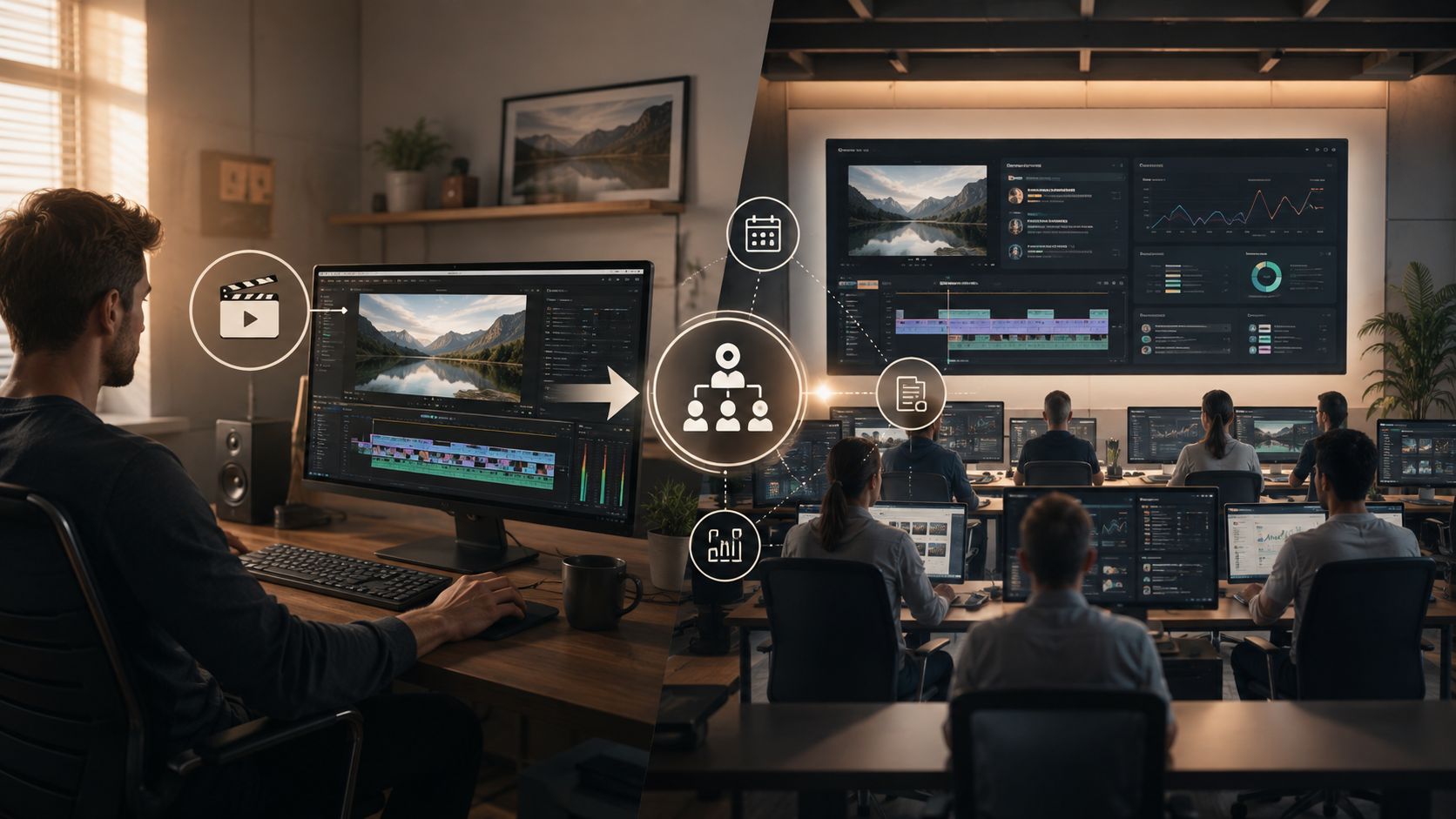
The strongest teams are no longer organizing work around a single finished asset. They are building onboarding, lifecycle, or internal communications systems that can generate many versions from one approved structure. One team still treats a customer welcome video as a one-off project, with separate edits for email, social, and product. Another starts with the data, maps the segments, and lets the workflow produce the variants each audience needs.
Personalized video can justify that shift when the workflow is designed for it. Vidico reports 16x higher click-to-open rates and 4.5x higher unique click-through rates for personalized video versus generic content. The lesson is narrower than the headline suggests. Teams should personalize the messages that benefit from context, not every asset.
The same logic shows up in other production teams. A real estate group might use one template for new listings, another for price changes, and another for open-house follow-up. For a concrete process reference, see how Pinnacle Property Media produces listings, which shows how production can be organized as a repeatable workflow rather than an isolated edit. A travel brand can route destination updates through the same structure while changing the fields by market or audience. A school district can do the same for onboarding, parent updates, and staff training.
For teams starting from scratch, Wideo’s library of video ideas can help identify which message families are worth systematizing first. This represents the fundamental shift. The producer stops managing a single cut and starts managing a content supply chain.
How a Systems-Based Workflow Actually Runs
The workflow is straightforward once the team stops treating every asset as a one-off. A CRM, HRIS, product event stream, or customer database feeds a template. A trigger, such as a signup, renewal, onboarding milestone, or internal training event, generates the right variant. Distribution then sends the piece to email, a portal, a learning platform, or a social channel based on the use case.
That same logic is what makes platforms like Wideo relevant for teams that need hundreds of data-driven variants without manual editing. The point is not the logo on the tool, it’s the pattern, data source, template, trigger, distribution. Once that chain exists, production stops depending on a person rebuilding the same asset over and over.
In enterprise settings, this is especially useful for customer updates, internal announcements, and onboarding flows. The human job shifts to template governance, approval logic, and exception handling. The machine handles repetition, the team handles judgment.
What Does Not Change and What You Should Ask Yourself
Fewer people doing manual timeline editing is a real career shift, and pretending otherwise would be hype. Some roles will narrow, some will disappear, and some people will need to move up into systems thinking faster than they expected. The disruption is real, especially for teams that built their identity around custom one-off production.
What does not change is the need for judgment. Someone still has to decide which message belongs to which audience, how far brand voice can stretch, and when machine-generated output is not good enough. That is true in ecommerce, finance, education, HR, and customer success. The future of video production belongs to teams that can protect that judgment while removing everything that doesn’t need a human touch.
The teams that win will not be the ones that make more videos. They’ll be the ones that design systems that make the right videos, at the right time, for the right audience. Which part of your own video workflow is still manual out of habit rather than necessity?
Wideo helps teams move from one-off production to repeatable, data-driven workflows with templates and automation built for business use cases. If your team is still rebuilding the same onboarding, training, or customer-update assets by hand, explore Wideo and map your current process to a system that can produce more without losing control.