

Picture this: an AI that doesn’t just wait for your next command. Instead, it independently plans, decides, and acts to build out entire video campaigns on its own. That’s the massive leap we’re seeing with agentic AI, the next evolution of video automation that finally lets content scale without constant manual intervention.
How Agentic AI Is Redefining Video Creation
For years, content teams have chased the dream of truly scalable video. Early automation tools connected data to templates, but they were rigid. They operated on a simple script: “if this happens, then create this video.” It was a step forward, but lacked the intelligence to adapt, personalize deeply, or manage a project from start to finish.
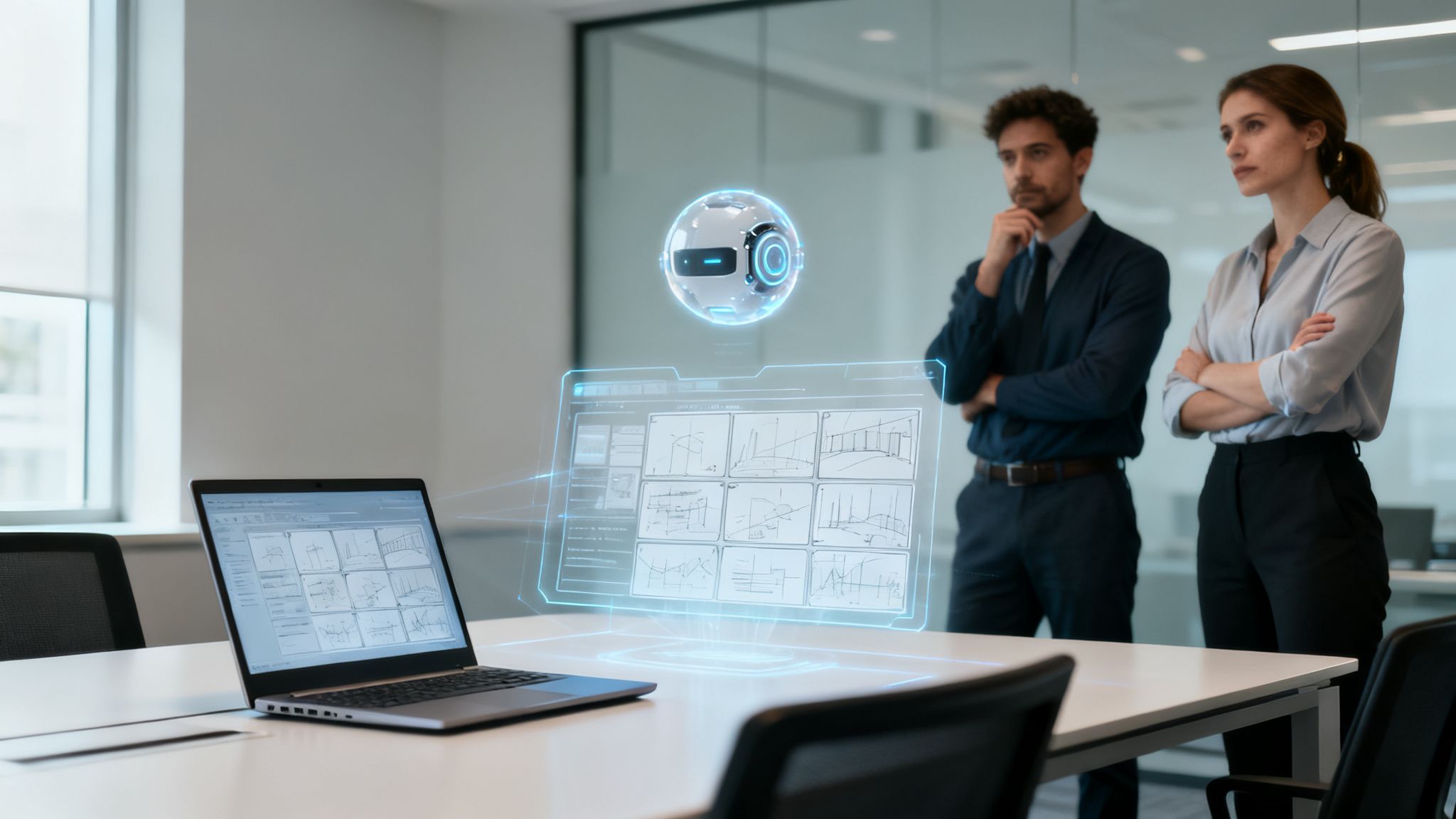
Agentic AI completely changes the game. It’s no longer a passive tool waiting for instructions; it’s an active participant in the creative process. Think of it as an autonomous digital team member. You don’t just tell it what to do—you give it a goal, and it figures out how to achieve it.
From Simple Instructions to Autonomous Actions
So, what does this actually look like for making videos? It’s the difference between a tool that slaps a customer’s name onto a pre-made template and an AI system that builds a completely unique video from the ground up for every single customer.
A true agentic AI system can:
- Trigger a new video project when a specific event happens, like a customer hitting a key milestone in your app.
- Generate a custom script by pulling and analyzing relevant data from your CRM or product database.
- Personalize the visuals, captions, and even the voiceover to perfectly match the viewer’s profile and preferences.
- Distribute the finished video across different channels, automatically picking the best format for each one.
This isn’t just about making things faster. It’s about building intelligent, always-on video engines that work for you 24/7. These systems are designed to operate on their own, freeing up your team to focus on bigger-picture strategy and creative direction.
If you want to get a better handle on the basics, it’s worth exploring guides on how to create videos with AI from scratch. Understanding those fundamentals helps you appreciate how agentic systems can coordinate all those moving parts on a massive scale.
Traditional Automation vs Agentic AI in Video Workflows
To really grasp the shift, it helps to see a side-by-side comparison. Traditional automation follows a pre-set path, while agentic AI charts its own course to reach a destination.
| Capability | Traditional Video Automation | Agentic AI Video Systems |
|---|---|---|
| Core Function | Executes predefined, linear tasks (e.g., insert name into template). | Sets a goal and autonomously determines the steps to achieve it. |
| Flexibility | Rigid. Follows a fixed “if-then” logic. | Adaptive. Can change its plan based on new data or feedback. |
| Decision-Making | None. It only follows programmed rules. | Makes independent decisions to solve problems and optimize outcomes. |
| Scope of Work | Handles isolated, repetitive tasks. | Manages entire, complex workflows from ideation to distribution. |
| Example | “Create a video for every new customer using Template A.” | “Create personalized onboarding video campaigns for new enterprise clients, optimizing for engagement.” |
The bottom line is that while traditional automation is a helpful assistant for repetitive tasks, agentic AI is more like a project manager—one that can think, plan, and execute with a level of independence we haven’t seen before.
Understanding Agentic AI Video Workflows
So, how does an agentic AI system actually create a video without a human directing every move? The best way to think about it is like an automated, hyper-efficient digital production team.
Your typical video project has a project manager, a scriptwriter, a designer, and someone to handle distribution. An agentic video workflow merges these roles into a single, autonomous system that plans, decides, and acts to achieve a goal.
This isn’t just a one-click process. It’s a smart sequence of steps. Let’s break down how these autonomous video pipelines work.

The Planner Agent
Every project starts with a goal. The Planner is the strategist. You give it a high-level objective, like, “Create a personalized welcome video for every new trial user to increase activation.”
Instead of waiting for a detailed brief, the Planner immediately breaks that goal down into smaller, concrete tasks. It figures out it needs to:
- Connect to the CRM to identify new trial sign-ups.
- Pull the user’s name, company, and industry.
- Outline a script structure focused on relevant features.
- Locate necessary brand assets like logos and color palettes.
The Planner essentially draws up the blueprint for the entire video creation process, ensuring all pieces are accounted for before a single frame gets rendered.
The Decision-Maker Agent
With a plan in hand, the Decision-Maker agent steps in. Think of this as the creative director, making specific choices based on the plan and available data. It’s all about selecting the right assets for the job.
For instance, if the new user is in the finance industry, the Decision-Maker might choose a specific video template, grab relevant B-roll footage, and select a professional voiceover style that fits the audience. This ensures the final product isn’t generic, but contextually spot-on. If you want to see how some of these creative steps work individually, you can check out our guide on how to make videos using AI.
The Executor Agent
Finally, you have the Executor agent. This is the hands-on producer that brings the vision to life. It takes the blueprint from the Planner and the creative direction from the Decision-Maker and assembles the final video.
This agent handles all the technical grunt work: rendering scenes, generating the voiceover, adding captions, and applying the branding perfectly. Once the video is complete, it carries out the final step—delivering it to the right person, whether that’s via email, a social media DM, or an in-app notification.
This entire workflow—from planning to delivery—runs on its own, triggered by a single event. That’s the real power of agentic AI: turning a complex, multi-step creative process into an always-on, scalable system.
Why Agentic AI Is a Big Leap for Scalable Video
While the idea of an autonomous system might sound futuristic, its impact on your video strategy is very real. For marketing and content teams, agentic AI isn’t just another tool—it’s the engine that finally achieves goals previously out of reach due to manual work.
This shift boils down to four key advantages: incredible speed, true scalability, perfect consistency, and deep, one-to-one personalization. Together, they turn video from a slow, project-by-project chore into an always-on asset that works for you around the clock.
Speed at an Unimaginable Scale
The most immediate benefit is pure velocity. A human team could spend days scripting, designing, and producing one high-quality video. An autonomous agentic system can generate hundreds or even thousands of unique, data-driven videos in that same timeframe.
This isn’t about cutting creative corners. It’s about automating repetitive, mechanical tasks. Once you define a workflow, the AI agent can execute it instantly based on a trigger. Imagine sending a personalized follow-up video just seconds after a lead downloads a whitepaper—that’s the kind of timely, high-impact content it makes possible.
True Scalability Without Piling on More Work
This is where agentic AI truly changes the game. Traditional video production always hits a ceiling. You can only hire so many people or cram so many hours into a day. An agentic workflow, on the other hand, can serve one customer or one million with the same efficiency.
Imagine a single autonomous system handling a global product launch, generating localized video ads for dozens of regions simultaneously. Or picture it creating unique summary videos for every attendee of your last webinar. Your video strategy can finally grow with your business without your costs or workload growing alongside it.
Rock-Solid Brand Consistency
Keeping your brand consistent across a huge volume of content is a massive headache. Human error, different interpretations of brand guidelines, and tight deadlines often lead to visuals or messaging that are slightly off.
Agentic AI makes this problem disappear. By working from a central playbook of approved assets, templates, and brand rules, an autonomous agent ensures every single video it creates is perfectly on-brand—right down to the exact hex code of your logo and the approved tone of voice in the script.
Deep, One-to-One Personalization
Finally, and perhaps most powerfully, agentic systems unlock a level of personalization we’ve never seen before. These agents can connect to different data sources—your CRM, product catalog, or analytics platform—and weave unique data points into each video.
This enables powerful, hyper-relevant experiences:
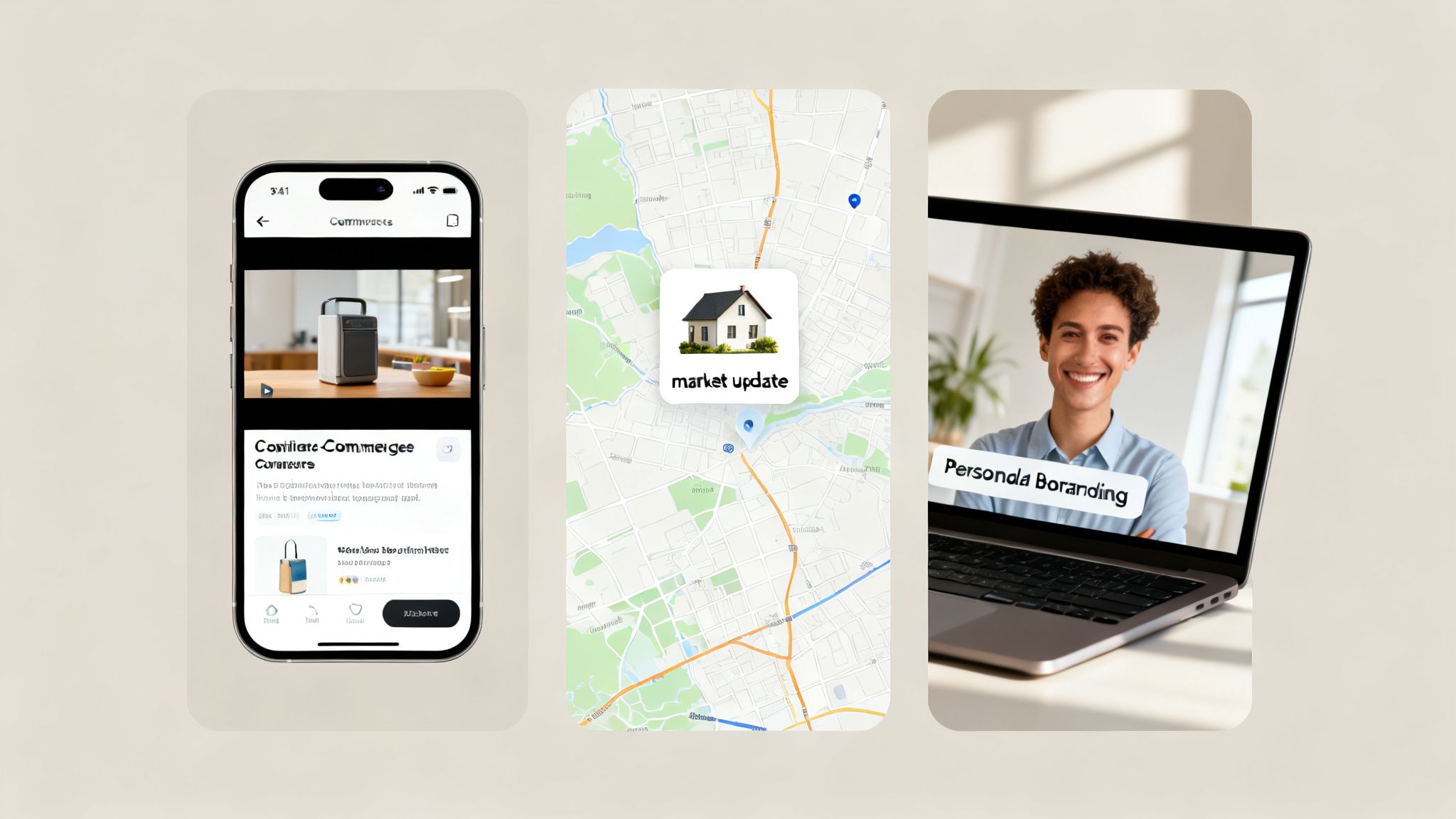
- An e-commerce agent creating a video that features the specific product a customer was just viewing.
- A SaaS agent generating a weekly report video showing a user their personal usage stats.
- A real estate agent producing hyperlocal market updates that include current listings for a specific zip code.
This kind of customization builds a powerful one-to-one connection, making every viewer feel like you’re speaking directly to them. It’s this blend of speed, scale, consistency, and deep personalization that makes agentic AI a capability you can’t afford to ignore in any modern video strategy.
Real-World Scenarios of Autonomous Video in Action
Let’s move beyond theory and see how this actually works. The magic of agentic AI is watching it solve tangible business problems without a human needing to micromanage every step. These aren’t future ideas; they’re workflows you can build today.
Here are three scenarios where autonomous agents become non-stop video creation engines, turning raw data and real-time events into personalized, engaging content.
E-commerce Abandoned Cart Recovery
Every online store owner knows the pain of an abandoned cart. Trying to create personalized follow-ups for every single one is impossible by hand. A smart retailer deploys an agentic video workflow to solve this.
- The Trigger: A customer adds items to their cart but leaves the site before checking out.
- The Agent’s Actions: The AI agent is alerted. It instantly connects to the product database, grabbing images, names, and prices of the exact items left behind. The agent then selects a suitable video template, writes a script highlighting those products, and renders a unique video reminding the shopper what they’re missing.
- The Outcome: Minutes later, the customer receives an email with a video made just for them. This hyper-personalized approach grabs attention and drives a much higher recovery rate than a generic “You left something behind!” email ever could.
Hyperlocal Real Estate Market Updates
Imagine a real estate agency serving clients across a dozen neighborhoods. Creating weekly video updates for each one would be a nightmare for a production team.
- The Trigger: A recurring schedule—every Monday morning at 9 AM.
- The Agent’s Actions: The agent taps into a live real estate data API for each neighborhood. It automatically pulls the latest numbers: new listings, average sale prices, and days on market. This fresh data is fed into a branded video template, generating a separate, data-rich market update video for every area. It then posts each video to the correct regional social media page.
- The Outcome: The firm instantly positions itself as the local expert in every market it covers, consistently providing valuable content that builds trust and brings in leads—all without weekly production effort.
Automated Employee Onboarding
A company is growing fast, and the HR team is buried. They need to give every new hire a great first impression but lack the bandwidth for personalized welcomes.
- The Trigger: A new employee’s profile is created in the company’s HR system.
- The Agent’s Actions: The agentic AI gets the notification and springs into action. It pulls the new hire’s name, department, and manager from the HR database. From there, it generates a personalized welcome video that includes a message from the CEO, an intro to their new team, and key info for their first week.
- The Outcome: The new hire gets a warm, custom welcome video on day one, making them feel seen and ready to go. This automated workflow guarantees a consistent, top-notch onboarding experience, no matter how swamped HR gets.
As agentic AI reshapes how video is created, being able to verify that content is authentic becomes more important than ever. This is driving a new need for the critical tools for forensic video analysis.
These examples aren’t hypotheticals; they show how autonomous video workflows are already making a real difference. If you’re wondering where to begin, check out our guide on using an AI video generator to take your first steps.
The Building Blocks of an Autonomous Video Pipeline
An always-on, autonomous video system might sound complex, but it boils down to a coordinated team of specialized AI agents. Instead of one giant AI trying to do everything, an effective pipeline gives specific jobs to different agents—much like a human production crew.
This multi-agent approach is what makes an agentic AI video workflow so powerful. You can build a seamless, end-to-end process where each step is handled by an expert, guaranteeing quality and speed from start to finish.

How Specialized AI Agents Coordinate Tasks
Let’s pull back the curtain on how this digital assembly line works. Say you want to create a personalized thank-you video for every customer who makes a purchase. Your autonomous pipeline would look something like this:
- The Monitoring Agent: This agent is your lookout. Its only job is to watch a data source, like your Shopify or Salesforce API. The moment a new purchase is detected, it kicks off the entire workflow.
- The Scripting Agent: Once triggered, the monitor passes customer and product details to a scripting agent. This agent, a natural wordsmith, uses its language model to write a compelling, personalized script.
- The Visuals Agent: The script is then handed off to the visuals agent. It scans your brand’s asset library and approved stock footage to find the perfect scenes, product shots, and graphics to match the script.
- The Production Agent: This agent is the director, taking all the pieces—script, visuals, and brand guidelines—and putting them together. It generates a voiceover, adds captions, and renders the final video.
- The Distribution Agent: Finally, the finished video is passed to the distribution agent, which sends it to the customer through the designated channel, like email.
This coordinated effort happens in minutes, creating a highly relevant video without a single person lifting a finger. This shift is massive. By 2028, a whopping 33% of enterprise software applications will have built-in agentic capabilities, a huge jump from under 1% in 2024. This change allows businesses to automate complex workflows, cutting costs by 25% and speeding up execution by 40% using multi-agent systems. You can dig deeper into these AI agent statistics and trends.
An autonomous video pipeline isn’t about a single “do-it-all” AI. It’s about orchestrating a team of specialized agents, each mastering one part of the video creation process to deliver a perfect result, every time.
The Central Hub for Your Agentic Workflow
Of course, this whole process needs a central hub to orchestrate these moving parts. You need a system that can manage triggers, pass data between agents, and provide the core video rendering engine.
This is exactly where solutions for autonomous video workflows come in. For example, Wideo’s Video Automation platform provides the foundation for building these intelligent systems without needing a team of developers. It acts as the command center, letting you define the rules and connect the data while the underlying agentic system handles the complex coordination behind the scenes. It’s what turns your strategic goals into an always-on video reality.
How to Prepare Your Team for the Agentic AI Revolution
Bringing agentic AI into your video workflow is more than a tech upgrade—it’s a new way of thinking about strategy. Preparing your team for this shift starts with spotting the right opportunities and building a culture that embraces experimentation.
Start small. Look for repetitive, data-heavy video tasks that consume your team’s time. These are the perfect test cases for your first agentic workflow. This could be anything from automatically generating weekly social media clips based on performance data to creating personalized follow-up videos for event attendees.
Fostering a Collaborative Mindset
The goal isn’t to replace your team, but to give them a powerful collaborator. Think of agentic AI as the ultimate assistant, built to handle high-volume, repetitive work. This frees up your people to focus on what they do best: high-level strategy, creative storytelling, and dreaming up the next big campaign idea.
Getting this right comes down to a few key things:
- Clean Data: An autonomous agent is only as smart as the information it can access. Ensure your CRM, product catalogs, and other data sources are clean, organized, and ready to go.
- Clear Objectives: Define what success looks like for each automated workflow. Is the goal to boost lead conversion, improve customer onboarding, or simply increase content velocity?
- A Culture of Experimentation: Encourage your team to try things, see what works, and iterate. Your first automated workflow won’t be perfect, but the lessons you learn will be invaluable.
Things are moving fast. Projections show that 2026 is poised to be the breakout year for agentic AI, as big tech players push these autonomous systems into the enterprise. You can explore the full industry predictions for agentic AI to get a sense of how quickly this is happening.
By focusing on collaboration and starting with clear, achievable goals, you can set your team up to not just survive this shift, but to lead it. These intelligent agents are unlocking the next frontier of scalable, always-on video strategies. For teams looking to get started, platforms offering no-code video automation provide a great, accessible entry point for building these powerful systems.
Your Questions About Agentic AI, Answered
Jumping into the world of autonomous systems can feel like learning a new language. Let’s break down some of the most common questions marketing and content teams have about putting agentic AI to work for video.
What’s the Real Difference Between Agentic AI and Regular AI Video Tools?
In one word: autonomy.
Most AI video tools today are reactive. You give them a direct command, like “turn this blog post into a video,” and they execute a single task. A human still needs to initiate every action.
Agentic AI, on the other hand, is proactive. It operates independently based on goals you define. It could monitor your e-commerce platform for a spike in sales on a specific product, decide a promotional video is needed, plan the content, generate it, and push it live to your social channels—all without you lifting a finger.
Do I Need to Be a Developer to Use This for Video?
Not anymore. While the underlying technology is complex, a new wave of platforms is making agentic capabilities accessible to non-technical teams. They offer a user-friendly framework where you can build your own autonomous video workflows.
Think of it like setting up rules in your email client. You define the triggers (e.g., a new 5-star review comes in), provide the creative assets (video templates, logos), and the agentic system takes it from there. The goal is to let marketing and content experts build these engines without ever touching a line of code.
What Kind of Data Do I Need to Create Personalized Videos with Agentic AI?
Good, clean, structured data is the fuel for effective personalization. For an agentic system to work its magic, it needs a way to access that data, usually through APIs or direct integrations.
Here’s the kind of data we’re talking about:
- Customer data from your CRM, like names, purchase history, or loyalty status.
- Product information from your Shopify or e-commerce platform, such as product names, images, and prices.
- Live market data pulled from a public API—think stock prices, local weather reports, or real estate listings.
The better organized and more accessible your data is, the more creative and personalized your AI agents can be with the videos they produce.
Ready to build your own always-on video engine? Explore how Wideo’s platform can help you create autonomous video workflows that scale your content strategy.
Related posts:
 AI Integration A Practical Guide for Business Growth
 Ai data processing: Practical strategies for pipelines, tools, and compliance
 Unlocking AI Performance in Modern Video Creation
 From Manual Handoffs to Automated Video: A Practical Guide to AI Workflows
 Beyond Dashboards: A New Way to Compare AI Platforms for Scalable Communication
 AI in Video: The Ultimate Marketer’s Playbook for the 2026 AI Landscape


