Your team doesn’t need another “video strategy.” It needs a benefits of white label video platform decision that changes who owns the customer, who sets the price, and who keeps the margin. If you’re still paying engineers to patch together a branded player while clients ask for faster launches, you’re funding someone else’s roadmap. A white-label stack is not a cosmetic layer, it’s a business model choice.
The Decision Behind Every White Label Video Play
A 12-person agency owner looking at a six-figure build quote isn’t really comparing software. She’s deciding whether to spend the next year building infrastructure or to put her name on a system that already works. That choice forces five questions, and each one maps directly to the benefits of white label video platform buyers care about: who owns the brand, who sets the price, who holds the relationship, who absorbs the next spike, and who pays when the dev team slips again.
The strongest argument for white labeling is speed and economics. One industry source says these platforms can cut launch time from years to weeks and reduce development costs by more than 90% versus building in-house, while custom teams can exceed $5 million in budget Wideo’s white-label platform overview. That matters because the online video platforms market is projected to grow from USD 14.90 billion in 2026 to USD 57.79 billion by 2033 at a 21.4% CAGR Wideo’s white-label platform overview. If you’re an agency, SaaS firm, or media operator, the question isn’t whether demand exists. It’s whether you’re entering that demand with ownership or dependency.
Practical rule: if the platform doesn’t let you control the billing surface, you don’t really own the product.
Who owns the customer is the real question
A lot of teams call this “white label” and stop there. That’s too shallow. In practice, the white-label move decides whether the customer sees a vendor or sees you. It changes whether renewal conversations happen around your service package or around someone else’s tool.
For agencies, that’s the difference between being a reseller and being the relationship owner. For SaaS, it’s the difference between an add-on and a product line. For media and EdTech, it’s the difference between controlling distribution and renting attention.
The benefits of white label video platform only become obvious when you compare them to the alternative. Build in-house, and you inherit roadmap risk. Don’t offer the service at all, and a competitor sells it first. White labeling sits in the middle with a sharper outcome, you move fast without surrendering the customer.
Internal teams often miss that the first decision isn’t technical. It’s commercial. The rest follows from there.
Wideo’s video automation page is a useful reference point if you want to see how a branded workflow can sit on top of repeatable production without turning your team into a video engineering shop.
How a White Label Video Platform Actually Works
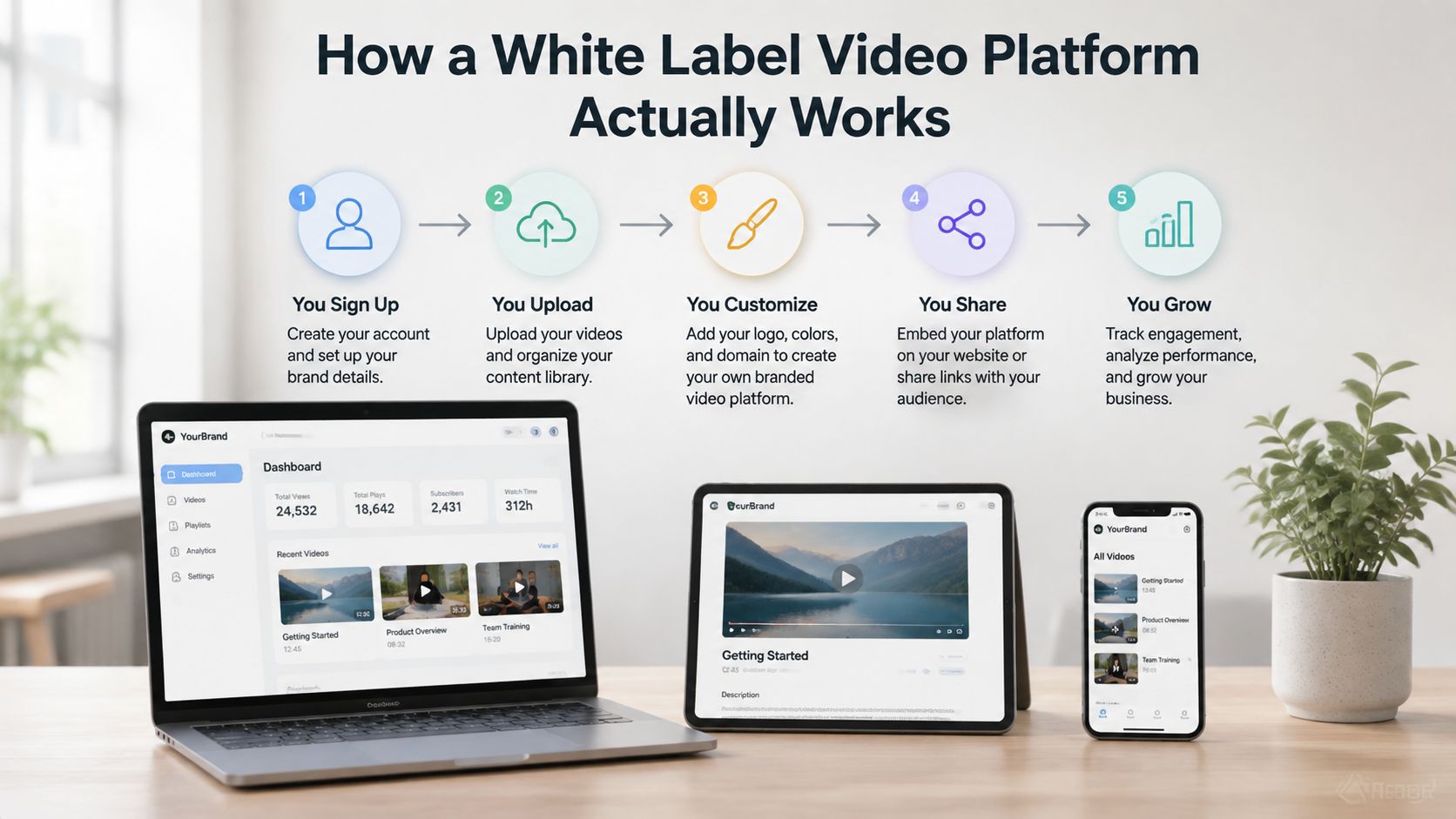
A white-label stack is simple once you stop thinking like a developer. The vendor runs the heavy machinery, transcoding, CDN delivery, storage, player logic, and API plumbing. You present the experience through your domain, your login, your colors, and your invoices. That separation is the whole point.
The operational value is easy to picture in a regional auto group. An agency logs into its branded portal, loads dealer data, and publishes user-specific recorded messages for each location. The client sees the agency’s environment, not the underlying vendor. Meanwhile, player updates, bandwidth handling, and rendering happen behind the curtain.
What you keep and what you give up
You keep the customer relationship, the brand surface, the analytics story, and the billing layer. You do not keep the source code, and you don’t get to rewrite the roadmap on your own schedule. That trade-off is real, and it’s why the smartest buyers treat vendor selection like a long-term operating decision, not a feature checklist.
The upside is clean. The vendor’s infrastructure disappears into your service. That’s why branded delivery matters in finance, insurance, real estate, education, and enterprise operations, where professionalism and control matter more than a public-platform presence.
The best white-label setups make the hard parts invisible. If your team is still explaining hosting, player settings, and maintenance to clients, the stack isn’t doing enough for you.
Wideo’s no-code video automation page fits this model for teams that need repeatable production without asking engineers to babysit every asset.
Revenue Control and the Pricing You Set
The primary benefits of white label video platform show up in pricing power. If you resell a standard SaaS tool, the vendor often controls billing, discounting, and the wholesale relationship. You may keep a slice of margin, but you’re still working inside someone else’s commercial rules. White label flips that. You set the retail price, invoice the client, and decide how the service is packaged.
That matters because pricing isn’t cosmetic, it determines whether this is a side service or a product line. A white-label model lets agencies and platforms keep what they charge, while multi-year contracts reduce churn pressure and make revenue planning more predictable. The trade-off is responsibility. You now own support, churn risk, and the consequences of weak positioning.
Reseller vs. White-Label Margin on 50 Clients
| Metric | Reseller model | White-label model |
|---|---|---|
| Pricing authority | Vendor-led | You set the price |
| Billing relationship | Vendor-owned | Client-facing under your brand |
| Margin capture | Smaller, shared | Larger, retained by you |
| Contract shape | Often month-to-month | More room for longer terms |
| Product positioning | Access to someone else’s tool | Your own service line |
A practical example makes this obvious. If 50 clients each pay $1,200 per month for managed visual content services, that is $720,000 ARR. Under the white-label framing in the brief, gross margin is roughly $500,000 versus about $200,000 as an affiliate, assuming the same client count and pricing structure. The point isn’t that every business will hit that exact result. The point is that owning pricing and billing changes what the service can become.
A reseller often sells access. A white-label operator sells outcome, packaging, and trust.
Wideo’s pricing guide is the kind of resource teams should review before they decide whether they want a tool, a margin line, or both.
Client Retention Through Branded Delivery
Retention gets easier when the client experiences your service as part of your brand, not as rented software. That’s the overlooked benefits of white label video platform angle. When a client logs into a branded player, sees your domain in the browser, and forwards your dashboard to their own stakeholders, the value attaches to you, not to an outside vendor.
That matters in agencies and SaaS companies where switching costs are mostly emotional and procedural. A client doesn’t just replace software. They re-train internal users, rewrite workflows, and explain a new platform to their team. White labeling makes that switch feel heavier.
The marketing side is not weak either. Independent research cited in the brief shows 91% of businesses used visual content as a marketing tool in 2026, 93% of marketers said it matters to strategy, and 82% reported positive ROI Komet Media video marketing ROI statistics. In the same body of research, 52% of B2B marketers identified it as the highest-ROI format, and businesses using it reported 49% faster revenue growth than those that do not Komet Media video marketing ROI statistics. If the channel already carries that much commercial weight, branded delivery makes the channel stickier.

Where branding compounds
Branding compounds in three places. First, the player UI the client embeds on their site. Second, the workspace their team uses daily. Third, the analytics dashboard they forward upstairs when they need to justify the spend. Each one makes your service feel native.
If you want a useful non-technical framing of this idea, the guide for non-technical founders is a clean reminder that client-facing software is often about perception, trust, and repeat use as much as it is about features.
Speed to Market and the Cost of Building It Yourself
A custom build looks controlled on paper, then the bill shows up in engineering time, hosting, QA, and ongoing fixes. White-label systems exist because in-house builds slow revenue teams down and keep product people stuck on maintenance instead of growth.
The cost is not just launch. It is the weeks spent hardening playback, the budget tied up in security reviews, and the churn every time a client asks for a new branded experience or reporting view. Each of those requests pulls attention away from the product you sell.
Build vs. White Label Video Platform
| Factor | Build In-House | White Label |
|---|---|---|
| Launch speed | Slow, multi-stage | Fast, ready to ship |
| Engineering burden | High and ongoing | Lower and vendor-managed |
| Maintenance | Internal responsibility | Included technical support |
| Market entry | Delayed by roadmap work | Faster commercial launch |
| Cost structure | Heavy upfront investment | Lower capital intensity |
The trade-off is simple. Building in-house gives you control, but it also puts every fix, feature request, and infrastructure issue on your team. White label keeps the customer-facing experience under your brand while letting you spend less time staffing the plumbing.
If your goal is to win clients, keep pricing power, and own the relationship without turning engineering into a bottleneck, white label is the cleaner path.
No Developer Dependency and Operational Independence
The strongest operational case for the benefits of white label video platform is that it removes developer dependency from client delivery. That matters for agencies and enterprise teams that can’t afford to wait on a sprint every time a customer wants a branded experience, a new portal, or a fresh analytics view.
A real white-label setup handles the ugly parts in the background. Dedicated infrastructure absorbs traffic spikes. Multi-tenant architecture keeps client environments separated. Global CDN delivery keeps performance stable under load. The vendor handles updates and uptime, so your team doesn’t have to become an infrastructure department.
Operational rule: if one client launch can take down the rest of your portfolio, you don’t own a platform, you own a risk.
What independence looks like in practice
For a media company, independence means a campaign can go live without asking engineering to patch the player. For an EdTech platform, it means onboarding flows and training libraries stay live while content changes. For insurance or finance, it means the team can move under compliance pressure without rebuilding the security layer from scratch.
The Dacast white-label article underscores the practical value of controlling the experience, ads, and distribution instead of depending on third-party hosting rules or competing recommendations, which matters even more as viewing fragments across web, mobile, and smart TV environments Dacast white-label streaming guide. That’s the independence story. You’re not just changing the skin. You’re insulating the business from platform volatility.
Personalization, Automation, and AI Workflows at Scale
White labeling matters most when it turns one recorded message into many context-aware variants. That’s where production stops being manual and starts becoming a system. A single template can pull in viewer name, location, account stage, or CRM data, then generate thousands of versions without a producer editing each one by hand.
That operational shift is important for sales enablement, onboarding, retention, and internal communication. A SaaS team can send a user-specific renewal message. An insurance team can route policy updates. An EdTech operator can deliver a different onboarding path for each cohort. The asset stays the same at the core, but the delivery feels personal.

The brief’s 2025 MIT draft reports that personalized visual ads increased engagement by 6 to 9 percentage points versus personalized image ads and generic visual ads, while generative AI cut traditional production costs by 90% MIT Initiative on the Digital Economy draft. Rollins scholarship research found that personalized recordings produced higher message downloads, higher rewatch likelihood, and higher click-through rates than non-personalized versions Rollins scholarship research. In onboarding, Guidde reports that video-based workflows can improve retention by 82%, raise productivity by 70%, and that video retains 95% of information after three days versus 10% for text Guidde onboarding guide Guidde onboarding guide.
Wideo’s personalized video page is relevant here because it shows how branded, data-driven delivery can sit on top of repeatable templates without turning every campaign into a manual editing job.
Implementation with a platform stack
A practical workflow looks like this. Pull data from CRM or LMS records, drop it into a branded template, trigger generation when a deal stage changes or a new hire joins, then distribute through email, portal, or internal workflow tools. That sequence turns one-off production into a repeatable operating layer.
Choosing a White Label Vendor and What to Do Next
Don’t buy on branding alone. The vendors worth serious attention should give you full white-label rights across domain, branding, and billing surfaces, plus multi-tenant architecture, API depth, webhook coverage, uptime support, and compliance posture that fits your market. If you work with regulated clients, the data and security story matters as much as the player.
Compare deployment models. A SaaS-reseller model is quicker, but you stay closer to a middleman. Self-hosted gives maximum control, but the infrastructure burden comes back to your team. Hybrid models sit between the two and can work when you need some control without taking on every operational task yourself.
The Wideo partners resources page is a useful next stop if you’re evaluating how a branded platform can be packaged for clients, resellers, or internal teams.
Use this shortlist in your demo
- Brand control: Can you remove vendor branding from domain, player, and invoices?
- Data ownership: Can you access per-client analytics without ambiguity?
- Workflow depth: Do APIs and webhooks support your real stack?
- Operational support: Who handles maintenance, uptime, and updates?
- Commercial freedom: Can you mark up the service, or are you stuck reselling it as-is?
Which benefit above changes your P&L this quarter, pricing control, client retention, or operational independence? Pick one, and your shortlist gets a lot shorter.
Book two demos, send both vendors the same five-client scenario, and compare the proposals side by side. That exercise will tell you very quickly whether you’re buying a tool, a margin line, or a real product.
Wideo gives teams a white-label video platform they can run under their own brand, with branded creation, automation, and client-facing delivery built into the workflow. If you’re deciding whether pricing control, retention, or operational independence matters most, take a look at Wideo and compare that model against building it yourself. The right white-label choice changes who owns the customer, and that changes the business.