
Launch Your Own Branded Video Plataform: Agency Growth 2026
Your agency sells marketing services. But every time a client needs a video, you face the same problem: you either outsource it (losing margins and control), or you use a tool that puts someone else’s logo on the final product. Neither option builds your brand.
That is the branding dilemma. You stay a coordinator instead of becoming the company that owns the client experience.
A lot of agencies live in this trap longer than they should.
The branding dilemma every agency faces
An ecommerce client wants product explainers for a seasonal launch. A SaaS company wants onboarding walkthroughs. An insurance broker needs renewal reminders. HR wants internal training. Sales wants follow-up recorded messages after demos. The requests keep coming, but the delivery model stays fragile.
When you outsource, the margin shrinks fast. You wait on another team’s calendar, another team’s revisions, another team’s production pace. Your client still holds you responsible when deadlines slip. Brand trust lands on your desk, but production control sits somewhere else.
When you use a standard third-party tool, the problem shifts. The audiovisual piece gets delivered, but the platform’s identity is visible in the player, the editor, or the portal. Your client sees the supplier. That weakens your position as the strategic owner of the service, especially when you’re trying to expand into onboarding, internal communication, or training systems.
A client should remember your agency’s system, not the vendor sitting behind it.
This isn’t a design issue. It’s a business model issue. If you want to scale under your own name, your visual content operation can’t depend on rented branding. That’s why identity design in recorded media matters more than is widely acknowledged, and why agencies should think harder about how video identity shapes client perception.
The invisible solution a white label video platform
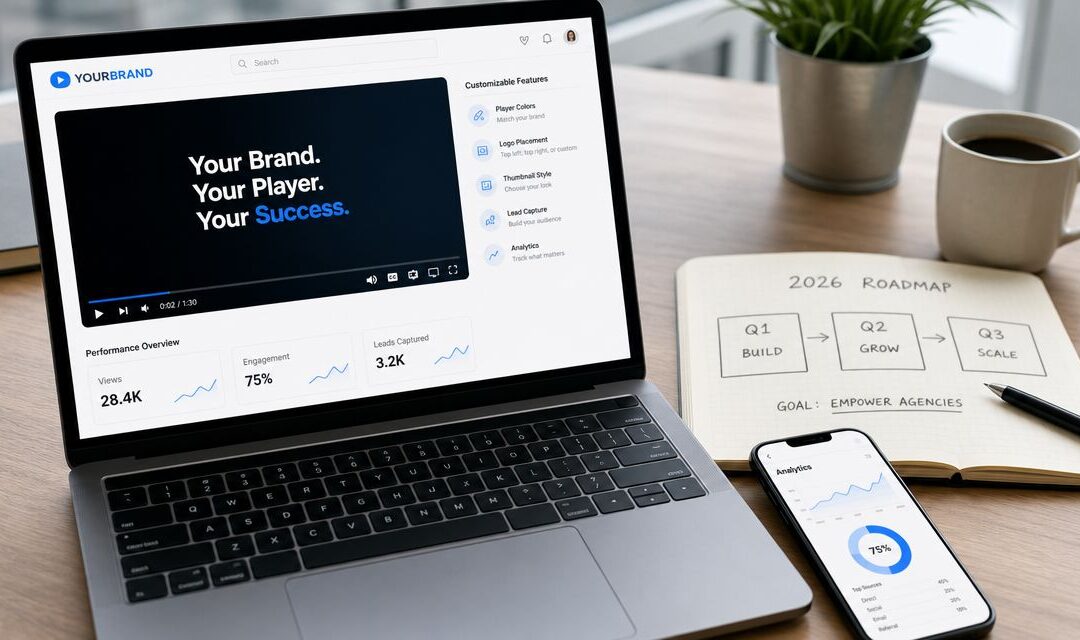
A white label video platform allows agencies and companies to remove all supplier branding and replace it with their own, logo, colors, custom domain, user interface, and the entire client experience.

A regular tool displays the provider’s brand. A white label platform is invisible to the end client. The client believes the agency built the tool. The agency keeps full control of the commercial relationship.
What clients actually experience
That difference changes how a finance firm rolls out investor updates, how a real estate group distributes listing explainers, and how a travel company sends post-booking visual content. Instead of receiving a link from a recognizable third-party app, they log into your portal, on your domain, with your interface. The dynamic asset feels like part of your service stack, not a borrowed add-on.
The technical side matters too. Enterprise-grade branded platforms are defined by delivery infrastructure such as encoding, storage, adaptive bitrate streaming, custom domains, branded players, access control, and viewer-level analytics, which is what makes private branded hosting operationally different from public social publishing, as described in this breakdown of business video hosting architecture.
Why this matters beyond marketing
This isn’t just for campaigns. Customer success teams can publish one-to-one renewal explainers. Operations can standardize branch updates. Education teams can deliver repeatable lesson libraries. Internal communications can send recorded messages from leadership without routing every request through editors.
If you’re building partner services or product extensions, partner resource models for branded media services are often a better fit than another standalone editing subscription.
Building a new revenue stream with your brand
Agencies keep treating visual content like labor. Smart agencies package it like software.

The market context matters. The global online video platform market was estimated at USD 6.13 billion in 2020 and is projected to reach USD 18.71 billion by 2027, implying a 17.3% CAGR from 2021 to 2027, according to Grand View Research’s online video platform market analysis. That tells you this isn’t a side service. It places an agency in a growing software category.
How agencies charge for it
You can package a white label platform several ways, depending on your client base and sales motion.
- Monthly access model for SaaS, HR, training, or franchise clients that need ongoing visual content production under your brand.
- Per-project pricing for real estate launches, travel campaigns, investor updates, or seasonal ecommerce promotions.
- Per-asset pricing when clients want a fixed output such as onboarding sequences, policy explainers, or customer lifecycle messages.
- Managed service retainers where your agency owns templates, workflows, reporting, and distribution.
- Hybrid plans that include platform access plus a set number of machine-driven content runs each month.
If an agency charges $100 per video and produces 50 videos a month, that’s $5,000 in monthly revenue. With a white label platform, the cost per video could be $2–$5. The margin is real.
Where the margin really comes from
The obvious gain is lower delivery cost. The bigger gain is recurring revenue. A manual studio gets paid when it produces. A branded platform gets paid when clients stay, generate more dynamic assets, invite more users, and make the system part of daily work.
Practical rule: sell the system, not only the output.
For a marketing agency, this means turning campaign requests into subscriptions. For a SaaS product team, it means adding visual content as a branded capability instead of passing customers to another vendor. For a media business, it means building a private distribution environment under its own name. If you want examples tied to agency packaging, this marketing agency use case page is the kind of model worth studying.
From middleman to tech provider your new workflow
The biggest shift isn’t creative. It’s operational.

You brand the portal once. You create templates once. Then your team, your clients, or both generate repeatable visual content without rebuilding every project from zero. That changes onboarding, retention messaging, employee training, and stakeholder reporting because production stops being a bottleneck.
What this looks like in real companies
An ecommerce brand can generate product launch explainers from a product feed. A bank can send user-specific updates tied to account events. A SaaS company can trigger onboarding walkthroughs after signup. A university can publish course notices and internal faculty updates from the same branded environment. An airline or travel company can send trip prep recorded messages based on itinerary data.
Modern platforms make this possible through dynamic layer assembly, where text, images, audio, and scene elements are combined in a programmed render pipeline, enabling brand-consistent, user-specific output at scale, as described by Pirsonal’s explanation of dynamic video layers.
A simple implementation path
A company can pull data from a CRM, spreadsheet, or product catalog, map those fields into a branded template, trigger generation when a status changes, and distribute the finished dynamic asset through email, a portal, or internal channels. The workflow is straightforward: data source to template, trigger to render, render to delivery. That’s how manual production turns into a systematic content operation.
For teams that need to generate hundreds of onboarding videos using CSV files, templates, or API-based triggers under their own branding, Wideo’s white label video platform is one option built for that model. If your product team wants direct system-level control, video automation through an API is the operational layer to evaluate.
Are you still selling hours when you could be selling access?
Your first steps to launching a branded video service
Don’t start with a giant rollout. Start with a usable service.
Build the portal around one clear offer. Pick one audience segment, such as ecommerce onboarding, SaaS customer education, insurance renewals, or internal HR training. Then create a small template library and one reliable delivery workflow your team can repeat.
Start narrow. A platform becomes valuable when clients can use it immediately.
The first setup usually comes down to a few moves:
- Brand the portal: apply your logo, colors, custom domain, and branded player so clients only see your identity.
- Create a starter library: load a handful of reusable templates for onboarding, sales follow-up, internal updates, and reporting.
- Define permissions: decide who can create, review, publish, and manage templates across client accounts.
- Set pricing early: choose whether you’ll charge monthly, per project, or per audiovisual piece before inviting clients in.
- Test one trigger: run a CSV, CRM event, or form submission through the system so delivery is proven before launch.
If you need to compare packaging before rollout, video automation pricing structures help frame the economics.
The agencies that win this category won’t be the ones making the prettiest one-off videos. They’ll be the ones that own the platform, the workflow, and the client relationship. What does your current business model leave you owning?
Book a demo to see how Wideo‘s white label platform helps you sell videos under your own brand without building a tool from scratch.


