
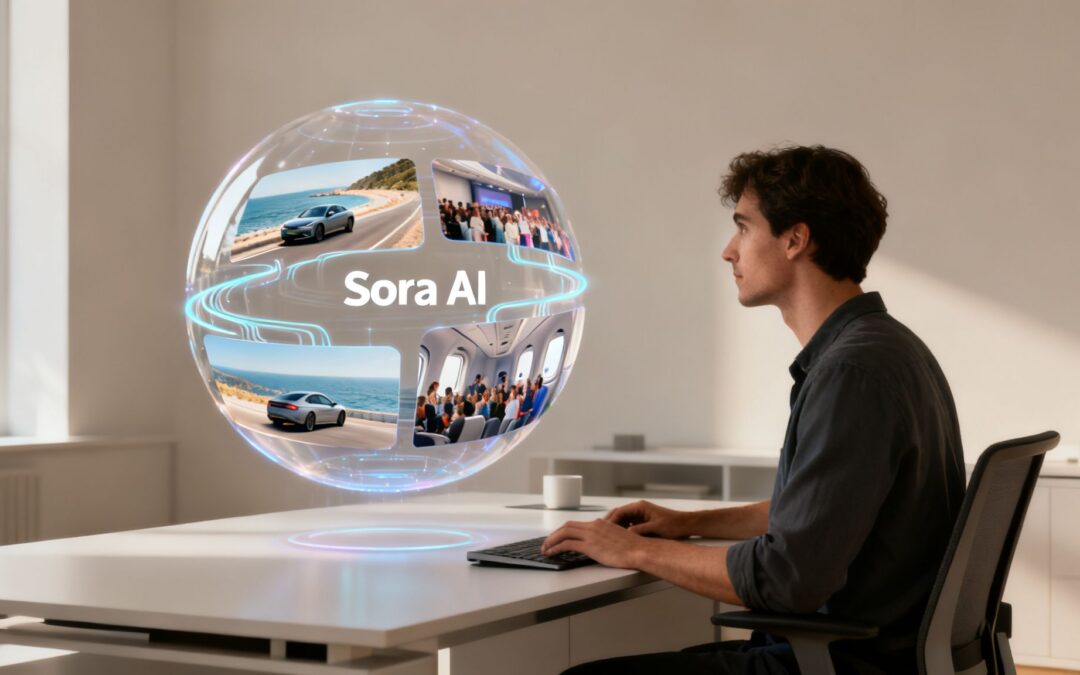
OpenAI’s new text-to-video model, Sora AI, is generating breathtaking videos from simple text prompts. While the cinematic quality is impressive, the real story for marketing, growth, and content teams isn’t about creating one-off art pieces. It’s about what Sora signals for the future of video creation: a shift toward scalable, automated, and personalized content that’s as easy to produce as writing an email.
This technology is a glimpse into a future where your scripts, data, and ideas become high-quality video instantly, reshaping workflows and unlocking unprecedented scale.
What Sora AI Means for Practical Video Workflows

It’s tempting to view Sora AI’s demos as just a cool creative tool. But for businesses, its true significance lies in how it will fundamentally change video production. Sora AI is a catalyst, showing us a clear path away from manual, resource-intensive projects and toward automated, repeatable video pipelines driven by prompts and data.
The conversation is shifting from “How do we film this?” to “How do we describe this?” This change transforms video from a creative bottleneck into a strategic advantage.
From Manual Production to Instant Generation
Traditional video production is slow, expensive, and requires specialized skills. It’s a logistical challenge that limits how much content teams can create. Generative video flips that model entirely, removing the friction between an idea and a finished asset.
This forces a critical question for every business: How do we evolve our video strategy from a series of one-off projects into a scalable content engine? The answer lies in embracing a new workflow where ideas become visuals almost instantly.
The New Video Production Lifecycle
| Stage | Traditional Workflow | Generative Workflow |
|---|---|---|
| Concept | Manual scriptwriting, storyboarding, multiple revisions. | A simple text prompt describes the scene, action, and style. |
| Production | Location scouting, casting, filming with crew and equipment. | AI generates the video footage directly from the prompt. |
| Post-Production | Manual editing, color grading, sound mixing, adding effects. | Minor edits or prompt refinements to tweak the AI output. |
| Iteration | Time-consuming re-shoots or extensive re-editing. | Quickly generate new variations by modifying the text prompt. |
As the table shows, a generative model doesn’t just accelerate production—it completely redefines the resources and skills required to create compelling video content.
The Power of Text-to-Video Workflows
Sora AI can generate up to a full minute of HD video from a text description. The initial demos showcased everything from a “short fluffy monster” to cinematic scenes of the California Gold Rush.
For businesses, this points to a future of incredible efficiency and scale. This technology offers several key advantages for any video strategy:
- Reduced Production Friction: The need for camera crews, physical locations, and long editing sessions is virtually eliminated, dramatically lowering the barrier to creating high-quality video.
- Massive Scalability: Your team can create dozens of video variations for A/B testing or personalizing campaigns in the time it once took to produce a single version.
- Unprecedented Creative Agility: Marketers can react to market trends or campaign data in near real-time, generating relevant video content on the fly instead of weeks or months later.
To understand the foundational concepts, you can learn more about these initial AI video generation capabilities and their implications.
The Shift from Manual Editing to Generative Systems
Imagine creating a professional video without ever touching a complex timeline, trimming a clip, or mastering sophisticated software. This is the new reality that Sora AI points toward, signaling a massive shift away from the painstaking process of traditional post-production.
For decades, video editing has been a specialized skill. Generative video redefines this role. Instead of spending hours on keyframes or searching for B-roll, creative teams will focus on a new core skill: writing descriptive, powerful prompts.
From Timelines to Text Prompts
At its core, this is a move from a visual, timeline-based process to a linguistic, prompt-driven one. This is more than a simple workflow improvement; it’s a complete reimagining of creative production.
The lines between ‘pre-production,’ ‘production,’ and ‘post-production’ are blurring. Your script or a simple text description doesn’t just guide the video—it becomes the video. This removes the mechanical friction and makes the entire process more accessible.
The real value of generative video is its ability to lower the barrier to entry. High-quality video creation becomes accessible to marketers, founders, and business professionals—not just trained video experts.
This accessibility changes how teams approach video. It’s no longer a high-stakes, one-off project but a fluid, iterative component of everyday communication.
A New Focus for Creative Teams
When the technical burden of editing is lifted, your team can concentrate on high-value work that drives results. This new focus includes:
- Strategic Prompting: Translating visual concepts and marketing goals into clear, detailed instructions for an AI.
- Data Integration: Structuring product information, customer data, or market insights to feed automated video systems.
- Creative Direction: Focusing on the overarching story and brand message, using AI as a powerful execution tool.
This trend isn’t happening in a vacuum. We’re seeing similar shifts in other creative fields. Just as Sora hints at a future beyond traditional video editing, the rise of AI Portrait Generators is making conventional photoshoots less critical for certain use cases.
While highly advanced tools like Sora AI are still emerging, the principles of generative video are already accessible. You can prepare for this shift by experimenting with an AI-powered video creation platform to see firsthand how text and data can be instantly transformed into compelling visual stories.
How Your Script Becomes the Production Crew

The true power of text-to-video technology like Sora AI is how it democratizes video creation for businesses. We’re seeing a fundamental shift where a simple text prompt—a line from a script or a product description—can instantly become a fully realized video.
This is about more than just speed; it revolutionizes the economics and logistics of content creation. The complexities of coordinating shoots, hiring crews, and securing locations are replaced by the focused, creative work of writing a clear, descriptive prompt. This change removes the biggest barriers that have prevented businesses from leveraging video at scale.
From Abstract Idea to Tangible Asset
Let’s look at what this means for real-world marketing and business teams. These examples show how generative AI turns simple ideas into tangible assets.
Imagine a car dealership planning a campaign. Instead of a costly, multi-day shoot, the marketing manager writes a prompt:
“A cherry-red SUV driving on a scenic coastal highway at sunset, cinematic style, with lens flare and warm tones.”
Within minutes, they can generate multiple high-quality variations to test different camera angles, lighting, or moods. The production crew is no longer a dozen people on set; it’s a well-written sentence.
Industry-Specific Prompting Examples
This capability isn’t limited to one industry; it’s a versatile tool for turning any business need into a compelling visual.
- Airlines: A prompt like, “First-person view of a passenger in a lie-flat business class seat on an overnight flight to Paris, with soft cabin lighting,” can generate immersive clips for social media or email campaigns.
- Real Estate: An agent can create a virtual tour by prompting, “A walkthrough of a modern, minimalist kitchen with marble countertops and sunlight streaming through the windows.”
- Nonprofits: A fundraising team might use, “An optimistic, slow-motion shot of volunteers planting trees in a sunny field,” to create an immediate emotional connection with donors.
As prompts replace production crews, knowing how to write them effectively is becoming a critical business skill. Learning to craft unbeatable prompts for short films is no longer just for filmmakers; it’s a core competency for modern content teams.
Sora AI is a catalyst, showing us that the future of video is less about managing physical resources and more about articulating a clear creative vision. For teams looking to start today, a great first step is to explore how to convert text to video with existing AI tools.
Scaling Video: From One-Off Projects to Automated Pipelines
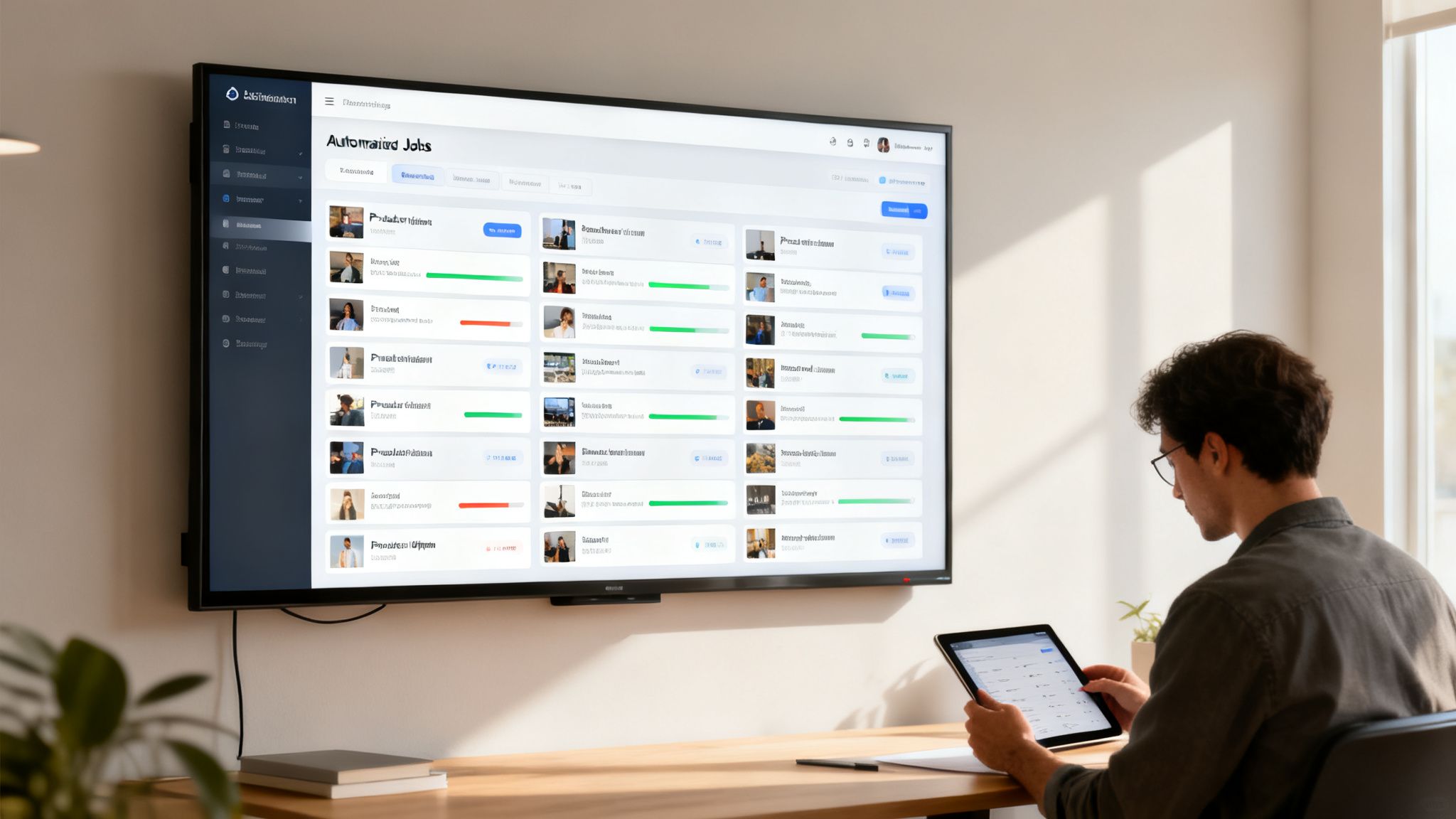
The most transformative aspect of generative video isn’t making one stunning clip. It’s about fundamentally changing how companies approach video, moving away from standalone projects and toward automated, repeatable content pipelines.
For years, video has been a heavy lift. Each ad, social post, or training video required its own budget, timeline, and creative cycle. Tools like Sora AI signal a future where video is treated more like a programmatic output than a project built from scratch every time.
This is where the concept of a video pipeline becomes powerful. Imagine connecting a generative video tool directly to your company’s data. Suddenly, video creation becomes a dynamic, always-on process, generating content at a scale that was previously unimaginable.
Building Your Automated Video Engine
The goal is to move beyond simple templates and into an era of truly dynamic, data-driven video. Instead of just swapping text in a pre-made design, a generative pipeline can create entirely new visuals based on real-time triggers and information.
This approach makes AI the core engine for scaling video production. It’s not about making one video better; it’s about building a system that can generate thousands of personalized videos automatically. The possibilities are vast:
- E-commerce: Connect your product catalog to a generative AI to automatically create a unique video for every item, showcasing it in different settings or being used by various customer personas.
- Real Estate: Integrate your property listings with an AI that generates a custom video tour for each new home, highlighting key features directly from the listing data.
- Travel: Link flight deal databases to an AI to instantly produce promotional videos for specific routes the moment a price drops, featuring scenes from the destination city.
The ultimate advantage is transforming video from a content format you create to an output you program. This pipeline-driven approach is the key to achieving personalization and relevance at an immense scale.
The Mindset Shift for Marketing Teams
This shift requires a new mindset. The focus moves from managing individual video projects to designing and supervising automated systems. Your team’s job becomes setting the rules, defining the data inputs, and outlining the creative direction for the pipeline.
For example, you could build a system that automatically produces weekly market update videos by pulling financial data, generating relevant visuals, and adding an AI voiceover. For teams interested in these principles, exploring video automation is a great way to understand how data and repeatable systems can work together.
While a fully generative system like Sora AI represents the future, the principles of building video pipelines are already helping businesses scale their content today.
How Your Team Can Prepare for the Generative Video Era
The excitement around tools like Sora AI is a clear signal for marketing and content teams to start adapting. Although Sora isn’t publicly available, you can begin building the skills and workflows that will define success in a generative video world. Taking action now will give your team a significant advantage.
Getting ready doesn’t require a complete overhaul. It starts with a mindset shift, focusing on the new skills that will matter most in an AI-driven creative landscape.
Develop Strategic Prompting Skills
The most critical new skill is prompt engineering: the art and science of writing clear, descriptive text that guides an AI to create the desired visuals. Your team’s creative energy will shift from directing actors or camera settings to crafting the perfect prompt.
Start practicing now by reframing existing content as prompts. How would you describe your latest product feature or case study for an AI?
- Be Specific: Instead of “a video about our new software,” try “a close-up shot of a user smiling while clicking a brightly lit ‘submit’ button on a modern dashboard interface.”
- Define the Mood: Add stylistic cues like “optimistic and airy,” “dramatic and cinematic,” or “fast-paced and energetic.”
- Dictate the Action: Clearly describe movement and sequences, such as “a camera pans smoothly from left to right across a clean, organized office space.”
Rethink Your Content Strategy Around Systems and Data
Generative video thrives on structure. Instead of planning one-off video projects, start thinking about building repeatable, automated video systems. This means organizing your data so an AI can easily use it to create personalized content at scale.
A generative video strategy is less about a content calendar and more about creating a content engine. Your data is the fuel, and your prompts are the instructions.
Begin building a structured library of your core brand messages, customer testimonials, and product data. By organizing this information for programmatic use, you’ll be prepared for mass personalization.
This shift is a natural evolution. OpenAI, founded in 2015, has consistently pushed the boundaries of AI. The foundational skills your team develops today with current tools will be directly transferable to more advanced systems tomorrow. You can start building this muscle now with an accessible, AI-powered video creation platform. Tools like Wideo’s AI Video Generator provide the perfect bridge, letting you turn text into video and experiment with AI voiceovers. This hands-on experience is the best way to prepare your team for the future of generative video.
Answering Your Questions About Sora AI
As generative video tools like Sora AI capture headlines, it’s natural for business leaders to have questions. Here are answers to some of the most common inquiries about what this technology means for your team and strategy.
Will Sora AI Replace Video Production Teams?
Sora AI is more likely to augment creative teams than replace them. It will change the type of work they do, shifting their focus from time-consuming technical tasks to higher-level creative strategy and direction.
Instead of dedicating weeks to a single shoot, teams can focus their energy on campaign concepts, storytelling, and brand messaging. The core skill will evolve from operating a camera to writing the perfect prompt that brings a vision to life. This empowers smaller teams to achieve results that once required a large agency and allows larger teams to execute ambitious ideas faster.
How Can My Business Start Using AI for Video Today?
You don’t have to wait for Sora AI to integrate AI into your video strategy. The core principles of AI-driven video are already available, and adopting them now can give your team a significant head start.
The key is to start using platforms that leverage AI to make video creation faster and more scalable. These tools help you build an AI-first mindset and establish the workflows that will be crucial when generative video becomes mainstream.
The most effective way to prepare for tomorrow’s technology is to master today’s. By adopting current AI video tools, you build the foundational skills and processes needed to capitalize on more advanced systems as they become available.
What Is the Difference Between Current AI Video Tools and Sora AI?
Most AI video tools available today are designed to create professional videos using existing assets, text, or data. They excel at tasks like turning a blog post into a social video, generating an explainer from a script, or automating personalized ads. They are practical, ready-to-use solutions for marketing and corporate communications.
Sora AI represents the next major leap. Its focus is on generating entirely new, often photorealistic video scenes from scratch using only a descriptive text prompt. Think of it this way: today’s tools are masters of assembly and enhancement, while Sora AI is a master of pure creation.
What New Skills Will My Marketing Team Need?
To prepare for a future shaped by models like Sora AI, your marketing team should cultivate a few key skills focused on strategic oversight rather than technical execution.
- Prompt Crafting: The ability to write clear, descriptive text that guides an AI to create exactly what you envision. This skill blends creative writing with technical direction.
- Systems Thinking: Moving beyond one-off videos to design automated video pipelines that connect data sources to generative AI for personalized content at scale.
- AI Content Curation: A sharp, critical eye to evaluate AI-generated content, identify subtle flaws, and refine prompts to ensure every video is on-brand and meets campaign goals.
As you prepare your team for this new era, the best first step is to experiment with the powerful AI video tools available today. Wideo offers a practical and accessible way to begin this journey. With our platform, you can transform text into professional videos, utilize AI voiceovers, and build a foundation in automated content creation.
Explore how your team can get ahead of the curve by visiting Wideo’s AI Video Generator.
Related posts:
 Ai data processing: Practical strategies for pipelines, tools, and compliance
 Unlocking AI Performance in Modern Video Creation
 From Manual Handoffs to Automated Video: A Practical Guide to AI Workflows
 Beyond Dashboards: A New Way to Compare AI Platforms for Scalable Communication
 The New Face of Conversational AI: Why Video is the Voice of the Future
 How Financial Brands Use AI Video Creation to Build Trust and Scale Growth


