
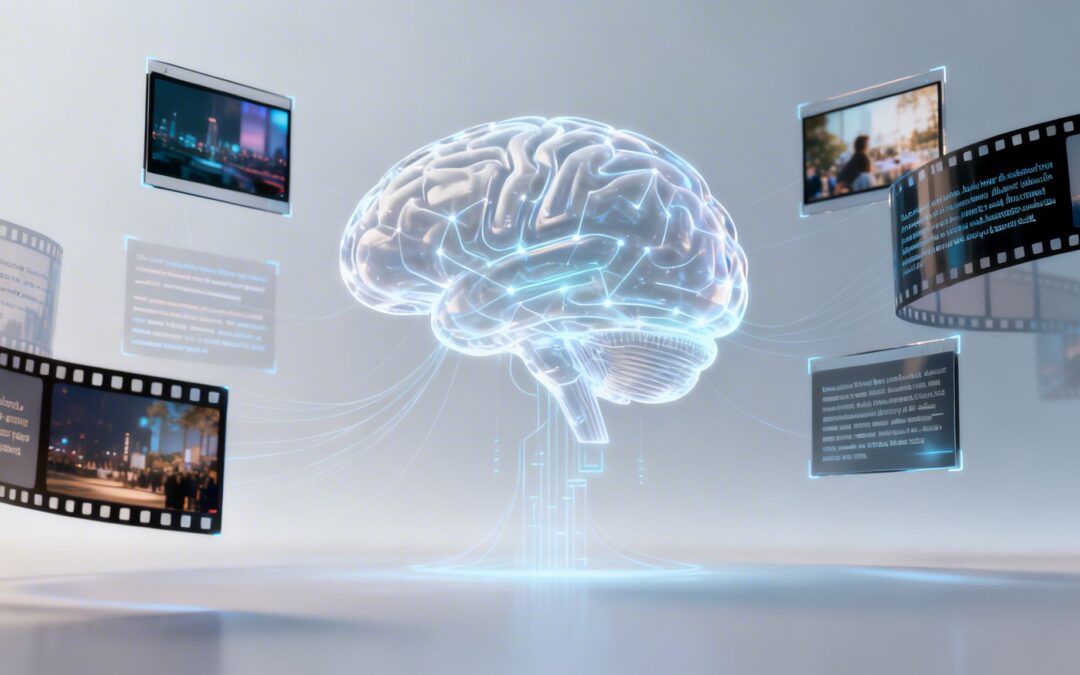
When you think of large language models, your mind probably jumps to chatbots or writing assistants. That’s a common starting point, but it misses the bigger picture. For marketing, sales, and content teams, the true power of LLMs isn’t just about generating text—it’s about using that text as the blueprint for creating video at scale.
It’s time to stop seeing LLMs as simple text generators and start seeing them for what they are: the core engine powering the next wave of automated video production.
From Text Prompt to Video Pipeline: The New Workflow

This requires a fundamental shift in thinking. The output from an LLM isn’t the final product; it’s the architectural plan for a dynamic video. It’s the structured set of instructions—the story, the scene breakdowns, the on-screen text, and the call-to-action—that feeds directly into an automated video creation pipeline.
This changes everything. Instead of manually crafting one video script, you’re generating the narrative DNA for hundreds of video variations, all tailored to specific audiences and consistently on-brand.
The Engine for Scalable Storytelling
Once you position a large language model as the starting point for video, you unlock a new level of efficiency, personalization, and speed. Your content strategy evolves from a slow, manual process into a dynamic, video-first model that captures attention and drives action.
The benefits are clear:
- Unprecedented Speed: Move from a simple idea to a fully-structured video script in minutes, not days.
- Deep Personalization: Create tailored video messages for different customer segments, regions, or stages in the buyer’s journey.
- Brand Consistency: Ensure every video, whether for a global marketing campaign or an internal training module, adheres to your brand’s voice and messaging guidelines.
The real value of large language models in a business context is unlocked when their output automates a high-impact medium. Video is the ultimate destination for LLM-generated content, turning abstract ideas into tangible, engaging assets.
The Core Component in AI-Powered Video Systems
When you connect LLMs with AI video generators, you create a powerful synergy. The LLM acts as the creative brain, generating the narrative logic and structured content. The video platform then becomes the hands, executing those instructions to build the final visual asset.
Knowing about the different best LLM models available can help you choose the right engine to power these workflows. This integration gives non-technical teams the ability to produce high-quality, on-brand videos at a scale that was once unimaginable.
The future of business communication isn’t just about writing better text—it’s about turning that text into compelling video experiences.
Generating Production-Ready Scripts for Any Business Goal

Imagine an on-demand creative partner that can generate polished, ready-to-use video scripts for any business objective. That’s what using large language models for video content feels like.
The magic lies in their ability to produce highly structured, actionable content—not just a wall of text. An LLM can deliver formatted scenes, dialogue, narrator cues, and clear calls-to-action that are ready to drop directly into your video creation workflow.
From Marketing Campaigns to Sales Outreach
For marketing and sales teams, the impact is immediate. Instead of spending days brainstorming a single script for a product launch, you can generate a dozen different angles in one session.
For a new software feature launch, an LLM can help you write:
- A 30-second script for a snappy social media ad, complete with visual ideas for each scene.
- A 90-second explainer video script for your landing page, breaking down the feature’s benefits.
- Multiple script versions tweaked for different user personas, focusing on the specific problems each audience wants to solve.
This speed is a game-changer for sales, too. Personalized video outreach has always been effective but difficult to scale. Now, a sales rep can feed an LLM a few details about a prospect’s company and challenges to get a custom script for a short, compelling video that speaks directly to their needs.
Scaling Training and Onboarding Content
The benefits extend beyond customer-facing content. Corporate training and HR teams can use LLMs to make internal communications more engaging. An LLM can take a dense instruction manual or a complex policy document and break it down into a series of clear, concise video scripts.
This transforms static information into a dynamic learning experience that helps new hires absorb and retain information, ensuring a consistent, high-quality training program across the entire organization.
To get this kind of precise, production-ready content, mastering prompt engineering is key. A well-designed prompt unlocks structured, high-quality output that meets your video goals. For those starting out, our guide on how to write an explainer video script can provide a solid narrative foundation.
Using an LLM isn’t about replacing human creativity; it’s about amplifying it. It handles the heavy lifting of drafting and structuring, freeing your team to refine the message and create more high-impact videos than ever before.
Connecting LLMs to Automated Video Creation Workflows

A well-crafted script from a large language model is the blueprint. The magic happens when that blueprint connects seamlessly to an automated video creation system, turning words into engaging visual assets. This is the modern assembly line for content.
The LLM acts as the architect, providing detailed plans—scripts, voiceover text, and scene descriptions. The AI video platform is the automated construction crew, taking those instructions and building the final video by finding the right visuals, synthesizing the voiceover, and assembling the scenes.
This integration allows teams to leave slow, manual production cycles behind for a model built on incredible speed and scale.
The Synergy of Language and Visuals
When a large language model and an AI video tool work together, the most tedious bottlenecks in traditional video creation simply disappear. Manual tasks like storyboarding, searching for stock footage, and recording audio are replaced by a direct, automated pipeline.
This partnership empowers teams without technical video editing skills to produce high-quality, on-brand content. A marketing manager can generate a script for a new campaign and have a polished video ready for review in minutes, without ever opening a complex editing suite.
Achieving Unprecedented Scale and Personalization
The true power of this connected workflow is its ability to scale storytelling. Consider these business scenarios where this integration is a game-changer:
- Global Campaigns: A marketing team needs to launch a product video in five languages. An LLM translates and culturally adapts the script for each region. These new scripts are then fed into the video platform to automatically generate localized versions with the right voiceovers and on-screen text.
- Personalized Sales Outreach: A sales team wants to send unique videos to 1,000 top prospects. An LLM takes a base script and merges it with customer data—like name, company, and industry—to create a unique script for each person. The video system then produces a thousand personalized videos that feel like one-to-one conversations.
- Automated Customer Updates: An airline needs to notify passengers about a flight delay. An LLM instantly writes a clear script with the new details, and an automated system turns it into a short video update sent directly to everyone affected.
This seamless connection between LLMs and video automation finally delivers on the promise of scalable, personalized communication. It’s no longer a futuristic concept but a practical workflow that forward-thinking teams are adopting today.
This approach shifts your content strategy from making one-off videos to building a system that can generate a constant stream of relevant and personalized content. This is how you move from static text to dynamic, video-first communication that gets real results.
From Static Text To Dynamic Video in the Real World

Theory is one thing, but seeing how large language models transform real-world business challenges into engaging videos is where it all clicks. Let’s walk through how an LLM-to-video workflow turns a simple business need into powerful, personalized video content.
Scenario 1: A Car Dealership’s Personalized Offers
A car dealership wants to re-engage past customers whose leases are ending. Instead of a generic email, they decide to create personalized video offers showcasing new models.
- The Prompt: “Generate a 45-second video script for a customer named [Customer Name] who leased a [Car Model]. Congratulate them on their lease ending and introduce the new [New Model], highlighting its [Key Feature 1] and [Key Feature 2]. End with a call-to-action to book a test drive.”
- LLM Output: The model generates hundreds of unique, structured scripts. Each one is tailored with the customer’s name, their previous car, and details about a relevant new model.
- Video Creation: These scripts are piped into an AI video generator. The system automatically populates a video template with the personalized text, adds a natural-sounding AI voiceover, and pulls in visuals of the specific car being offered.
In hours, the dealership has a library of hyper-personalized videos ready to send, creating a one-to-one connection that a static email could never achieve.
Scenario 2: A Non-Profit’s Impactful Fundraising Story
A non-profit needs a compelling video for a social media fundraising drive but lacks a big production budget.
- The Prompt: “Summarize the key achievements from the attached annual report into a 60-second, emotionally resonant video script. Focus on the story of one beneficiary and use statistics to show our impact. Structure it with an opening hook, a short narrative, and a clear appeal for donations.”
- LLM Output: The LLM transforms the dense report into a powerful, human-centered story, pulling out the most compelling data points and weaving them into a narrative perfectly paced for video.
- Video Creation: This script is used to generate a video complete with emotive stock footage, on-screen text highlighting key stats, and an inspiring soundtrack. What was once a dry report is now a moving call-to-action.
Comparing Video Creation Workflows: Manual vs. LLM-Powered
The difference between the old way of making videos and an LLM-powered workflow is night and day. The new way is fast, affordable, and incredibly flexible.
| Stage | Traditional Manual Workflow | LLM-Powered Automated Workflow |
|---|---|---|
| Concept & Scripting | Days or weeks of team brainstorming, writing, and revisions. | Minutes to generate multiple script variations from a single prompt. |
| Storyboarding | Hours of manual creation, often requiring a specialized artist. | Instantly generated scene suggestions based on the LLM script. |
| Production | Expensive and time-consuming shoots, voiceover recording, and editing. | Automated asset selection, AI voice generation, and scene assembly. |
| Personalization | Impractical and cost-prohibitive to create more than one version. | Effortlessly generate thousands of unique versions for different audiences. |
| Total Turnaround | Weeks or months. | Hours or even minutes. |
This isn’t just about speed; it’s a fundamental change in strategy. This is where tools that bridge the gap from text to video become essential. By using platforms designed for this workflow, teams can directly transform their LLM-generated text into video. It allows them to move from slow, static communication to a dynamic, video-first approach that gets results.
Why the Future of LLM Output Is Video
While a large language model begins with text, its most powerful application for business is video. Text is the engine, but video is the vehicle that delivers your message in a memorable and impactful way. The goal was never just to generate a script; it’s about creating an experience that drives action.
An LLM-to-video workflow delivers hyper-personalization, brand consistency, and global scale at incredible speed. This isn’t a far-off concept—it’s how smart teams are gaining a competitive edge today.
The New Standard for Communication
One-size-fits-all content is a thing of the past. Customers, clients, and employees expect communication that is relevant, timely, and easy to consume. Video is the undisputed champion of engagement, but traditional production has always been a major bottleneck.
Placing LLMs at the start of the video creation process removes that bottleneck. Instead of one video taking weeks, you can generate the narrative for hundreds of variations in minutes.
This unlocks immense possibilities:
- Personalize at Scale: Create thousands of unique video messages for sales prospects or customer onboarding.
- Achieve Global Reach: Instantly translate and adapt marketing videos for different languages and cultures.
- Maintain Brand Consistency: Ensure every video, from an internal training clip to a social media ad, perfectly matches your brand’s voice.
- Move at Market Speed: Respond to business needs with relevant video content almost immediately.
The global LLM market is projected to reach USD 140.8 billion by 2033, driven by real-world business applications that transform communication. This growth isn’t just about smarter chatbots; it’s fueled by a demand for scalable, personalized content. You can learn more about these LLM usage statistics to see how this technology is enabling global scale.
The bridge from powerful text generation to impactful, scalable video is no longer a futuristic concept—it’s here. The most forward-thinking teams are already building workflows that capitalize on this synergy.
Unlocking the true power of large language models happens when their text output is transformed into something more dynamic and engaging. Tools are now built specifically to make this transition seamless. For example, by connecting your scripts to a platform like Wideo’s AI Video Generator, your team can take LLM-generated text and instantly transform it into a professional video, capitalizing on the full communication potential of these incredible models.
Answering Your Questions About LLMs for Video Creation
As teams explore using large language models to drive their video strategy, practical questions often arise. Moving from theory to a real-world workflow is more straightforward than it seems. Here are answers to common questions from marketing, sales, and content teams.
Can an LLM really match our unique brand voice?
Absolutely. The key is to provide clear direction. By feeding the LLM examples of your existing marketing copy, brand guidelines, and target audience personas, you teach it what “on-brand” means for you. Whether your style is formal and corporate or witty and energetic, effective prompt engineering ensures the output is a solid, on-brand draft.
Do I need technical skills to connect an LLM to a video platform?
Not at all. Modern video platforms are designed for non-technical users, with no-code integrations. The process is often as simple as generating your script in one tool and pasting it into an AI video generator. The video platform then takes over, automatically creating scenes, adding voiceovers, and suggesting visuals based on the script.
How does this approach enable personalization at scale?
This is where large language models truly excel. Traditional video personalization has been too expensive and time-consuming for most. With an LLM, you can create a script template and feed it customer data from a spreadsheet—names, companies, locations—to generate thousands of unique script variations in seconds. When connected to an automated video platform, this achieves a level of one-to-one communication that was previously unthinkable.
Will the final video look generic or templated?
The quality of the final video depends on the detail in your script and the capabilities of your video platform. You can prompt an LLM to be highly descriptive, suggesting specific visuals, on-screen text, or pacing. When you use that detailed script in a robust AI video generator with deep customization options and rich asset libraries, the result is anything but generic. The LLM provides the scalable foundation; your team adds the final creative touch.
With Wideo, you can easily bridge the gap between text and video. Take the scripts and narratives generated by large language models and instantly turn them into professional, engaging videos with Wideo’s AI Video Generator.
Related posts:
 Beyond Dashboards: A New Way to Compare AI Platforms for Scalable Communication
 The New Face of Conversational AI: Why Video is the Voice of the Future
 How AI Assistants Accelerate Team Video Creation
 Unlocking Your Business With Key AI Capabilities
 12 Practical AI Use Cases for Video Automation in 2025
 Beyond Transcription: How AI Subtitles Became a Strategic Layer in Video Marketing


