
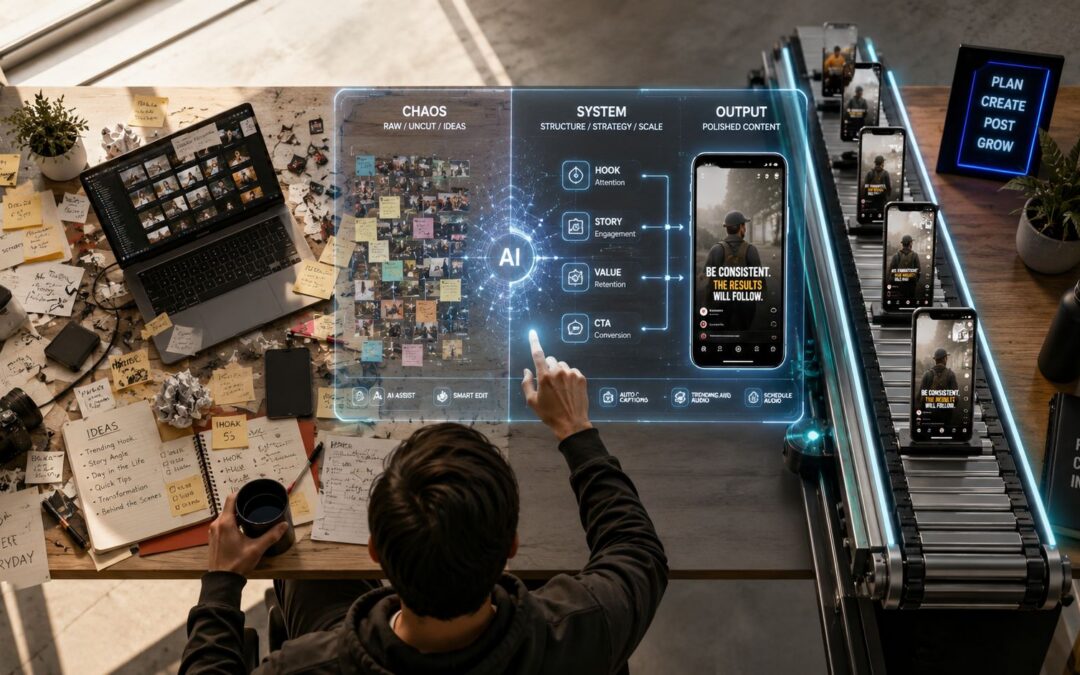
Short‑form video is no longer optional for social media. But producing enough videos to keep up with TikTok, Instagram, LinkedIn, and YouTube Shorts is impossible with manual workflows. AI video for social media changes that math.
Teams often don’t have a creativity problem. They have a capacity problem.
A social media manager at an ecommerce brand needs product Reels, a SaaS marketer needs LinkedIn clips from webinars, customer success needs onboarding walkthroughs, HR wants training updates, and leadership still expects polished stakeholder recaps by Friday. The request queue keeps growing while the production model stays stuck in one-off editing, fragmented approvals, and platform-by-platform exports.
The Impossible Math of Social Video Production
Short-form demand keeps rising because audience behavior has already moved. The AI in social media market analysis from Grand View Research values the market at USD 2.96 billion in 2024 and projects USD 48.18 billion by 2033, with a 36.4% CAGR. The same report notes that short-form video has become the most noticed content type, ahead of static images and carousels.

That sounds like an opportunity until you look at the operating model most companies still use. One person briefs the clip. Another writes captions. A designer resizes assets. An editor exports versions for TikTok, Instagram Reels, LinkedIn, and Shorts. Legal or brand review sends it back. By the time the audiovisual piece is ready, the campaign window has moved.
Where manual work breaks
In ecommerce, manual production means only hero products get visual content while the long tail sits untouched. In finance and insurance, teams delay customer education because compliance review on every recorded message takes too much coordination. In education and SaaS, blog repurposing often dies in a backlog because nobody has time to cut every article into native social clips.
Manual social production treats every asset like a custom project, even when the message pattern repeats.
That’s why the treadmill feels impossible. The output requirement is continuous, but the workflow is handcrafted. If your team is still stuck in that loop, a bank of fresh video ideas for business teams won’t fix the core issue by itself. Throughput comes from system design, not ideation alone.
Shifting from Production to a Video System
The practical meaning of AI video for social media isn’t “type a prompt and hope for a miracle.” It means building a repeatable engine that turns approved inputs into platform-ready dynamic assets with less manual assembly.

Company A still works like a studio. Every campaign starts from a blank timeline. The team debates hooks, writes fresh scripts, resizes every scene manually, and rebuilds captions for each channel. Quality varies because the process depends on whoever has time that week.
Company B works like an operations team. Product data, campaign copy, customer FAQs, and approved brand components flow into templates. The intelligent layer handles repetitive production work such as script drafts, scene assembly, voice generation, captioning, and format switching. People still direct the story, approve the message, and decide where each dynamic asset belongs. They just stop wasting hours on the parts that repeat.
The business shift
This matters far beyond marketing. Sales teams can send one-to-one follow-up clips after demos. Customer success can deliver onboarding sequences by segment. Real estate groups can create listing recaps from property data. Travel brands can publish destination updates from inventory and promotion feeds. Internal comms can turn executive notes into recorded messages staff will indeed watch.
Research from Rival IQ on AI-generated videos in social media reports that teams using AI video tools create 5x to 10x more content with the same resources. That’s the actual shift. Not novelty. Not style filters. Capacity.
What the team still owns
People still own strategy, audience judgment, brand standards, and review.
The machine-driven layer owns the repeatable labor.
For teams building this kind of repeatable engine, no-code video automation workflows are usually the turning point between “we make clips” and “we run a production system.”
The Four Layers of an AI Social Video Engine
A working system has four layers, and each one solves a different bottleneck.
The architecture
- Content source means the raw business input. This can be a product feed for ecommerce, a help center article for customer onboarding, a webinar transcript for SaaS demand generation, a policy update for insurance, or a hiring announcement for HR.
- Template library means approved layouts for each use case. One for TikTok product drops, another for LinkedIn thought leadership, another for employee training, another for investor or stakeholder recaps.
- Adaptation logic handles platform rules. For TikTok and Instagram Reels, social video specs from Sovran note that 9:16 at 1080×1920 is essential, and H.264 is the preferred codec because it balances compression and quality for mobile delivery.
- Distribution is where the rendered asset goes next. Scheduling tools, ad platforms, internal portals, sales outreach, onboarding sequences, or support libraries.
How it works in practice
A retailer can feed product titles, prices, and images into a social template that generates a short audiovisual piece per SKU. A SaaS company can feed a blog post into a template that turns key sections into a founder-style summary clip for LinkedIn. An insurance firm can pull renewal reminders and policy explanations into context-aware customer education assets that stay on brand without requiring a designer on every request.
Practical rule: If the same type of message appears every week, it should become a template before it becomes another editing task.
The important point is that templates don’t reduce quality. They protect consistency. Teams get into trouble when they think scale requires generic output. It doesn’t. It requires agreed structure, clear variables, and review rules.
A company could apply this with a simple workflow: data source into a branded template, an automation trigger when a new product, article, or update is published, then distribution to the right social channel or internal audience. Tools built for AI video generation workflows make that pattern much easier to run because they connect templates, rendering, and publishing in one place.
AI Video Workflows in the Real World
The system becomes real when you tie it to a business outcome.
An ecommerce brand can generate product showcase Reels from its catalog feed for customer acquisition. Each item pulls images, pricing, and selling points into a 9:16 template, then publishes platform-ready visual content for TikTok and Instagram. The team doesn’t ask, “Which products deserve a video?” It asks, “Which products need a stronger hook?”
A SaaS company can turn every blog post, feature release, or webinar recap into short LinkedIn and Shorts content for sales enablement and thought leadership. The model-generated workflow drafts a script, assembles scenes, adds captions, and creates a recorded message that a sales rep can share after a call or a content manager can publish to support pipeline education. Teams looking for adjacent ideas often review broader guides to AI tools for small business owners because the same repurposing logic works across channels.
A campaign team can create multiple ad variants from one approved concept for testing across platforms and segments. According to Vidu’s guidance on AI social video structure, social algorithms reward watch-through rate, so the core message needs to appear in the first 3 seconds, with cuts aligned to audio beats. That’s useful for media, education, travel, and enterprise operations because it turns creative testing into a system instead of a scramble. Teams can also study broader video automation approaches for companies when they want one engine that serves marketing, onboarding, and internal updates at the same time.
One pattern across departments
The same workflow can support retention, training, and reporting. A customer success team sends renewal education. HR sends policy updates. Operations sends process walkthroughs. Executives send monthly performance recaps as short visual content staff will finish.
Implementing a Scalable Production Workflow
The hard part isn’t generating one clip. The hard part is orchestrating inputs, templates, approvals, aspect ratios, captions, and distribution without creating a new mess in the process.

That’s where a platform matters. Sociality.io’s report on AI in social media marketing found that 71.1% of social media teams report significant time savings when using AI for visual and video creation. Time savings aren’t the headline by themselves. The primary value is that teams can redirect those hours into messaging, approvals, channel planning, and testing.
A practical implementation looks like this. Pull source data from a CMS, CRM, product catalog, or knowledge base. Map that data into templates with fixed branding and variable fields. Trigger rendering when a new item is published or a lifecycle event occurs. Push the finished assets to social scheduling, ad platforms, onboarding email, or internal communication channels.
For teams that need template-based creation, AI script generation, voiceover, auto-captioning, aspect ratio switching, and bulk rendering in one workflow, Wideo’s AI video generator is a useful example of how the system can be assembled without manual editing as the center of the process.
Measuring Success and Avoiding Common Pitfalls
If you measure only views, you’ll miss the point. This is a business system, so success starts with throughput, speed, and hours removed from repetitive work.
What to measure
Track how many assets your team can publish per week or month. Track how long it takes to turn a launch brief, blog post, product update, or training note into a finished piece of visual content. Track engagement only when it connects to a business goal such as product interest, onboarding completion, support deflection, stakeholder clarity, or employee understanding.
Better reporting starts with one question: did this system reduce manual effort while improving delivery consistency?
A social team cares about completion and shares. A sales leader cares whether reps have current assets to send. A customer success lead cares whether onboarding material reaches the right accounts on time. An operations lead cares whether the process runs without bottlenecks.
What usually goes wrong
The first failure mode is treating AI as strategy. It isn’t. It won’t tell you what your audience cares about, which message to push this quarter, or why one market is stalling. It handles production labor. Your team still has to think.
The second is ignoring platform differences. TikTok, LinkedIn, Instagram, and YouTube Shorts don’t reward the same pacing or presentation. Build channel-specific templates, not one generic master for everything.
The third is brand drift. Generic prompts create generic output. Approved language, visual rules, and human review keep the system from sounding like everyone else.
The fourth is scaling too early. Test a small batch first. Review captions, audio timing, formatting, and the first-second hook before you push a larger run. If your current process still depends on manual checking for every tiny variation, measurement guidance for marketing videos helps teams separate useful production metrics from vanity reporting.
Video isn’t just a marketing tactic anymore.
It’s a repeatable operating layer for acquisition, sales enablement, onboarding, retention, internal communication, training, reporting, and execution at scale.
Are you still producing social video one file at a time, or are you building a system that can keep up?
Book a demo to see how Wideo handles AI video for social media at scale.
SUGGESTED SLUG: ai-video-for-social-media-from-chaos-to-system
Related posts:
 Beyond Automation: Why Video is the Future of AI Marketing Tools
 Beyond the Hype: How to Build Your “Day AI” and Win in 2026
 The Smartest Artificial Intelligence Applications Are All About Communication
 What is Artificial Intelligence? A Guide for Businesses Who Want to Move Faster
 Types of Artificial Intelligence: Your Guide to Business Impact in 2026
 The Real Benefits of Artificial Intelligence in 2026 (Hint: It’s Not What You Think)


