

What Exactly Are AI Platforms?
Instead of just one algorithm or piece of software, an integrated environment provides the full workspace for your entire AI project—from sorting through raw data to launching the final product.

Here’s a simple way to think about it. Imagine you want to open a world-class restaurant. You wouldn’t just go out and buy a single high-end oven, right? You’d need a complete professional kitchen with dedicated stations for every step.
You’d have prep areas for washing and chopping ingredients (that’s your data preparation). You’d have powerful stoves and ovens for the actual cooking (model training). And finally, you’d need a smooth, efficient serving counter to get those perfectly crafted dishes out to your customers (application deployment). An AI platform is that fully equipped kitchen, giving you all the tools you need to turn a raw idea into a functional AI application.
The Power of an Integrated Toolkit
Without a platform, data scientists and developers are stuck trying to duct-tape dozens of separate tools, libraries, and frameworks together. It’s slow, messy, and a nightmare to scale—kind of like trying to run that restaurant with your appliances scattered across different buildings.
An AI platform pulls everything under one roof, creating a seamless workflow. This is a game-changer for any business trying to get real value from AI. The numbers back this up, too. The consumer AI market has ballooned into a $12 billion industry in just a few years. On top of that, a recent survey found that 78% of organizations now report using AI, a huge jump from 55% the year before. If you want to dig deeper, you can get more details on recent AI trends to see just how fast companies are adopting these solutions.
An AI platform isn’t just a piece of software; it’s an operational backbone. It enables teams to collaborate, experiment, and deploy AI solutions with speed and reliability, turning complex technology into tangible business value.
Key Components of Modern AI Platforms
Most AI platforms share a common set of components built to handle the entire AI lifecycle. While the bells and whistles might differ from one platform to another, you can almost always count on finding these core features:
- Data Management and Preparation: Tools to help you pull in, clean up, and label raw data so it’s ready for training your models.
- Model Development Environments: Dedicated workspaces where your team can build, train, and fine-tune different AI models using popular frameworks.
- Deployment and Operations: The infrastructure needed to push your trained models into a live environment and keep an eye on how they’re performing over time.
To give you a clearer picture, let’s break down the main types of AI platforms you’ll encounter and what they’re best at.
At a Glance Overview of AI Platform Types
| Platform Type | Primary Function | Common Use Case Example |
|---|---|---|
| Machine Learning (ML) Platforms | Building and deploying predictive models from structured data. | An e-commerce site predicting which products a customer is most likely to buy next. |
| Generative AI Platforms | Creating new content (text, images, video, code) from prompts. | A marketing team generating ad copy and social media visuals in seconds. |
| Conversational AI Platforms | Developing chatbots and voice assistants for human-like interaction. | An airline using a chatbot to handle flight booking and customer service inquiries. |
| Video AI Platforms | Automating the creation, editing, and analysis of video content. | A non-profit creating thousands of personalized thank-you videos for donors. |
| MLOps Platforms | Managing the end-to-end lifecycle of machine learning models. | A large enterprise automating the process of retraining and redeploying fraud detection models. |
Each of these platform types solves a different set of problems, but they all share the same goal: to make it easier for businesses to build and deploy powerful AI solutions without having to start from scratch every single time.
Exploring the Main Categories of AI Platforms
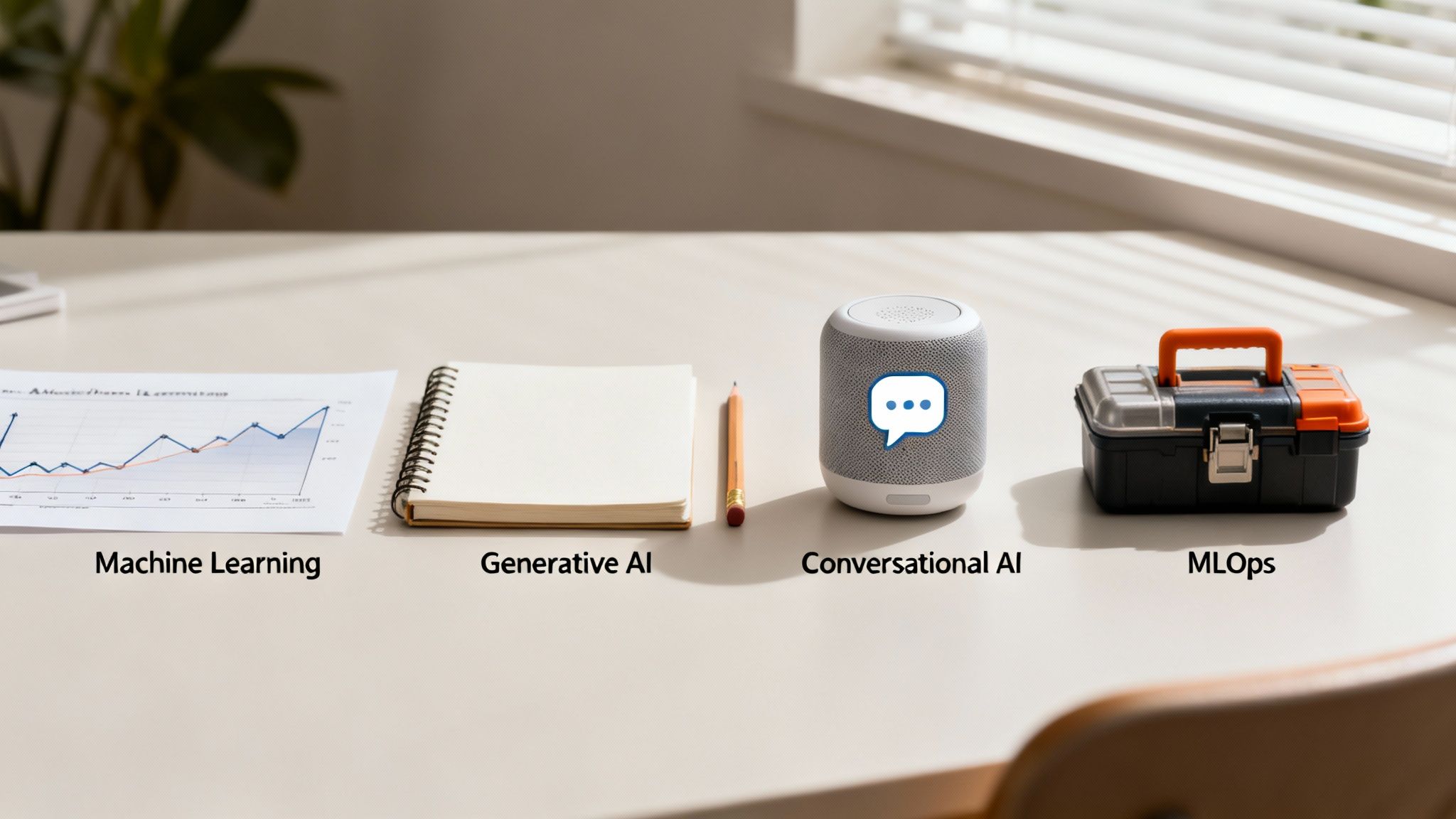
Not all AI platforms are built the same; each type is designed to solve a totally different kind of business problem. Getting a handle on these categories is your first step to finding the right fit. Think of it like a contractor’s toolbox—you wouldn’t grab a sledgehammer to hang a picture frame.
The platform you choose depends entirely on the job you need to do. Are you trying to predict what’s coming next, create brand-new content from scratch, or automate conversations with customers? Let’s break down the main types to see which tool is right for which task.
Machine Learning Platforms: The Predictors
Machine Learning (ML) platforms are the data detectives of the AI world. Their whole job is to dig through historical data, spot patterns, and build models that can predict what will happen next. These platforms are the bedrock of data-driven decisions, helping businesses forecast future events with impressive accuracy.
Imagine an e-commerce company trying to cut down on unsold inventory. An ML platform can sift through past sales data, seasonal trends, and marketing campaigns to predict demand for certain products. This helps the company stock just the right amount, avoiding both costly overstock and frustrating stockouts.
You see ML platforms in action all the time:
- Fraud Detection: Banks lean on ML models to flag sketchy transactions in real-time, saving millions from would-be thieves.
- Customer Churn Prediction: Subscription services can spot customers who are likely to cancel and step in with an offer to keep them.
- Dynamic Pricing: Airlines and ride-sharing apps use them to tweak prices based on demand, supply, and a dozen other factors happening at that very moment.
Generative AI Platforms: The Creators
Generative AI has completely captured the public’s attention, and for good reason—it creates something out of nothing. These platforms use large language models (LLMs) and other massive models to generate text, images, code, and even video from a simple text prompt. It’s like having a creative partner that can churn out content at an incredible scale.
For a marketing team, this is a game-changer. Instead of spending a whole day brainstorming ad copy, they can prompt a generative AI tool and get dozens of options in seconds. As you dig into the main categories of AI platforms, it’s worth checking out some of the top generative AI tools for marketing to see what’s possible.
This creative power goes way beyond just text. For example, making an engaging video used to be a long and expensive headache. Now, much of it can be automated. An AI video generator can take a simple script or even a blog post and turn it into a professional-looking video in minutes.
Generative AI doesn’t just automate tasks; it amplifies creativity. It lets teams explore more ideas, test more concepts, and produce higher-quality content faster than ever before.
Conversational AI Platforms: The Communicators
If you’ve ever used a support chatbot that actually solved your problem, you’ve met conversational AI. These platforms are all about building smart, human-like virtual agents that understand and respond to people through text or voice.
The goal isn’t just to spit back answers but to create a smooth, genuinely helpful experience for the customer. A well-built chatbot can handle thousands of conversations at once, freeing up your human agents to tackle the really tricky issues.
This technology is the engine behind a ton of applications:
- 24/7 Customer Support: Answering the usual questions about order status, returns, or account info.
- Lead Qualification: Chatting with website visitors to gather info and see if they’re a good fit for the sales team.
- Internal Helpdesks: Helping employees with IT problems or basic HR questions.
MLOps Platforms: The Orchestrators
Finally, there are MLOps (Machine Learning Operations) platforms. These are the crucial operational backbone for any serious AI effort. An AI model isn’t a “set it and forget it” kind of thing; it needs constant monitoring, updating, and retraining to stay accurate and effective over time.
Think of an MLOps platform as the air traffic control for your fleet of AI models. It manages the entire lifecycle, from development and testing to deployment and ongoing monitoring. Without a solid MLOps strategy, even the most brilliant models can fall flat in a live environment. These platforms are what make sure your AI solutions are reliable, scalable, and consistently delivering real value.
Comparing Core Features and Key Integrations
Picking the right AI platform can feel a lot like choosing a new car. They all promise to get you where you’re going, but the real value is under the hood. The engine, the transmission, and how it connects to everything else—those are the details that separate a smooth ride from a bumpy, frustrating journey.
It’s the same with AI platforms. Forget the flashy promises for a moment. You need to look at the core technical features and, most importantly, how well a platform will play with the technology you already use. A powerful AI tool that can’t talk to your customer data is like a supercar with an empty gas tank.

Unpacking the Essential Features
Every AI platform is really a bundle of different tools designed to work together. While the specifics can vary, a few non-negotiables form the foundation of any system worth its salt. These are the components you’ll need to inspect closely to make sure a platform can handle your business needs from start to finish.
Think of these features as the essential stages of an assembly line for your AI solutions.
- Data Management and Ingestion: This is ground zero. A solid platform makes it easy to hook into different data sources—your CRM, product databases, or cloud storage—and pull that information in. It also needs tools to clean and prep that data, which is often 80% of the work in any AI project.
- Model Development Environment: This is the workshop where your AI models get built. The best platforms offer flexibility here, providing both user-friendly, drag-and-drop interfaces for quick experiments and full-blown coding environments (like Jupyter notebooks) for data scientists who need total control.
- Deployment and Scalability: An AI model just sitting on a developer’s laptop is pretty useless. The platform has to provide simple, reliable ways to push models into a live production environment. It also needs to handle scaling automatically, so your app doesn’t crash the minute you get a spike in traffic.
The true test of an AI platform isn’t just its ability to build a clever model, but its capacity to deploy, manage, and scale that model reliably in the real world. Without robust operational features, even the best AI is just a science project.
The Make-or-Break Role of Integrations
Integrations are the central nervous system of your tech stack. For an AI platform, they are absolutely critical. A platform’s ability to seamlessly connect with your existing software determines whether it becomes a force multiplier for your business or just another isolated data silo.
Think about it. An e-commerce company needs its AI platform to plug directly into its inventory system to make accurate demand forecasts. A marketing team needs its generative AI tool to pull customer info from its CRM to create personalized campaigns that actually land.
Low-Code vs. Custom Code Environments
One of the biggest forks in the road you’ll face is choosing between a low-code and a custom-code approach. There’s a big difference.
- Low-Code/No-Code Platforms: These are all about accessibility. They use visual, drag-and-drop interfaces that let people like business analysts and marketers build AI applications without writing a single line of code. They’re fantastic for moving fast and empowering non-technical teams.
- Custom Code Platforms: These give data scientists and developers maximum flexibility and control. Using languages like Python, teams can build highly specialized, complex models that are dialed in to solve unique business problems.
The best AI platforms often deliver a hybrid model, giving you the best of both worlds. This lets your team score quick wins with low-code tools while leaving the door open for deep customization when a project really demands it. For any serious deployment, it’s also wise to follow established MLOps best practices to keep everything running smoothly.
Feature Comparison Across AI Platform Types
To make sense of the options, it helps to see how the core features stack up across different types of AI platforms. Each is built for a different job.
| Feature | Machine Learning Platform | Generative AI Platform | Conversational AI Platform |
|---|---|---|---|
| Primary Function | Build, train, and deploy predictive models from data. | Create new content (text, images, video) based on prompts. | Automate human-like conversations via text or voice. |
| Data Handling | Advanced tools for data cleaning, prep, and feature engineering. | Focuses on large, pre-trained models; less user data prep. | Manages dialogue flows, user intents, and entity recognition. |
| Model Development | Offers both low-code (AutoML) and custom code (Python) options. | Primarily prompt-based interaction; some allow model fine-tuning. | Visual dialogue builders and some scripting for complex logic. |
| Key Integrations | CRMs, ERPs, data warehouses (e.g., Snowflake, BigQuery). | Content management systems, marketing automation tools, APIs. | Messaging apps (WhatsApp, Messenger), CRM, helpdesk software. |
| Common Use Case | Predicting customer churn, forecasting sales demand. | Generating marketing copy, creating personalized ad creative. | Building customer service chatbots, voice-activated assistants. |
This table highlights that your choice really depends on what you’re trying to accomplish. You wouldn’t use a chatbot platform to forecast inventory, just as you wouldn’t use a heavy-duty ML platform to write a blog post.
A Practical Example of Smart Integration
Let’s see how this all comes together in the real world with a video AI platform like Wideo. Imagine a large non-profit that wants to send personalized thank-you videos to thousands of donors. Doing this by hand is a non-starter.
By integrating Wideo with its donor database (like Salesforce or even a custom SQL database), the organization can automate the entire workflow. The AI platform can pull each donor’s name, their donation amount, and the specific project they funded. It then uses a template to automatically generate a unique video for every single person.
This kind of magic is made possible by a powerful API that lets data flow seamlessly between systems. For anyone interested in the technical side, you can see how a well-documented API from a platform like Wideo makes these powerful automations happen.
That one integration transforms a generic thank-you email into a powerful, personal experience that deepens donor relationships—all without any manual effort. This is the real, tangible power of choosing an AI platform with the right core features and, most importantly, smart integrations.
How to Select the Right AI Platform for Your Industry
Picking an AI platform isn’t just about the tech; it’s a strategic move that hinges entirely on the unique challenges and goals of your industry. A platform that works wonders for an e-commerce brand could be completely wrong for an automotive manufacturer. Context is everything. To get it right, you have to match a platform’s capabilities directly to the problems you’re trying to solve.
Let’s get practical. This means going beyond generic feature lists and honing in on industry-specific use cases, regulatory hurdles, and critical integration points. The best AI platforms aren’t one-size-fits-all. Instead, they are finely tuned to the rhythms and demands of a particular sector.

Automotive and Airlines Precision at Scale
In high-stakes industries like automotive and aviation, there’s no room for error. Operations are complex, safety is paramount, and efficiency gains can save millions. Here, AI platforms aren’t just for marketing—they’re core operational tools.
An automotive company building self-driving tech needs a platform that can chew through staggering amounts of sensor data. Their must-haves include massive data handling capabilities and specialized tools for training computer vision models. A manufacturer focused on predictive maintenance, on the other hand, needs a platform that excels at analyzing IoT data from factory machines to predict part failures before they grind production to a halt.
Airlines are wrestling with a different beast: logistical optimization. Their ideal AI platform needs to plug into flight scheduling systems, weather data feeds, and crew management software. The mission is to build models that can optimize fuel consumption, forecast maintenance for an entire fleet, and manage crew rosters with ruthless efficiency.
For both sectors, ask these key questions:
- Data Handling: Can the platform ingest and process terabytes of sensor, telematics, or operational data in near real-time?
- Specialized Models: Does it support the specific model types you need, like computer vision for autonomous systems or complex forecasting for logistics?
- Regulatory Compliance: Can it meet strict industry safety and data governance standards (think FAA or NHTSA guidelines)?
E-commerce and Marketing Customer-Centric Experiences
In the worlds of e-commerce and marketing, the game is all about winning customer attention. The right AI platform is one that helps you understand customer behavior on a deep level and deliver personalized experiences that actually connect. The focus shifts from operational efficiency to customer engagement.
E-commerce brands live and die by their recommendation engines. They need a platform that can analyze browsing history, purchase data, and user behavior to suggest products customers truly want. The key is an AI platform that integrates seamlessly with their product catalog and customer database to serve up these recommendations instantly.
Marketing teams are on the hunt for platforms that can automate and personalize campaigns. This means tools for segmenting audiences with precision, generating creative ad copy and visuals, and optimizing ad spend across different channels. A video-focused platform like Wideo, for instance, lets a marketing agency create thousands of personalized video ads, each tailored to a specific customer segment, without a massive production budget.
Choosing an AI platform is less about finding the ‘best’ one and more about finding the ‘right’ one. The right platform aligns with your industry’s specific data, workflows, and success metrics, turning a powerful technology into a true competitive advantage.
HR and Non-Profits People-Powered Missions
For human resources and non-profit organizations, the mission is all about people. HR departments need to find, attract, and retain top talent, while non-profits must build strong relationships with donors and volunteers. The best AI platforms for these fields are those that enhance human connection, not replace it.
An HR team might choose a platform built for talent acquisition. Such a tool can analyze resumes to spot the best candidates, automate interview scheduling, and even use chatbots to answer common applicant questions. This frees up recruiters to focus on what really matters: building relationships with promising people.
Non-profits can use AI to supercharge their fundraising and outreach. A platform that analyzes donor data can help identify individuals most likely to contribute to a new campaign. Generative AI tools can also help create personalized thank-you messages, emails, and even videos, making each donor feel seen and appreciated—which is crucial for long-term engagement.
When evaluating AI platforms for your industry, start with your core business problem. Pinpoint the specific outcome you need, then work backward to identify the features, integrations, and capabilities required to make it happen. This industry-first approach ensures you invest in a solution that delivers real, measurable value.
Untangling Implementation Costs and Security
Choosing an AI platform based on flashy features alone is a recipe for disaster. The real success of any AI strategy comes down to two things that are far less glamorous but infinitely more important: cost and security.
This is where the rubber meets the road. Get these two elements right, and you’ll build a sustainable system that adds real value. Get them wrong, and you’re setting yourself up for budget blowouts, unacceptable risks, and a project that never gets off the ground. Think of it like building a skyscraper—you wouldn’t skip the foundation or the security system, would you?
How AI Platforms Bill You
That sticker price on a platform’s website? It’s rarely the full picture. To get a real sense of your investment, you need to understand the different ways these platforms charge and calculate the true total cost of ownership (TCO). That means looking beyond the subscription fee to account for everything from training your team to ongoing maintenance.
Most AI platforms use one of three common pricing models:
- Subscription-Based: You pay a flat fee, usually monthly or annually. This is fantastic for predictable budgeting, but you might overpay if your usage fluctuates.
- Pay-As-You-Go: You only get billed for what you actually use—think processing hours, data storage, or API calls. It’s incredibly flexible and efficient for teams with inconsistent workloads, but it can make forecasting your monthly spend a real headache.
- Tiered Pricing: This is a hybrid model. You pick a subscription tier that unlocks a certain level of features, usage limits, and support. It’s designed to let you start small and scale your investment as your needs get more complex.
The initial subscription fee is just the tip of the iceberg. The true cost of an AI platform includes hidden expenses like data migration, employee training, ongoing maintenance, and the cost of integrating it with your existing software stack.
To get a clearer picture of what different pricing structures look like in the real world, check out our detailed guide on how software pricing models work, which breaks down these concepts even further.
Why Security is a Non-Negotiable
When you sign on with an AI platform, you’re handing over the keys to one of your most valuable assets: your data. A security breach is more than just an inconvenience; it can be a company-ending event, leading to massive financial losses, a trashed reputation, and a mountain of legal trouble. Security isn’t just another feature on a checklist—it’s the whole foundation.
This is especially critical now, with the global AI platform market set to explode from USD 18.22 billion to over USD 94.3 billion by 2030. That kind of rapid growth brings a flood of new tools, but also a flood of new vulnerabilities. You can read the full research on the AI platform market to see just how fast things are moving.
When you’re vetting a platform, you absolutely have to grill them on these key security pillars:
- Data Governance and Privacy: How does the platform control who sees what? It needs rock-solid tools for managing data access, like role-based access control (RBAC), and must comply with regulations like GDPR. Data should be encrypted, period—both when it’s sitting on a server and when it’s moving.
- Model Integrity and Security: Your trained AI models are priceless intellectual property. How does the platform stop them from being stolen, tampered with, or hit with adversarial attacks? Look for secure model repositories and strict version control.
- Infrastructure Security: Whether it’s in the cloud or on your own servers, the underlying infrastructure has to follow industry-best security practices to fend off external threats and guarantee it stays up and running.
Getting Over the Integration Hurdles
Even the most secure, perfectly priced AI platform is useless if it can’t talk to the rest of your tech stack. Integration friction is one of the top reasons AI projects stall out or just plain fail. The trick is to plan for these roadblocks before they ever appear.
Before you even think about signing a contract, take a hard, honest look at your current setup. Do you have the technical chops in-house to handle complex API integrations? Is your data clean and actually accessible? Answering these questions upfront will save you a world of pain later. It ensures your new AI tool becomes a seamless part of your workflow, not just another frustrating data silo.
Common Questions About AI Platforms
Jumping into the world of AI platforms can feel like learning a new language. You’re hit with a flood of technical terms, acronyms, and big promises. Let’s cut through the noise and tackle some of the most common questions business and tech leaders have when they start exploring these tools.
Getting clear, straightforward answers is the first step toward making a solid, informed decision. This section is all about giving you just that—the essential info you need, without the confusing jargon. We’ll break down the difference between models and platforms, clarify what kind of tech skills you really need, and look at the critical role integrations play.
What Is the Difference Between an AI Model and an AI Platform?
This is probably the single most important thing to get straight, and a simple analogy makes it crystal clear.
Think of an AI model as a highly trained specialist—like an expert chef who has spent a decade perfecting one single dish, say, handmade pasta. This chef is incredible at that one specific task, but they can’t run an entire restaurant alone.
An AI platform, on the other hand, is the entire professional kitchen that surrounds that chef. It’s got everything needed to operate at scale:
- Refrigerators and Pantries: This is the platform’s data storage and management system, keeping all your raw ingredients (data) fresh and organized.
- Prep Stations: Here’s where you clean, chop, and prepare your ingredients. In the AI world, these are the data processing and transformation tools.
- Ovens, Stoves, and Grills: These are the model training environments where you can “cook up” different AI models for all sorts of tasks.
- Serving Staff and Expo Line: This is your deployment and monitoring system, which gets the final product out to customers and makes sure it’s always top-notch.
In short, the model does one specific, focused job. The platform provides the complete, end-to-end infrastructure to build, manage, and actually use that model effectively in a real business.
How Much Technical Expertise Do I Need to Use an AI Platform?
The answer here has changed a ton over the last few years, and it really comes down to the platform you choose. The skill level required is now a spectrum, which has opened up AI development to a much wider group of people than ever before.
Some platforms are built as “low-code” or “no-code” solutions. These tools have intuitive, visual interfaces with drag-and-drop features, letting business users, marketers, and analysts build powerful AI apps without writing a single line of code. They’re perfect for getting prototypes up and running fast and empowering teams to solve their own problems.
On the flip side, other platforms are built from the ground up for data scientists and software engineers. These offer deep control and customization through programming languages like Python and come with advanced toolkits for building highly specialized models. They provide the raw power needed for tackling unique, complex challenges.
A smart move is to look for a hybrid platform—one that offers user-friendly interfaces for quick wins and citizen developers, while also providing a powerful, code-based environment for your technical experts to tackle the heavy lifting.
This dual approach means everyone in your organization can contribute to your AI goals, from the marketing department to the machine learning team.
Can I Integrate an AI Platform with My Current Software?
Yes, and you absolutely have to. A platform’s ability to connect with the software your business already runs on is one of the most critical factors for success. An AI tool that operates in a silo isn’t a solution; it’s just another headache.
The best AI platforms are designed with integration in mind. They come with pre-built connectors and robust APIs (Application Programming Interfaces) that let them talk seamlessly with your existing tech stack.
Think about what this looks like in practice:
- CRM Integration: Connecting to a system like Salesforce lets your AI access customer data to build personalized marketing campaigns or predict churn.
- ERP Integration: Plugging into systems like SAP can give your models access to supply chain and operational data for optimizing logistics.
- Data Warehouse Integration: Linking to services like Snowflake or BigQuery allows your platform to tap into massive, structured datasets for training sophisticated predictive models.
Before you commit to any platform, you have to nail down its integration capabilities. Poor integration will hobble your efforts, stop you from getting the full value of your investment, and create endless frustration for your team.
Ready to see how a powerful, integration-friendly AI platform can transform your content strategy? With Wideo, you can automate the creation of thousands of personalized videos for marketing, sales, and HR. Discover what you can build with Wideo today!
Related posts:
 From Production Cycles to Creative Velocity: How Generative AI Is Reshaping Video Marketing
 How AI Applications Are Reshaping Modern Industries
 A Creator’s Guide to Practical AI Ethics
 A Practical Guide to AI Security for Your Business
 A Practical Guide to AI Development for Modern Business
 A Practical Guide to Modern AI Systems


