
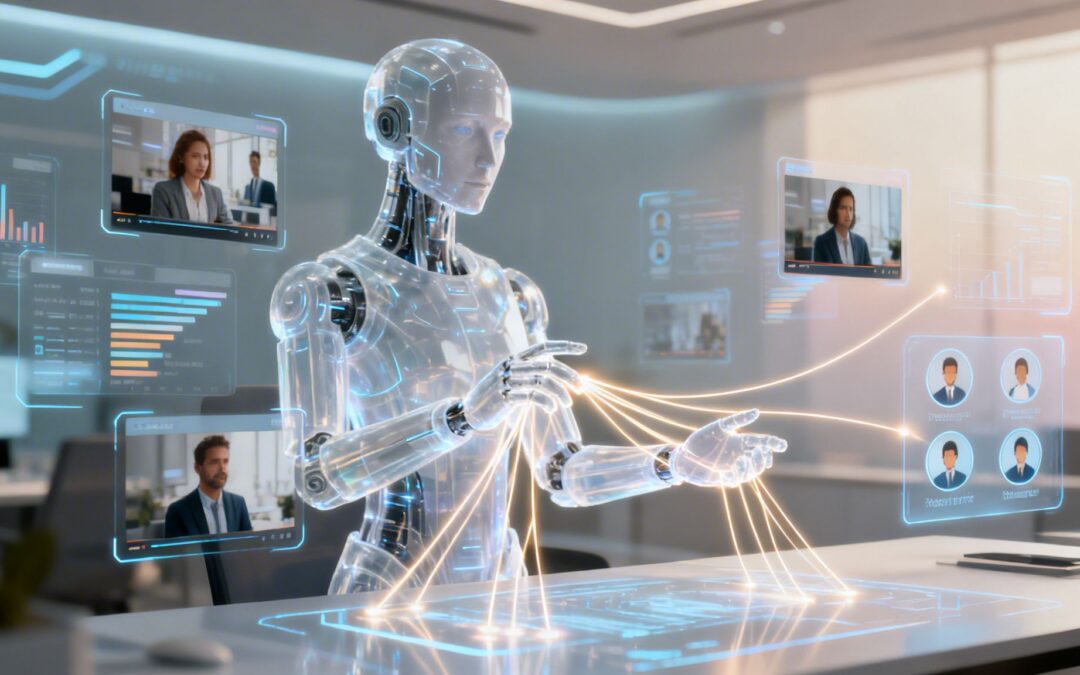
Imagine a video strategy that runs itself. Not just scheduling posts or sending pre-made clips, but an intelligent system that decides when to create a video, what story it should tell, and who needs to see it, right now. This is the new reality powered by Agents AI—autonomous systems that act as the operational layer behind always-on, automated video pipelines.
For marketing, growth, and sales teams, this marks a monumental shift: moving from manual execution to intelligent, self-managed video systems that drive results 24/7.
Beyond Simple Automation: The Rise of Intelligent Video Systems
For years, we’ve relied on automation to handle repetitive tasks. We set up email sequences, schedule social media updates, and trigger basic alerts. This is rule-based automation: a series of rigid, pre-programmed commands. It’s helpful, but it doesn’t think. It just follows instructions.
Agents AI represent a huge leap forward. Instead of just following a script, an AI agent perceives its environment (like your CRM or website data), makes a calculated decision based on a strategic goal, and then takes action on its own. It’s the difference between a simple “if this, then that” bot and a self-managing system that can trigger, generate, personalize, and distribute video content autonomously.

Why This Matters for Video
When you apply this intelligence to video, everything changes. Manual video production is slow, expensive, and a notorious bottleneck. Traditional automation can help distribute content, but it can’t touch the core creative and production process. AI agents bridge this gap, acting as intelligent producers who work around the clock.
This technology allows businesses to:
- Generate videos based on real-time data, like a new lead in your CRM or a sudden shift in customer behavior.
- Run autonomous video workflows, handling everything from scripting and visual selection to rendering and publishing.
- Deliver true personalization at scale, creating a unique, relevant video for every single viewer without manual intervention.
This isn’t just about making videos faster. It’s about building intelligent, self-sustaining video systems that drive business outcomes without constant human oversight.
By handing over the operational grind to AI agents, your team is freed up to focus on high-level strategy. These systems can autonomously repurpose content AI assets you already own, turning a single webinar into a month’s worth of targeted social clips. It’s the key to maintaining a constant flow of fresh, relevant content without burning out your team.
This guide will cut through the hype to show you how Agents AI are fundamentally changing the game for video, unlocking a new level of speed, relevance, and scale.
Understanding How Agents AI Work for Video
Let’s demystify what an AI agent is in the context of video creation. Forget abstract, technical definitions. The easiest way to understand it is by comparing it to the simple automation we already know.
Think of a traditional automation tool as a light switch. You set one rule—”if I flip this switch, the light turns on”—and it follows that command perfectly. It’s reliable but rigid. It can’t think for itself.
An AI agent, on the other hand, is like a smart home manager. It doesn’t just follow a single rule; it perceives its environment, makes an independent decision, and takes the best action. It knows who’s home, the time of day, and your past preferences to decide, “This person usually prefers dim, warm lighting around this time,” and adjusts the entire room on its own.

The Perceive-Decide-Act Loop for Video
This same logic makes agents so powerful for your video strategy. Agents AI operate in a continuous loop that completely redefines how video content is triggered, created, and delivered, separating them from basic bots.
This three-step process is the engine of an autonomous video pipeline:
- Perceive: The agent constantly monitors your connected data sources. It’s not waiting for a manual command. It’s looking for meaningful events—a high-value lead added to your CRM, a customer abandoning their cart, or a support ticket being resolved.
- Decide: Based on that trigger and the strategic goals you’ve set, the agent makes a judgment call. It determines that a personalized welcome video is the best next step for the new lead, or that a quick tutorial video would be most helpful for the customer with the closed support ticket.
- Act: The agent executes the entire video workflow from start to finish. It coordinates the script, pulls in customer data for personalization, selects brand assets, generates a voiceover, and renders the final video. Then, it distributes it through the most effective channel, whether that’s an email, an SMS, or a social media DM.
This isn’t a one-off event. It’s an always-on system where agents are constantly perceiving, deciding, and acting, running your video operations 24/7 without human intervention.
Traditional Automation vs Agents AI in Video
| Capability | Traditional Automation (Bots) | Agents AI (Intelligent Systems) |
|---|---|---|
| Triggering | Follows pre-set, rigid “if-then” rules. | Monitors data sources for meaningful events. |
| Decision-Making | Cannot make independent judgments. | Makes strategic decisions based on goals. |
| Adaptability | Fails or stops if a new variable appears. | Adapts to countless variables and real-time changes. |
| Workflow | Executes a single, pre-defined task. | Manages the entire end-to-end video workflow. |
| Outcome | Completes a command. | Achieves a strategic outcome (e.g., convert a lead). |
This table highlights the leap from simple instruction-following to genuine, goal-driven action.
From Static Rules to Dynamic Systems
The critical difference is autonomy. Traditional automation is built on static workflows that can’t adapt to new information. If a situation arises that falls outside your pre-set rules, the automation simply stops.
Agents AI, however, are designed for dynamic environments. They can handle countless variables because their purpose isn’t just to follow a rule—it’s to achieve an outcome. For marketing teams, this means building video systems that respond intelligently to customer behavior in real time. An AI video generator becomes the creative engine of an agent-driven strategy, producing the right content at the right moment.
This shift from rigid instructions to intelligent, goal-oriented actions enables AI agents to manage complex, scalable video communications that were simply impossible before. They are the operational layer that turns your video strategy into a living, breathing system.
The Autonomous Video Workflow in Action
Theory is one thing, but seeing AI agents in a real-world context is where their power clicks. Let’s move past the abstract and look at how these systems act as the engine behind smart, always-on video pipelines for business.
Picture an e-commerce platform where an AI agent constantly monitors user activity. It doesn’t just wait for a command. Instead, it notices a high-value shopping cart has been abandoned. A standard automation tool might send a generic “You left something behind!” email. An AI agent, however, does something far more effective.

From Trigger to Conversion: An E-commerce Scenario
The agent sees the abandoned cart as a critical business event. It decides the best response is a personalized video and gets to work immediately. Here’s how that autonomous workflow unfolds:
- Data Access: The agent instantly connects to the product database, grabbing images, descriptions, prices, and features for the exact items left in the cart.
- Asset Coordination: It then pulls necessary brand assets—logos, color palettes, and approved music—to ensure total brand consistency without manual effort.
- Dynamic Scripting: The agent writes a unique script for this specific customer. It might highlight scarcity (“Only 2 left in stock!”) or reference a related product the customer browsed earlier.
- Video Generation: Next, it assembles all these pieces into a polished video showing the customer exactly what they’re missing out on.
- Multi-Channel Deployment: Finally, the agent pushes this new video across the most effective channels, like a personalized email and a social media retargeting ad, all within minutes of the cart abandonment.
This entire process happens autonomously, turning a potential lost sale into a conversion with a speed and relevance that is impossible for a human team to match.
Proactive Engagement in a Sales Cycle
Now, let’s consider a B2B sales environment. An AI sales agent monitors your CRM and notices that a promising deal has gone quiet for several days after a product demo.
This is a critical moment where generic follow-ups often fall flat. An AI agent, however, can step in with a targeted intervention that feels personal and solves a problem for the prospect.
The agent analyzes the history of interactions—call notes, emails, and demo feedback. It identifies a likely point of confusion, perhaps around a complex feature. Armed with this insight, the agent decides to create a custom video. It generates a short, clear tutorial that directly addresses the prospect’s concern, perhaps showing that specific feature in action. The agent then sends this video to the prospect with a personalized message, re-engaging them with valuable content at the perfect moment.
For teams looking to build these kinds of systems, exploring no-code video automation platforms is the key to connecting data sources to a powerful video generation engine.
These scenarios showcase a complete, end-to-end system where agents own the entire video lifecycle. This is what’s driving projections that the AI agents market could swell to $236 billion by 2034, unlocking trillions in productivity. This growth is centered on agents that can autonomously handle complex tasks, and it’s fundamentally reshaping how business gets done. These intelligent systems are turning video from a production bottleneck into a powerful strategic advantage.
Achieving True Video Personalization at Scale
Personalization has long been the holy grail for marketers, but with video, it always seemed blocked by impossible production demands. That era is over. AI agents finally move us beyond basic ‘mail merge’ tactics—like just slapping a prospect’s name onto a generic video.
We’re now talking about deep, contextual personalization that makes each viewer feel the video was created just for them. This is where an AI agent acts as both a smart data interpreter and a creative director, all in one.

Beyond The First Name Field
Real personalization is powered by data, and AI agents are built to use it intelligently. They connect directly to the heart of your business—your CRM, website analytics, and purchase history—to understand each person on a much deeper level.
Imagine an AI agent working for a travel company. It doesn’t just send out a generic promo. Instead, it analyzes a user’s browsing history and generates a unique video showcasing the exact destinations they viewed. It even includes flight details from their nearest airport and suggests activities based on past bookings. This level of detail transforms video from a one-to-many broadcast into a true one-to-one conversation.
How Agents Make Hyper-Personalization Happen
The magic happens when an agent autonomously coordinates the entire creative process using individual data points, smashing the production bottlenecks that once made this impossible.
Here’s a look at the workflow:
- Spotting the Trigger: An agent detects an event, like a customer hitting a loyalty milestone or a prospect viewing your pricing page for the third time.
- Pulling the Data: It instantly grabs all relevant info—the customer’s name, their loyalty status, the product they’re eyeing, and their company logo from your CRM.
- Assembling the Assets: The agent then selects the right video template, inserts personalized text, chooses imagery that matches their interest, and generates a custom voiceover.
- Generating and Delivering: The final, completely unique video is rendered and sent in real-time through the most effective channel, all without human intervention.
This process ensures every video isn’t just personalized by name, but is contextually relevant to that individual’s specific journey and needs, right now.
The Tangible Business Impact
This shift from mass communication to mass personalization directly moves the needle on key business metrics. When a video feels like it was made just for one person, it grabs attention and drives action.
The results are consistently powerful:
- Skyrocketing Engagement: Personalized videos see dramatically higher watch times and click-through rates because the content is directly relevant.
- Higher Conversion Rates: By speaking to a specific need or interest, these videos are far more effective at guiding viewers to the next step, whether that’s booking a demo or making a purchase.
- Stronger Customer Loyalty: Customers feel seen and valued when communications acknowledge their history with your brand, building long-term loyalty.
Ultimately, AI agents make it possible to deliver a bespoke experience to every customer, turning video into your most powerful relationship-building tool. Exploring the core concepts of a personalized video strategy provides a deeper look into bringing this data-driven content to life.
How to Build Your Agent-Powered Video Strategy
Shifting to an agent-driven approach is a change in mindset. You’re moving from planning individual video campaigns to designing an intelligent, self-managing video system where AI agents can perceive, decide, and act for you.
Getting started boils down to three key steps: connecting your data, setting clear objectives, and leveraging a powerful generation engine to bring it all to life.
Connect Your Key Data Sources
Your video agents are only as smart as the data they can access. The first step is to plug in the platforms that hold your most valuable customer information. Think of this data as the sensory input your agents will use to understand when and how to act.
Essential connections include:
- Customer Relationship Management (CRM): This gives agents context on lead status, interaction history, and deal value.
- Analytics Platforms: Website behavior, like pages viewed or time on site, provides insight into a user’s interests.
- Product or Service Databases: This allows agents to pull specific product images, descriptions, and pricing to personalize videos on the fly.
Define Triggers and Goals
Once your agents are connected to data, you need to tell them what a “win” looks like. Instead of writing rigid “if this, then that” rules, you define strategic goals and the trigger events that should kick off an agent’s workflow.
For example, a goal might be to “re-engage stalled leads.” The trigger could be “a deal in the CRM has had zero activity for seven days.” The agent then has the autonomy to figure out the best video to create and send to achieve that goal.
This is what makes it so different. You’re not micromanaging every step; you’re delegating the outcome.
An agent-powered strategy is less about programming a sequence of tasks and more about empowering an intelligent system with the context and objectives it needs to operate autonomously.
Leverage a Video Generation Engine
The final piece is the engine that actually creates the video content. This is where specialized platforms for AI-powered video automation are essential. These platforms act as the operational hub, connecting your data sources and triggers to a scalable video rendering system. When figuring out how to build your agent-powered video strategy, checking out available tools like lunabloomai’s AI-powered app can offer practical ideas.
This technology makes it possible to deploy autonomous video systems without a team of developers. Platforms like Wideo’s Video Automation provide the ready-made infrastructure for marketing and sales teams to design and launch agent-driven workflows through a simple interface. The global AI agents market is projected to skyrocket to USD 182.97 billion by 2033, a surge driven by the demand for hyper-personalized customer experiences. Read the full research about the AI agents market. This highlights the major shift toward autonomous systems that can manage complex tasks, with video communication at the center.
Gaining Your Next Competitive Edge
The arrival of AI Agents isn’t just another tool for your tech stack. It’s a fundamental change in how businesses operate and communicate. For years, the advantage in video came from having the resources for high-quality production. That’s no longer the only factor.
Today, the real edge comes from deploying smart systems that deliver the right video, to the right person, at the right time—autonomously.
This is the new moat. Businesses that embrace this shift will build a serious advantage. They won’t just be making videos; they’ll be running intelligent, always-on video pipelines that communicate with a speed and relevance that manual processes can’t match. While competitors are stuck in campaign-based production cycles, your video strategy will be running itself, engaging customers and driving revenue 24/7.
From Manual Execution to Intelligent Operation
Think about the operational drag that slows down your video output: scripting, asset gathering, editing, and scheduling. It’s a massive bottleneck that prevents you from communicating as quickly and effectively as you want.
AI Agents eliminate these barriers. They transform your video function from a cost center focused on production into a strategic engine for growth.
The big idea is to stop managing individual videos and start managing an intelligent system that can:
- Anticipate customer needs based on real-time behavior.
- Generate personalized content for thousands of unique customer journeys.
- Adapt its strategy without constant human intervention.
This operational freedom lets your team focus on high-level strategy, leaving the day-to-day tactical work to your autonomous agents.
The future of business communication is autonomous. It’s no longer about who can create the most videos, but who can build the smartest system to generate and deploy them.
Your Engine for Growth and Engagement
When you get down to it, the most powerful and practical outcome of using AI agents in business is the ability to run a fully automated video strategy.
By using a platform built specifically for AI-powered video automation, you give your agents the operational backbone they need to get the job done. Seeing how platforms like Wideo’s Video Automation connect data to a dynamic video generation engine is the clearest way to grasp this potential.
This isn’t about replacing human creativity; it’s about amplifying it. By building an autonomous video engine, you’re not just saving time—you’re creating a scalable system for growth, sales, and customer engagement that works for you around the clock. The future is already here, and it’s running on its own.
Frequently Asked Questions About Agents AI
As teams consider bringing autonomous video systems into their workflow, a few common questions arise. Here are clear, practical answers for marketing, sales, and content teams looking to put agents AI to work.
How Are Agents AI Different From Marketing Automation?
Think of standard marketing automation as a set of rigid, pre-programmed instructions. It’s all about ‘if-then’ rules you set up manually, like “if a user downloads an ebook, then send email A.” It’s a fixed path that can’t think for itself or adapt.
Agents AI, on the other hand, are autonomous and goal-oriented. They don’t just follow a script; they analyze complex situations and make their own decisions. An agent might see a high-value lead has gone quiet, analyze their browsing behavior, decide a video showcasing a particular feature is the best move, and then create and send it—all without a pre-written rule for that exact scenario. The big shift is from simply following commands to actively achieving outcomes.
Do I Need an Engineering Team to Use Agents AI for Video?
Not anymore. While the underlying technology is advanced, modern platforms have made it accessible for non-technical teams. The key is a solution that serves as the operational layer—the bridge connecting your data sources (like a CRM) to a powerful video generation engine.
These platforms let marketing and sales teams set goals and define triggers for their agents through a simple interface. This means you can design and manage autonomous video workflows without writing a line of code, removing the traditional engineering barrier. The focus shifts from technical development to strategic implementation.
What Is a Good First Step to Get Started?
Start with a high-impact project that has clear data and a measurable goal. Don’t try to boil the ocean. Pick a defined workflow where you can easily prove the ROI.
A few great places to begin are:
- E-commerce: Automating abandoned cart recovery by sending personalized product videos.
- Sales: Instantly creating customized follow-up videos for new leads as they hit your CRM.
- Customer Success: Generating personalized onboarding videos for new customers.
Each of these has an obvious data trigger (like a cart status change or a new contact) and a direct link to revenue or retention. By starting small, you can connect your data, configure your first agent, and demonstrate its value before scaling up to more advanced autonomous systems.
To see how these autonomous systems come to life, explore how Wideo’s platform provides the operational backbone for intelligent video workflows. Learn more about our AI-powered Video Automation.
Related posts:
 How AI Assistants Accelerate Team Video Creation
 Unlocking Your Business With Key AI Capabilities
 12 Practical AI Use Cases for Video Automation in 2025
 Conquer ai challenges: Practical strategies to overcome common hurdles
 Ai breakthroughs: How ai breakthroughs reshape video marketing
 AI for Video: The Ultimate Guide for Modern Marketing Teams


