
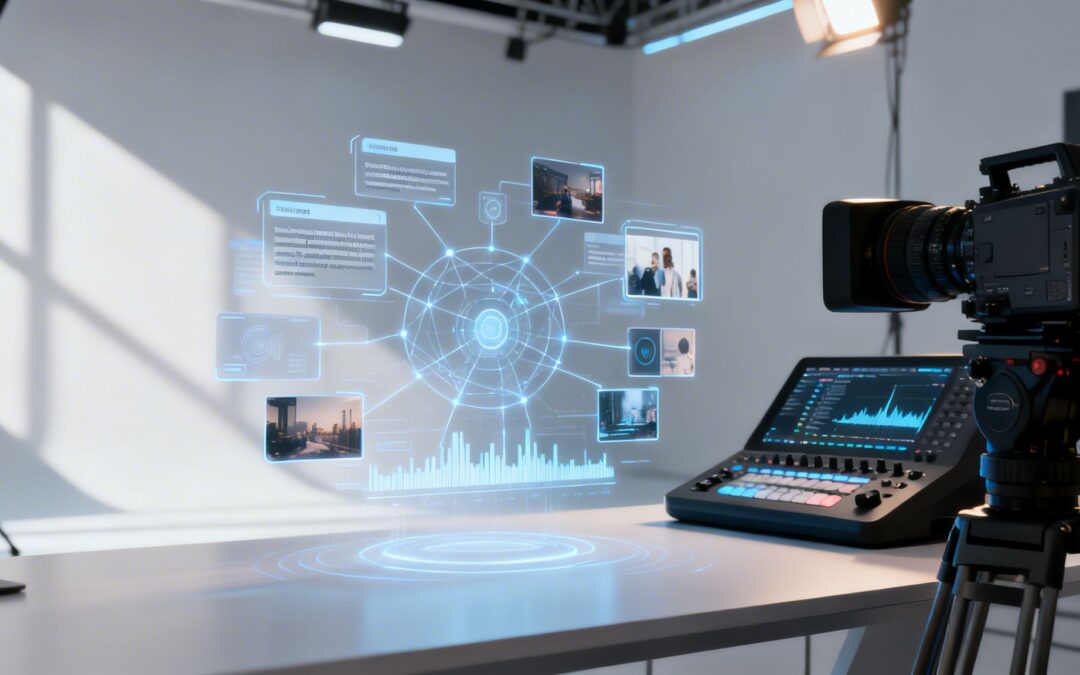
If you’ve heard the term multimodal AI, you might think it’s just another piece of complex tech jargon. But the idea behind it is simple and powerful: it’s about AI systems that connect text, images, video, and data to produce a single, cohesive piece of content. And when it comes to business communication, the ultimate output for this connected intelligence is video.
For marketing, growth, and content teams, this isn’t just an incremental improvement. It’s a fundamental shift from using disconnected, single-task tools to leveraging end-to-end systems that make video creation faster, more contextual, and massively scalable.
From Disconnected Tools to a Unified Video Workflow
Think about the traditional video production process. It’s a clumsy relay race. A script is written in one tool, visuals are sourced from another, data is visualized in a third, and an editor painstakingly stitches it all together. Each step is a silo, creating friction, miscommunication, and delays that make scaling video content nearly impossible.
This fragmented workflow forced teams into a corner, making them choose between speed, quality, and cost. The problem was simple: the tools weren’t smart enough to understand the full story. A text generator didn’t know what the visuals should look like, and a stock photo site had no concept of the narrative. This is the chaos that multimodal AI is designed to solve.

Connecting the Dots for Cohesive Storytelling
Instead of being a collection of separate tools, a multimodal AI system acts as a central director for your video content. It understands the relationship between different types of information, allowing it to drive the entire creation process from a single prompt or document.
This unified system can:
- Understand a Script: It doesn’t just read words; it grasps the intent, tone, and key messages in a blog post, whitepaper, or prompt.
- Select Contextual Visuals: It analyzes the script to find or generate images and video clips that match the narrative’s mood and meaning.
- Visualize Data: It can identify key figures in your text—like “a 30% increase”—and automatically turn them into animated charts or on-screen graphics.
- Generate Audio: It produces a professional voiceover and selects background music that aligns with the video’s tone.
By weaving these elements together automatically, multimodal AI eliminates the manual work that slows production to a crawl. It’s a shift from assembling assets to generating a complete, ready-to-publish video from a unified set of instructions.
Bridging the Gap Between Idea and Final Cut
This integrated approach removes the biggest bottleneck in content creation: the painful gap between a good idea and a finished video. An idea that starts as a simple text document can become a polished video in minutes, not weeks. The system handles the technical lift, freeing your team to focus on strategy and creativity.
Multimodal AI acts as a central hub for video creation, connecting disparate assets like text documents, brand visuals, and performance data to produce a single, polished video. This shift bridges the gap between raw information and engaging communication.
For marketing and growth teams, this means you can finally achieve the speed and scale that modern channels demand. Turning a dense report into a quick explainer video, a customer case study into a social media clip, or sales data into a weekly video update is no longer a major project—it’s an efficient, repeatable workflow.
How Multimodal AI Transforms Your Video Production
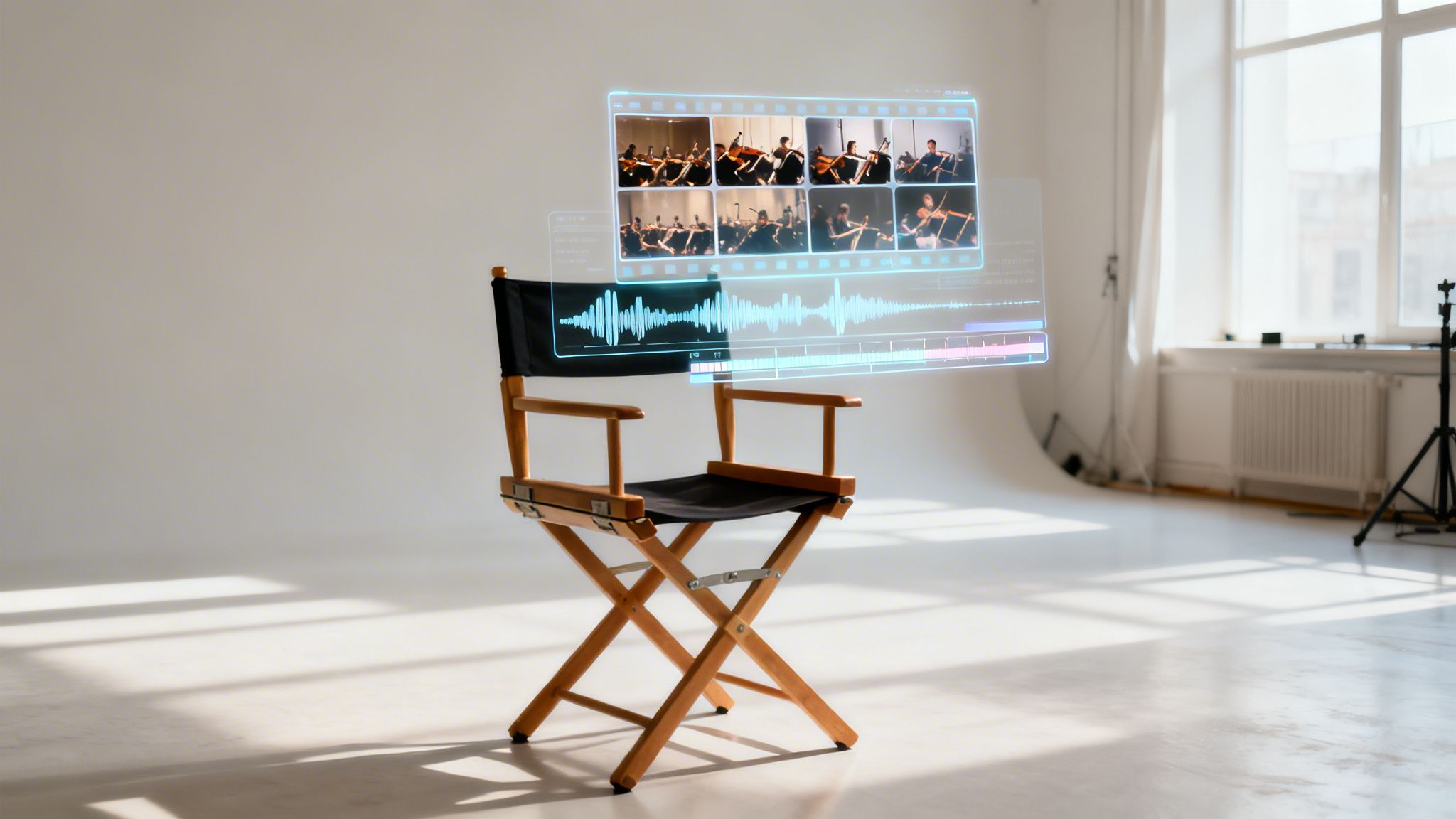
Imagine a single expert director who can read a script, visualize the scenes, hear the soundtrack, and animate data points—all at once. That’s how multimodal AI functions. It doesn’t just follow a list of commands; it understands the context that connects every word, image, and sound to tell a cohesive story.
This eliminates the endless back-and-forth between writers, designers, and editors, creating a seamless flow from raw inputs to a finished video.
From a Simple Prompt to a Complete Video
The magic of multimodal AI is its ability to translate one type of information into another. The process often starts with a single piece of text—a blog post, a script, or even a short prompt.
From that starting point, the AI orchestrates the entire production:
- Builds the Storyboard: The system analyzes the text and breaks it into logical scenes, creating a visual storyboard for the video.
- Sources Relevant Visuals: For each scene, it selects contextually appropriate visuals from stock libraries, your brand’s asset collection, or by generating new AI images. It knows why a certain visual fits the script’s message.
- Animates Key Data: If your script mentions “sales grew by 25%,” the AI recognizes that as a data point and automatically creates an animated chart or kinetic text to make it visually engaging.
- Adds Voice and Music: Finally, it generates a human-like voiceover to narrate the script and adds background music that matches the video’s intended mood.
This entire process transforms a static document into a dynamic video narrative in a fraction of the time it would take a human team. This is the core of modern video automation, driven by multimodal intelligence.
The table below highlights the shift from disconnected, single-purpose AI tools to an integrated multimodal system for video.
Single-Input AI vs. Multimodal AI for Video Creation
| Capability | Single-Input AI (The Old Way) | Multimodal AI (The New Way) |
|---|---|---|
| Scripting | Generates text, but disconnected from visuals. | Writes a script and simultaneously plans the visual scenes. |
| Visual Selection | Searches for images based on keywords. | Selects visuals based on the script’s emotional tone and context. |
| Data Visualization | Requires a separate tool to create charts. | Automatically generates animated graphics from data in the text. |
| Workflow | Juggling multiple separate tools for each task. | A single, unified process from concept to final video. |
| Final Output | A collection of assets that need manual assembly. | A cohesive, fully-edited video ready for review. |
As you can see, the multimodal approach isn’t just a minor improvement; it’s a completely new way of thinking about video creation.
Augmenting Creativity, Not Replacing It
A common fear is that this level of automation will make creative professionals obsolete. The reality is the opposite. By handling the tedious, repetitive tasks of video production, multimodal AI empowers your team to focus on what humans excel at: high-level strategy, creative direction, and compelling storytelling.
Multimodal AI doesn’t just follow instructions; it interprets intent. It connects a line in a script to the perfect visual, a data point in a report to a clear on-screen graphic, and a brand guideline to the final color grade—all within a single, unified workflow.
Instead of spending hours searching for stock footage or manually timing animations, your team can focus on refining the narrative and planning ambitious campaigns. It makes complex goals—like applying webinar content repurposing strategies to generate dozens of video assets from a single event—achievable for any team, regardless of size.
Practical Video Use Cases for Multimodal AI
The true value of any technology is what you can do with it. For teams in marketing, sales, and internal communications, multimodal AI bridges the gap between the information you have and the engaging videos you need. It allows you to finally turn existing assets—documents, data, and simple ideas—into compelling video content at scale.
Here are some real-world, video-centric examples of how businesses are using multimodal AI today.
For Marketing: Turning Blog Posts into Video Campaigns
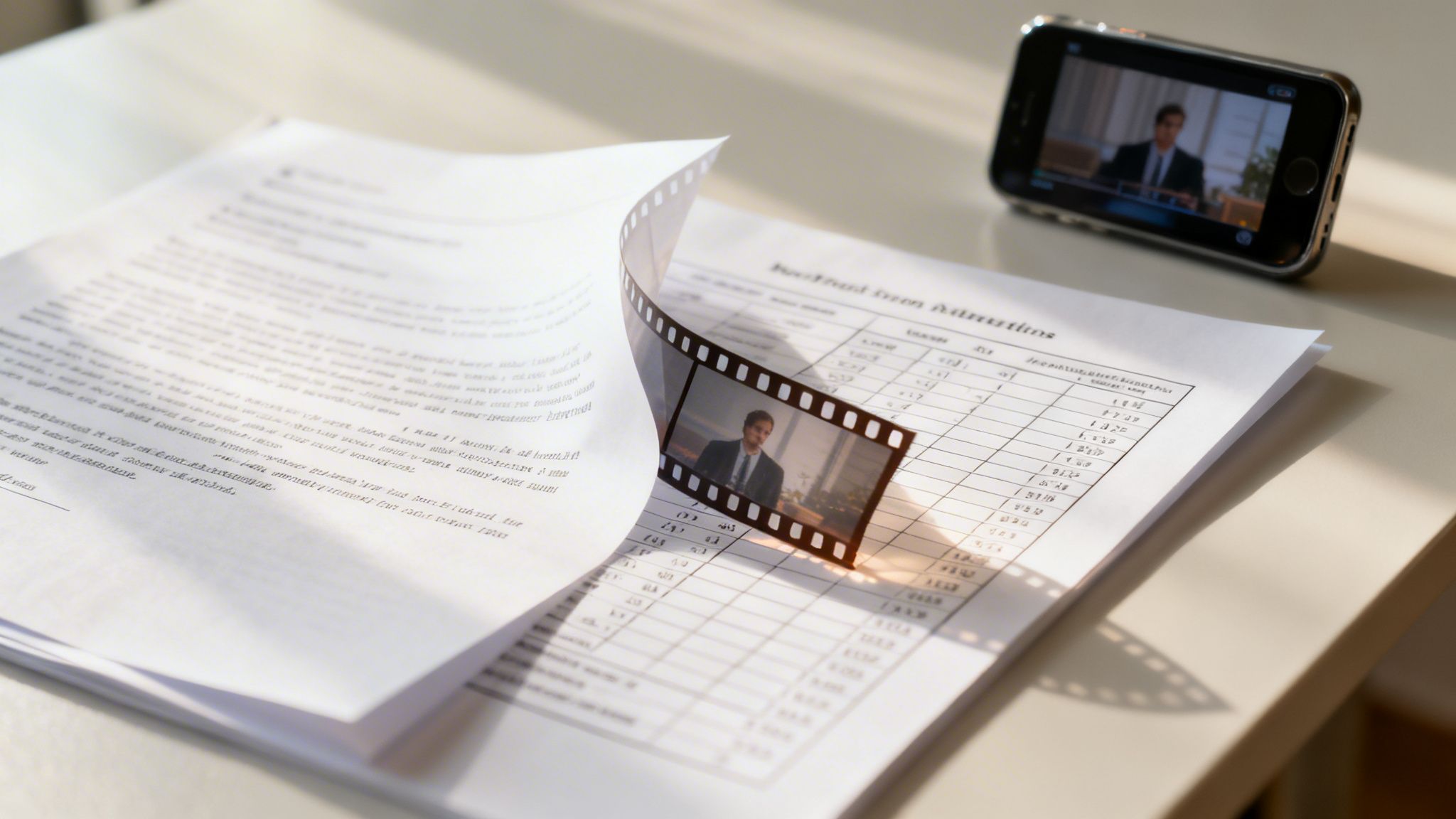
Your content team just published a brilliant, in-depth article. In the past, turning that asset into a video was a separate, time-consuming project. With multimodal AI, the article itself becomes the seed for an entire video campaign.
The process is seamless:
- Input the Article: The AI reads the entire text, understanding its structure, key arguments, and data points.
- Generate a Video Script: It automatically summarizes the core message into a concise script, broken down into scenes.
- Create Visuals and Narration: The system populates each scene with relevant stock footage, custom animations, on-brand graphics, and a professional voiceover.
- Produce Multiple Formats: From that single article, it can generate a 2-minute explainer for your website, a 30-second trailer for LinkedIn, and a series of 15-second clips for Instagram Stories—all aligned with the same core message.
This isn’t just about saving time. It’s about maximizing the ROI of your content by effortlessly repurposing it for video-first channels. This ability to transform text into visual stories is a key feature of modern AI Video Generator tools.
For Sales: Scaling Personalized Video Outreach
Imagine your sales reps sending every high-value prospect a custom video that speaks directly to their needs, instead of a generic PDF. Manually, this is impossible. Multimodal AI makes it scalable by connecting to your data.
A multimodal system can pull information from your CRM, including:
- The prospect’s name and company.
- The specific products they are interested in.
- Key pain points relevant to their industry.
The AI merges this data with a pre-approved video template, instantly generating a unique video for each prospect. This allows a single sales rep to create dozens of personalized videos in the time it once took to draft a few emails.
For Onboarding and Training: From Manuals to Engaging Videos
Let’s be honest: dense onboarding manuals and text-heavy training documents rarely get read. Multimodal AI helps HR and internal communications teams solve this by transforming those documents into engaging video series.
By interpreting a document’s content, identifying key themes, and matching them with appropriate visuals and narration, multimodal AI turns passive information into an active learning experience. This is crucial for making complex topics like company policies or software training clear and memorable.
Instead of a 50-page handbook, a new hire receives a playlist of short, digestible videos covering everything from company culture to software setup. Similarly, an internal comms team can turn a weekly email update into a quick 2-minute video recap, ensuring important news is actually seen and retained. For a deeper dive, learn how to convert text to video using these modern tools.
These examples show how multimodal AI tears down the walls between your raw information and the finished video, empowering every team to become a video creator.
Why Video Is the Ultimate Output for Multimodal AI
While multimodal AI can generate text or images, its full potential is realized when the output is video. Why? Because video is inherently multimodal. It’s the only medium that natively combines visuals, audio, text, and motion into a single, powerful format.
This makes video the most complete and effective way for a multimodal AI to communicate its rich, layered understanding of information.
Other AI outputs are just pieces of the puzzle. An AI-generated image is a static moment. An AI-written document lacks visual impact. A video, however, tells a complete story. It’s the natural destination for an AI that processes words, images, and data simultaneously. This synergy delivers four key benefits for business teams: clarity, speed, personalization, and scalability.
Unmatched Clarity and Impact
Complex ideas are hard to explain with text alone. Trying to describe a new software feature or break down quarterly financial results in an email is often ineffective. People skim, misunderstand, or lose interest.
Multimodal AI cuts through the clutter by translating complexity into clarity. It can analyze a dense data report, summarize the key findings (text), and instantly generate an animated chart (visuals) with a clear voiceover (audio). An abstract concept becomes something your audience can see, hear, and understand in seconds.
Video is the language of clarity. By translating abstract data and dense text into moving visuals, multimodal AI ensures your message isn’t just delivered—it’s understood. This dramatically boosts comprehension and retention.
Production Speed That Finally Scales
The biggest obstacle to creating more video has always been time. Traditional production is a slow, manual process that can take weeks. Multimodal AI demolishes that timeline, reducing it from weeks to minutes.
Because the AI manages the entire workflow—from scripting and asset sourcing to editing—it removes the human bottlenecks that slow things down. You can generate a first draft of a promotional video from a product description before your coffee gets cold. This speed allows your team to be more agile, reacting to market trends and meeting the relentless demand for video content.
The market is taking notice. The global multimodal AI market is projected to surge from $2.51 billion in 2025 to over $42.38 billion by 2034, largely driven by its application in content creation. You can explore the full research on this market’s growth to understand its business impact.
Personalization at an Unprecedented Scale
Personalization is the gold standard in marketing, but personalizing video has always been too costly and time-consuming to be practical. Multimodal AI changes the game.
By connecting to data sources like a CRM or product catalog, a multimodal system can automatically generate thousands of unique video variations tailored to individual viewers.
- For Sales: Create custom video proposals that include a prospect’s name, company, and specific pain points.
- For E-commerce: Generate product videos that highlight features based on a user’s browsing history.
- For Customer Success: Send personalized onboarding videos that guide new users through the exact features they need.
This level of customization was once a fantasy. Now, it’s an automated workflow. This is where a platform that offers multimodal AI for video creation truly shines, and tools like Wideo’s AI Video Generator make it accessible to any team. Multimodal AI doesn’t just make video creation easier; it solidifies video as the most powerful and scalable way for any business to communicate.
Maintaining Brand Consistency Across All Videos
As you scale video creation, a new challenge emerges: maintaining brand consistency. When multiple teams or individuals create content, it’s easy for logos, colors, and tone of voice to drift, creating a fragmented brand experience. This is a problem that multimodal AI is uniquely equipped to solve.
Instead of producing generic content, advanced multimodal systems can be trained on your specific brand guidelines. Think of it as giving the AI your company’s brand book, which it uses to ensure every video is perfectly aligned.
Embedding Your Brand DNA into the AI
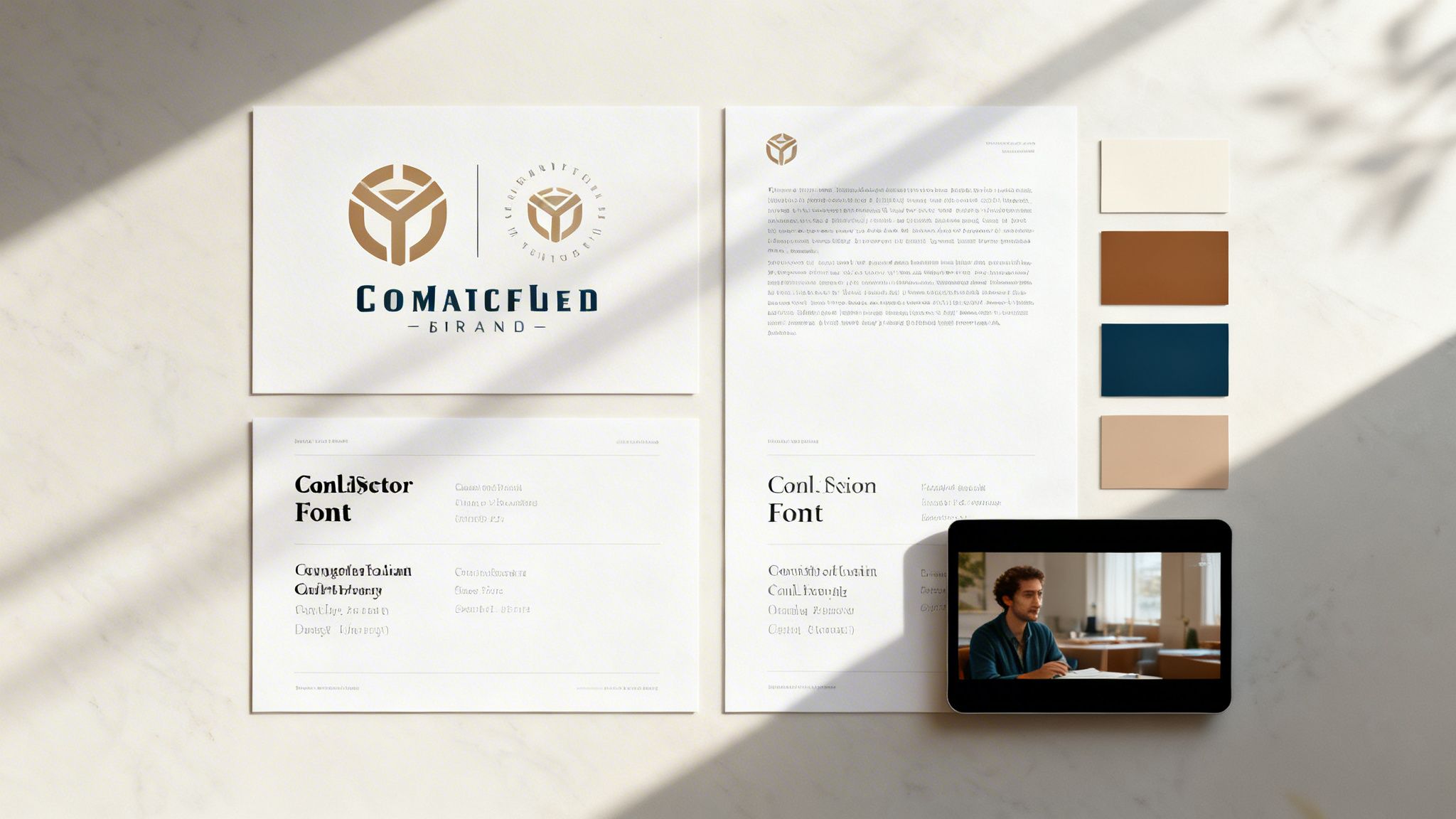
A multimodal system learns and internalizes every aspect of your brand identity, acting as a guardian of your visual and tonal consistency. You can train it to understand and apply:
- Visual Elements: Your logos, color palettes (down to the hex codes), approved fonts, and graphic styles.
- Tone of Voice: By analyzing your existing marketing copy and scripts, the AI learns to write in your brand’s personality—whether it’s formal, playful, or inspiring.
- Asset Libraries: You can provide a library of approved product images, team headshots, or custom icons, ensuring the AI always uses on-brand visuals.
Once trained, the AI doesn’t just create a video; it creates your video, perfectly reflecting your brand guidelines every time.
Consistent Video Storytelling on Every Channel
With a brand-aware multimodal AI, consistency is no longer a manual review process—it’s an automated outcome. This has a profound impact on your content strategy.
Whether your team is creating a social media ad, an internal training module, or a customer update, the AI ensures every video reinforces a cohesive brand story. This builds trust and recognition with your audience, no matter where they encounter your content.
Multimodal AI acts as a centralized brand steward for video creation. By embedding your unique guidelines into the generation process, it eliminates guesswork and deviation, ensuring every video asset reinforces a cohesive brand identity.
This automated consistency frees your marketing team from policing content. The endless back-and-forth over minor brand deviations disappears, drastically shortening production timelines and allowing your team to focus on more strategic work.
Empowering Your Entire Organization to Create On-Brand Video
Perhaps the greatest benefit is the democratization of on-brand video creation. You no longer need to rely on a small, over-stretched video team to produce compliant content.
Platforms built for multimodal AI for video creation, such as Wideo’s AI Video Generator, put this power into the hands of your entire organization. Your sales team can generate on-brand video proposals. Your HR department can create consistent onboarding materials. Your product team can produce feature updates that look and feel right, every time.
This transforms video from a specialized, bottlenecked function into a scalable communication tool for the entire business—all while keeping your brand’s integrity perfectly intact.
Your Questions About Multimodal AI for Video, Answered
As multimodal AI reshapes video creation, practical questions naturally arise. Here, we tackle the most common questions from marketing, growth, and content teams, focusing on what this technology means for your daily workflows.
Will multimodal AI replace our creative video teams?
No. Think of multimodal AI as a powerful creative collaborator, not a replacement. It excels at automating the repetitive, time-consuming tasks that bog down production, like finding stock footage, creating initial drafts, or syncing animations.
This automation frees your creative professionals to focus on high-value work: developing strategy, crafting compelling narratives, and dreaming up unique concepts that connect with your audience. The AI handles the “how,” so your team can elevate the “why” and “what” of your video content.
How can a small business start using multimodal AI for video?
Getting started is simpler than you might think. You don’t need a team of AI experts. The easiest entry point is a user-friendly platform with built-in multimodal AI capabilities.
Look for tools that offer intuitive features like text-to-video or article-to-video conversion. To get a quick win:
- Start with a Clear Use Case: Begin with something specific, like turning your most popular blog post into a short video for social media.
- Choose an Accessible Platform: Opt for a tool designed for business users, not AI researchers. The goal is to create content efficiently.
- Measure the Impact: Track engagement on the videos you create to demonstrate ROI without a major upfront investment.
Is multimodal AI only for marketing videos?
While marketing is a natural fit, the benefits of multimodal AI extend across the entire organization. Any department that needs to communicate complex information clearly and efficiently can benefit from turning its existing documents and data into video.
Consider these use cases:
- Human Resources: Transform dense employee handbooks into engaging video modules for new hire onboarding.
- Sales Teams: Create personalized video proposals on the fly by merging CRM data with pre-approved templates.
- Internal Communications: Turn weekly text updates or announcements into quick, digestible video summaries for the entire company.
What’s the real difference between text-to-video and multimodal AI?
This is a key distinction. A basic text-to-video tool performs a single function: it converts a script into a sequence of visuals, often with little understanding of the context. It’s a simple assembly line.
A true multimodal AI system operates on a much deeper level. It understands and connects multiple types of input simultaneously—text, images, data, and brand guidelines—to generate a cohesive output.
Think of it like this: a text-to-video tool is a teleprompter, simply displaying words on screen with generic visuals. A multimodal AI is a director—interpreting the script’s intent, selecting the right visuals to evoke emotion, designing the scene, and ensuring the final product tells a powerful story.
For example, a multimodal platform can analyze a financial report (data), understand the summary (text), and select visuals that match the tone of the analysis, all while applying your brand’s specific colors and fonts. It’s the difference between a simple converter and an intelligent creative partner.
Ready to see how a true multimodal system can transform your video workflow? Wideo’s platform makes it simple to turn your ideas, documents, and data into professional, on-brand videos at scale.
Explore Wideo’s AI Video Generator and start creating more impactful video content today.
Related posts:
 From Manual Handoffs to Automated Video: A Practical Guide to AI Workflows
 Beyond Dashboards: A New Way to Compare AI Platforms for Scalable Communication
 The New Face of Conversational AI: Why Video is the Voice of the Future
 How AI Assistants Accelerate Team Video Creation
 Unlocking Your Business With Key AI Capabilities
 How AI Video Automation Can Scale Your Marketing Strategy (Without Losing the Human Touch)


