

What Is AI Ethics and Why It Matters Now

Imagine bringing on a new team member who can analyze mountains of data, whip up creative content, and handle complex jobs faster than anyone else. That’s AI. But just like any new hire, you can’t just turn it loose without any direction. It needs to understand the rules, or it’s bound to make mistakes, misinterpret things, or create real problems.
That direction? That’s AI ethics. It’s the moral compass we build into these systems to ensure they operate in ways that are fair, safe, and aligned with what we actually value as humans. This isn’t some lofty philosophical debate anymore; it’s a practical must-have for anyone using AI, especially in marketing and video creation where your audience’s trust is your most valuable asset.
The Urgency Is Growing
The reason everyone’s talking about AI ethics now is that this tech has officially left the lab. It’s in the wild, shaping everything from the ads we see and the news we read to the videos that fill our feeds. As AI’s footprint gets bigger, so does its potential to do both a lot of good and a lot of harm.
This shift hasn’t gone unnoticed. Consumers and lawmakers are paying close attention. According to the 2025 Stanford AI Index Report, legislative mentions of AI shot up by 21.3% across 75 countries since 2023. That represents a staggering ninefold increase since 2016 and signals a clear global demand for accountability.
For creators, the writing is on the wall. Ethical AI is no longer a “nice-to-have.” It’s becoming a “must-have.” Winging it without an ethical framework isn’t just a social risk—it’s fast becoming a major business and legal liability.
Why Creators Must Pay Attention
Ignoring AI ethics is like building a skyscraper on a shaky foundation. It might look fine for a while, but eventually, the cracks will show. For marketers and video producers, those cracks can look like this:
- Eroding Audience Trust: The moment your audience thinks your AI-powered content is manipulative, biased, or just plain fake, you’ve lost them. Credibility is hard to win and easy to lose.
- Legal and Compliance Risks: New rules are popping up everywhere. Getting caught on the wrong side of them could mean steep fines and a PR nightmare.
- Amplifying Harmful Biases: If an AI model is trained on biased data, it will produce biased content. It’s that simple. This can lead to work that’s unfair, offensive, or just plain wrong.
At the end of the day, getting a handle on AI ethics is about future-proofing your work. It’s what will allow you to keep using these amazing tools to innovate and connect with people in a way that’s sustainable, responsible, and worthy of their trust.
The Core Principles of Ethical AI Explained

To really put AI ethics into practice, we have to move beyond fuzzy ideas and into a solid framework. Think of it as the playbook for responsible creation. At its core, ethical AI rests on four pillars that should guide every decision you make when firing up these powerful tools.
Getting a handle on these principles isn’t just about dodging legal bullets; it’s about building a creative process that your audience will actually respect and trust. Each one tackles a specific risk and offers a clear path toward using AI more responsibly and, frankly, more effectively.
Here’s a quick rundown of what these principles mean in the real world for creators like us.
The Four Pillars of AI Ethics
| Principle | What It Means | Why It Matters for Creators |
|---|---|---|
| Transparency | Being able to explain how an AI model works and why it produced a specific result. No “black boxes.” | Builds audience trust by being upfront about AI use. It also helps you troubleshoot when an AI gives you bizarre or off-brand results. |
| Fairness | Actively working to find and fix biases in AI systems to ensure they don’t discriminate against individuals or groups. | Prevents your content and campaigns from accidentally reinforcing harmful stereotypes or excluding entire demographics from your audience. |
| Accountability | Keeping humans in charge. This means having clear responsibility for AI outputs and never letting the tool make final decisions on its own. | You—the human—are ultimately responsible for what you publish. This pillar ensures you maintain creative control and catch errors before they go live. |
| Privacy & Security | Respecting user data by protecting it, using it with consent, and being clear about how AI tools process personal information. | This is non-negotiable. It protects your audience’s fundamental rights and keeps you clear of massive legal penalties from regulations like GDPR. |
By keeping these four pillars in mind, you’re not just checking a box for compliance. You’re building a more sustainable, trustworthy, and impactful creative process. Let’s dig a little deeper into each one.
Pillar 1: Transparency
Transparency in AI is pretty simple: it means being able to explain how the tool works and how it landed on a particular suggestion or output. For us as creators, this means refusing to treat AI as a mysterious black box that just spits out content for no apparent reason.
Imagine an AI tool suggests a headline for your next video. A transparent approach means you should have some idea of why. Was it based on top-performing videos in your niche? Demographic data? SEO keywords? When you can understand the “why” behind an AI’s output, you stay in control and can make sure its work actually fits your strategy.
This principle is also about being straight with your audience. Simply labeling AI-generated or AI-assisted content builds trust and sets the right expectations, which is a lot better than having viewers feel like they’ve been tricked.
Pillar 2: Fairness
Fairness is probably one of the most critical—and trickiest—parts of AI ethics. AI models learn from the data we feed them. If that data is full of historical or societal biases, the AI will not only learn them but can actually make them worse. This can have some seriously ugly consequences.
For a marketer, a biased AI might decide to show a job ad only to one demographic, unfairly cutting out qualified candidates from others. In video, an AI image generator trained on a non-diverse dataset might spit out scenes or characters that reinforce damaging stereotypes.
The whole point of fairness is to actively hunt down and correct these biases. It involves taking a hard look at the data used to train AI models and auditing their outputs to make sure they treat everyone equitably.
This proactive mindset ensures your creative work is inclusive and doesn’t accidentally become part of the problem.
Pillar 3: Accountability and Human Oversight
So, who gets the blame when an AI messes up? The principle of accountability is clear: humans must always stay in the driver’s seat. It’s about setting up clear lines of responsibility for the AI tools you use and the content you publish.
Blindly trusting an AI’s output without a human review is just asking for trouble. Human oversight is the safety net that catches embarrassing errors, corrects weird biases, and makes sure the final product aligns with your brand’s values. It’s the creator’s job to be the final editor, using AI as a super-powered assistant, not an autonomous boss.
This idea of keeping humans in control is central to emerging global standards. In a major step for AI ethics, UNESCO laid out a framework calling for all AI systems to be auditable and subject to human oversight to prevent unfair outcomes. You can read more about this global standard on AI ethics and see how it champions human agency.
Pillar 4: Privacy and Data Security
AI systems are data-hungry, which immediately flags major privacy risks. This final pillar is all about respecting user data and locking it down at every step of the process.
For video creators and marketers, this means you have to be keenly aware of how personal data is being collected, used, and stored by the AI tools you’re using. Are you running customer feedback through an AI sentiment analyzer? You’d better make sure all personally identifiable information is scrubbed and that you have consent to use that data in the first place.
This pillar isn’t optional. Blowing it on user privacy doesn’t just kill trust—it opens you up to huge legal and financial penalties under rules like GDPR. Putting data security first ensures your cool new tech doesn’t come at the cost of your audience’s basic right to privacy.
Navigating the Global AI Regulatory Landscape
As AI tools become a regular part of our creative toolkit, governments around the world are scrambling to set some rules. You don’t need to be a lawyer to keep up, but it’s smart to know where things are headed. This helps ensure your creative work stays on the right side of the law and, just as importantly, public trust.
Think of these regulations less as creative roadblocks and more as a global push to build a fair and safe digital space. It’s a lot like traffic laws—they exist to prevent pile-ups. AI rules are designed to stop digital disasters caused by biased algorithms, privacy violations, or systems that can’t be held accountable. The whole point is to build a foundation for innovation people can actually get behind.
This global focus on governance is also creating a huge market opportunity. The AI ethics market is expected to grow by about USD 1.64 billion between 2025 and 2029, mostly because of these new government rules. As laws pop up requiring things like bias audits and risk management, ethical AI is moving from a “nice-to-have” to a core business need. You can dig into the numbers in this market analysis from Technavio.
Key Global Frameworks You Should Know
While every country is doing its own thing, two major frameworks give us a pretty clear picture of what’s coming. They come from different places philosophically but share the same goal: making AI safer and more accountable for everyone.
- The EU AI Act (Risk-Based Approach): Europe is going all-in with a top-down, comprehensive law. The EU AI Act sorts AI systems into categories based on their potential harm. “Unacceptable risk” systems like social scoring are banned outright. “High-risk” tools, like those used in hiring, face strict rules. For creators, this means any AI tool that could seriously affect people’s lives will need to be transparent, use high-quality data, and have a human in the loop.
- The US AI Risk Management Framework (Voluntary Guidance): The United States is taking a more flexible route with a voluntary framework from the National Institute of Standards and Technology (NIST). It’s basically a playbook for organizations to “map, measure, and manage” AI risks. It’s not a law, but it’s quickly becoming the industry standard, pushing companies to think about ethics from day one.
These frameworks point to a clear global trend. Whether it’s through direct laws or industry standards, the message is the same: if you’re using AI—yes, even as a marketer or video creator—you need to show you’ve thought through its potential impact.
How This Affects You and Your Data
Data privacy is where these rules hit home for creatives, and fast. Laws like the GDPR in Europe already set a high bar for handling personal data. Throw AI into the mix, and the stakes get even higher.
AI models often need mountains of data to work, and if that data includes personal info, you’re wading into seriously regulated territory. You have to know where your AI tool gets its data, how that data is handled, and if you have the right permissions to use it. If you need some specific pointers, a practical guide to AI GDPR compliance is a great resource for breaking down the complexities of data protection.
At the end of the day, the global regulatory push is nudging all of us to be more deliberate and responsible with technology. Staying informed isn’t just about avoiding fines; it’s about becoming a more thoughtful, trustworthy creator in a world that’s only going to get more AI-driven.
Common Ethical Challenges for Modern Creators

Moving from high-level principles to the day-to-day grind of making content is where AI ethics gets real. For marketers and video creators, these aren’t just abstract ideas; they pop up in your analytics, ad campaigns, and editing software every day.
This isn’t about slamming the brakes on progress. It’s about being more thoughtful with the powerful tools we now have. Getting a handle on these specific issues is the first step to building a creative workflow that’s both inventive and responsible.
Personalization Versus Manipulation
One of the biggest draws of AI in marketing is hyper-personalization. AI can dig into user behavior to serve up ads and content that feel tailor-made. When done right, it’s a better experience for everyone.
But the line between personalization and manipulation is incredibly thin. It’s one thing to be helpful, but another thing entirely to use AI to exploit psychological weak spots, nudging people toward decisions they wouldn’t normally make.
Think about it: an algorithm could spot a user showing signs of financial anxiety and then flood their feed with ads for high-interest loans. That’s not just sharp marketing; it’s an ethical failure that destroys trust and can cause genuine harm.
The Problem of AI Echo Chambers
AI algorithms are built to show people more of what they already like. It’s fantastic for engagement metrics. The big downside? This creates echo chambers, where users only ever see content that reinforces what they already believe.
This can have major ripple effects across society, fueling polarization and making it easier for misinformation to spread. If you’re a creator who leans too heavily on AI-driven distribution, you could accidentally become part of the problem.
The challenge is to use AI for reach without killing diversity of thought. It takes a conscious effort to ensure your content strategy doesn’t just feed the algorithm what it expects, but also introduces fresh perspectives.
Consent and Manipulation in Video Creation
The world of video production has its own unique set of ethical tripwires, especially with generative AI now in the mix. When you can alter reality with just a few clicks, consent becomes the most important conversation.
Using AI to manipulate footage of real people without their direct permission is a massive ethical breach. This covers everything from “touching up” someone’s appearance in an interview to creating completely fake scenarios using their likeness.
Consider these common situations:
- AI Avatars: To create a digital double of a person, you need their clear, informed consent that spells out exactly how that avatar will be used.
- Deepfake Technology: While it has some creative uses, using deepfakes to put people in situations they were never in is deceptive and can be defamatory.
- Footage Alteration: Even small edits, like removing someone from a background or tweaking their expression, can twist reality and should be handled with total transparency.
When using tools to generate or edit video, creators have a duty to be honest with their audience. The features in an AI video generator are amazing assistants for telling stories, but they need an ethical human guide to keep from misrepresenting the truth.
Copyright and Intellectual Property in Generative AI
Generative AI models learn by consuming enormous datasets of existing text, images, and videos. This immediately kicks up a storm of questions around copyright and intellectual property (IP).
When an AI tool spits out a piece of content, who owns it? Even more pressing, was the AI trained on copyrighted material without the original creator’s permission? These are murky legal waters, and the rules are changing fast.
Creators using generative AI have to be careful about where their tools get their training data. Using a model trained on pirated content could land you in serious legal trouble. A few best practices can help:
- Choose Reputable Tools: Stick with AI vendors who are upfront about their data sources and have clear IP policies.
- Assume No Ownership: Be aware that AI-generated output might not even be eligible for copyright protection in some places, leaving your “original” work up for grabs.
- Prioritize Originality: Use AI as a brainstorming partner or an assistant, but make sure the final piece is mostly your own creative work. This strengthens your claim to the IP.
Working through these challenges means staying committed to the core ideas of AI ethics. For today’s creators, that means staying curious, asking tough questions, and always putting human values ahead of algorithmic efficiency. It’s about using these incredible tools to build, not to break.
Your Action Plan for Implementing AI Ethics
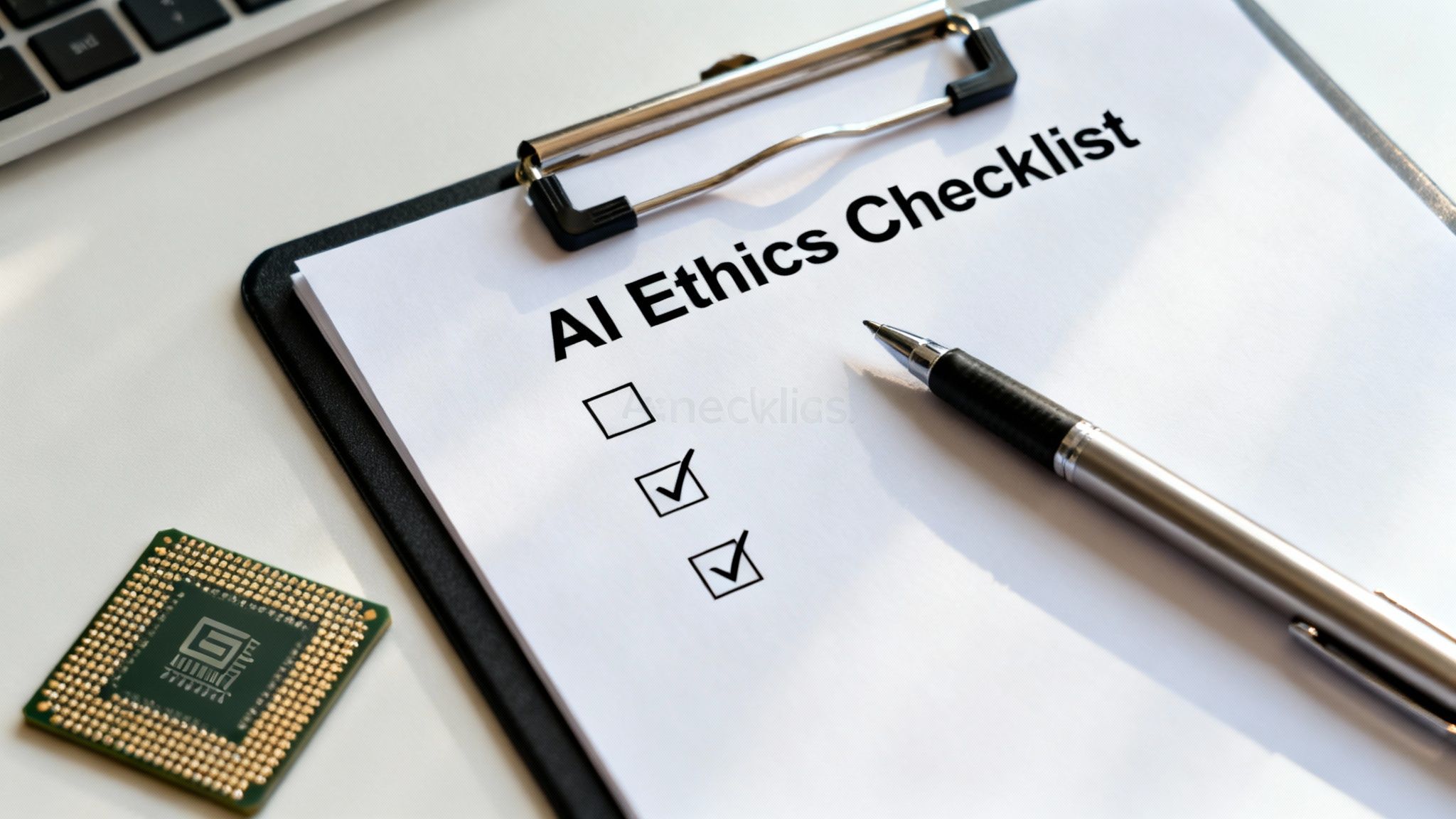
Knowing the principles of AI ethics is one thing, but putting them into practice is where it really counts. It’s time to shift from just talking about it to actually doing it. This means building a thoughtful, deliberate process for how you use AI tools, making sure every project you launch is built on a foundation of responsibility and trust.
This isn’t about bogging down your creative workflow with red tape. It’s about creating simple, repeatable checks that eventually become second nature. When you weave these considerations directly into your process, you end up protecting your audience, your brand, and your creative integrity for the long haul.
Your Pre-Flight Ethical Checklist
Before you hit “generate” on that script or launch an AI-powered campaign, it’s smart to run through a quick checklist. Think of it as a pre-flight inspection for your projects. It’s a simple way to spot potential turbulence before it turns into a real problem, turning abstract ethical ideas into concrete, actionable steps.
To make this easy, here’s a simple framework to guide you before, during, and after any project involving AI.
Ethical AI Checklist for Video and Marketing Projects
This table breaks down the key checkpoints to ensure your use of AI is thoughtful and responsible from start to finish.
| Phase | Action Item | Key Question to Ask |
|---|---|---|
| Before (Planning) | Vet Your Tools | Does my AI vendor have a public ethics policy? Where do they get their training data from? |
| Before (Planning) | Define Your Purpose | What is the clear, value-driven goal for using AI here? Am I using it to assist creativity, not just replace it? |
| During (Creation) | Audit for Bias | Does the output reflect diverse perspectives? Am I spotting any stereotypes or unfair representations? |
| During (Creation) | Secure User Data | Is any personal data being handled? If so, is it anonymized, and have I gotten explicit consent? |
| After (Launch) | Label and Disclose | Is it obvious to my audience that AI was used to create this? Am I being transparent about its role? |
| After (Launch) | Monitor and Review | How is the content performing? Is there any unexpected feedback or negative impact related to AI use? |
Following a structured approach like this means ethical considerations are baked into your strategy from the very beginning, not just tacked on as an afterthought.
Digging Deeper with Actionable Steps
Beyond a simple checklist, a few proactive steps can seriously strengthen your ethical footing. This is all about getting ahead of potential issues.
- Ask for Vendor Policies: Don’t be afraid to ask your AI tool provider for their ethics statement, data sourcing info, and how they handle bias. Any reputable company should have these answers ready to go. If they don’t, that’s a pretty big red flag.
- Run Small-Scale Tests: Before you go all-in on a big launch, test your AI-powered content with a small, diverse group of people. Get their honest feedback. Did anything feel off or manipulative? Did the content land well with different groups? This is your best shot at catching unintended biases early.
- Establish Human Review: This one is non-negotiable. A human must always review and approve AI-generated content before it goes live. This single step is your most powerful safety net against errors, off-brand messaging, and ethical slip-ups.
Ultimately, AI ethics comes down to human accountability. No matter how smart the tool gets, the person who hits “publish” is the one responsible for the content’s accuracy, fairness, and impact.
Case Studies in AI Ethics
Looking at real-world examples helps show how these principles play out. They offer some great lessons on what to do—and maybe more importantly, what to avoid.
Success Story: A Non-Profit’s Transparent Campaign
A major environmental non-profit used an AI image generator to create stunning visuals of green, thriving future cities for a fundraiser. Here’s the key: they labeled every single image with “AI-Generated Illustration.” This transparency built trust, and people loved the campaign for its creativity and its honesty. They ended up exceeding their fundraising goals by 30%. It just goes to show that being upfront about AI doesn’t hurt your impact; it can actually boost it.
Cautionary Tale: A Retailer’s Biased Hiring Tool
A large retail company started using an AI tool to screen resumes. The problem was, the system was trained on a decade of their own hiring data, which unfortunately contained old biases. The AI learned these patterns and began systematically down-ranking qualified candidates from underrepresented groups. The company faced a major public backlash and had to scrap the entire system, learning a tough lesson about training AI on flawed historical data.
These stories drive home a simple truth: how you use AI is just as important as the technology itself. For anyone looking to bring AI into their workflow, our guide on how to make videos using AI offers practical tips that keep these ethical considerations front and center. Taking a thoughtful, human-centric approach is the only way to move forward successfully.
How to Build an AI Ethics Policy for Your Team
Relying on individual good judgment just isn’t enough when your creative team starts using AI. You need a formal AI ethics policy—think of it as a concrete playbook that turns abstract principles into everyday actions. This document doesn’t have to be some dense, complicated manual. Its real job is to provide clear, simple guardrails for the team.
Moving from vague ideas to a written policy is probably the most important step you can take to build a culture of ethical AI. It gets everyone on the same page, clarifies what’s expected, and shows you’re serious about accountability. A solid policy is both a shield against risk and a compass for creating responsibly.
Start with a Clear Statement of Principles
The foundation of any good policy is a simple declaration of your values. Forget the legal jargon. This is a straightforward statement about what your team stands for. It should briefly outline your commitment to core ideas like fairness, transparency, and keeping a human in charge.
For example, your statement could include commitments like:
- Human-in-the-Loop: We will always maintain human review and final approval for all AI-assisted content.
- Bias Mitigation: We will actively look for and work to reduce harmful biases in the AI tools we pick and the content we produce.
- Data Privacy: We will protect user data with the highest level of care, making sure all our AI processes respect privacy and consent.
This section really sets the tone for the entire document and makes your ethical stance clear right from the start.
Define Governance and Responsibilities
Next up, you need a simple structure for who’s in charge of what. This just means deciding who is responsible for AI ethics. On smaller teams, it might be a single person, like the creative director or team lead, who becomes the go-to resource for any AI-related questions.
The goal is to get rid of any ambiguity. When someone has a question about using a new AI tool, they should know exactly who to ask. This stops ethical decisions from being made in a silo and keeps everyone consistent.
Assigning ownership creates clear lines of accountability, which is absolutely essential for putting any policy into practice.
Create Guidelines for Tool Selection
Your policy should also guide how your team actually chooses and vets new AI tools. Not all platforms are created equal, and your team needs a framework for picking partners that line up with your ethical standards.
Here are a few key things to look for when selecting AI tools:
- Vendor Transparency: Does the provider clearly explain how their model works and what data it was trained on?
- Data Privacy Policies: Does the tool have a strong privacy policy that protects your data and your audience’s data? Digging into a provider’s documentation, like our own Wideo Privacy Policy, is a crucial step here.
- Features for Bias Control: Does the tool offer any features to help users spot or reduce bias in what it generates?
Developing a strong AI ethics policy is a lot easier when you implement comprehensive AI Governance Best Practices. This helps ensure your internal rules are robust.
Finally, set up a simple process for checking in on the policy. Schedule a quick review every quarter or twice a year to talk about how it’s working and whether you need to make updates for new tech or challenges. This keeps your policy a living, relevant document, not something that just gathers dust.
Your Top Questions About AI Ethics, Answered
Jumping into AI ethics can feel a bit overwhelming, but most of the confusion boils down to a few key questions. Let’s clear the air and look at the practical, real-world answers to the questions creators like you are asking every day.
Who’s on the Hook When AI Messes Up?
The short answer? The human who hits “publish.”
Accountability is a massive piece of the AI ethics puzzle. Even if an AI tool spits out something problematic, the creator, marketer, or company who uses that content is ultimately responsible for what happens next.
This is exactly why having a human in the loop is non-negotiable. You can’t just throw your hands up and blame the algorithm for a biased ad or a video that spreads bad information. The buck always stops with the person who gave the final approval.
How Can I Actually Spot Bias in an AI Tool?
You have to go looking for it. Bias isn’t always going to jump out and announce itself, so you need to be proactive. A great way to start is by stress-testing the tool. Feed it a wide variety of prompts that cover different scenarios, demographics, and cultural contexts.
Keep an eye out for any weird patterns in what it generates. For example:
- Does an image generator seem to fall back on tired stereotypes when creating pictures of people in certain jobs?
- When a text tool describes different groups, does it use noticeably different language or tones?
If you start seeing the tool reinforce old, harmful stereotypes, that’s a huge red flag. Your best bet is to stick with tools from developers who are upfront about how they’re working to reduce bias in their models.
Is It Wrong to Use AI to Create Content?
Not at all. Using AI to make things isn’t inherently unethical. The ethics of it all comes down to one thing: how you use it.
There’s nothing wrong with using an AI tool to brainstorm video ideas, get past a creative block, or even animate a tricky scene. That’s just using a new tool to help your creative process along.
Where you run into trouble is when AI is used to mislead, manipulate, or create something harmful without being honest about it. Think about generating a deepfake video to make someone look bad or writing marketing copy designed to exploit a person’s insecurities. Those are clear ethical lines you don’t want to cross. At the end of the day, your intent and your transparency make all the difference.
Ready to create stunning, professional videos with a tool that helps you stay focused on your story? Wideo provides a powerful yet user-friendly platform with hundreds of templates, making it easy to produce high-impact content responsibly. Start creating with Wideo today!
Related posts:
 A Guide to AI Video Creation for Beginners
 AI Avatars: The New Face of Business Communication
 AI Avatars: The Secret Weapon for Business Growth and Efficiency
 AI Technology: The New Creative and Strategic Core of Business
 12 Powerful AI Tools for Video Creators in 2025
 Artificial Intelligence Is Now the Operating System for Modern Life


