
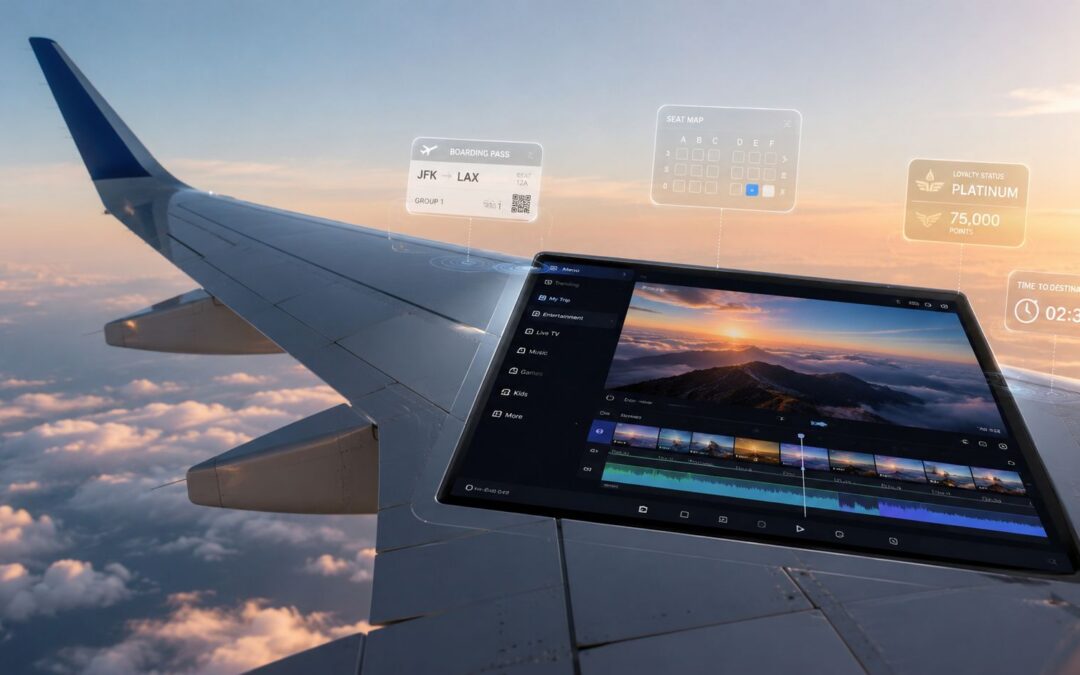
Your CRM already knows who just booked, who is eligible for an upgrade, who abandoned checkout, and who is stuck in disruption recovery. Most airline communication systems still act as if none of that context exists.
That gap is where revenue, trust, and service capacity get lost.
Personalized video automation for airlines works when you stop treating visual content as a campaign extra and start treating it as a business system.
The Communication Gap in Air Travel
A passenger books a long-haul trip, pays for extra baggage, joins the loyalty program during checkout, and then hits a schedule change two days before departure. In many airlines, those signals sit in separate systems while the customer still receives a generic email built for the average traveler.
That gap shows up every day. Airlines hold rich operational and customer data, but the message layer often strips out the context that would make that data useful. The problem is rarely weak creative. It is a delivery model built around static assets, fixed approval cycles, and limited room for live decisioning.
A premium customer on a long-haul route, a first-time leisure traveler, and a passenger trying to recover from a missed connection need different explanations, different offers, and different levels of reassurance. Sending the same framing to all three creates avoidable friction.
It also creates risk. Generic communication does not just miss revenue. It increases service contacts, weakens trust during disruptions, and raises privacy concerns when teams start handling exceptions manually outside approved workflows.
Where generic communication fails
A static email can confirm a booking. It struggles to adapt the story based on route, cabin, loyalty status, rebooking state, or ancillary eligibility without creating a difficult set of versions for marketing, operations, legal, and CRM teams to maintain.
Personalized video changes the production burden. Teams define one approved structure, then populate scenes, copy, and calls to action from live fields and rules. A practical example of that model appears in these personalized airline communication workflows.
The operational benefit is clear, but the compliance benefit is often missed. Once airlines move from batch messaging to individualized video, every variable needs governance. That includes which passenger attributes can appear on screen, which disruption details can be referenced, how long rendered assets are retained, and whether a vendor processes data under the airline’s required privacy terms. If those controls are not designed early, personalization creates a new review backlog instead of reducing one.
Generic messaging creates rework twice. Once for the marketing team that keeps rebuilding assets, and once for the service team that has to explain what the message left out.
The communication gap affects more than conversion. It shapes post-booking onboarding, ancillary attachment, loyalty engagement, disruption recovery, reporting quality, and the amount of manual intervention required from contact center and airport teams.
From Campaign Asset to Communication System
The old model is familiar. Marketing briefs a video, creative produces a polished dynamic asset, legal reviews it, and the team distributes the same file to a segment. It’s neat, controlled, and too slow for a passenger journey that changes by the hour.
The newer model is systematic.

Creative work moves upstream into template design, rules, and brand guardrails. Production moves downstream into machine-driven rendering tied to CRM, booking, CDP, and service events. That turns visual content into a repeatable communication layer rather than a one-off deliverable.
Why this fits the airline operating model
Airlines are already moving toward deeper, intelligent personalization across the passenger journey. A 2025 analysis from SoftClouds on AI in airline CX describes airlines using machine learning for personalized recommendations, personalized rewards, promotions, entertainment, meal suggestions, and other context-aware experiences. That matters because video automation depends on the same environment: structured data, event signals, and clear decision rules.
This shift isn’t just for customer acquisition teams. Sales teams can use it for upgrade conversion. Customer success and service teams can use it for onboarding after booking and disruption messaging. HR and training teams can use the same template logic internally for crew briefings, change communications, and policy explainers. Operations leaders can use recorded messages for stakeholder updates when route changes or service events require fast communication across functions.
One platform category built for this pattern is video automation for data-driven rendering, where a master template connects to a source system and outputs individualized assets without manual editing each time.
The airlines that get value from this don’t ask, “How do we make more videos?” They ask, “Which communications should become programmed?”
High-Impact Use Cases Across the Passenger Journey
The best use cases are the ones where context is already sitting in a system field and timing matters.

Upgrade and ancillary offers
A passenger books economy on a route where premium inventory opens closer to departure. The airline sends a user-specific recorded message showing the booked route, the cabin being offered, and a clear CTA. That’s acquisition logic applied after the initial sale. It drives ancillary revenue without requiring a net-new campaign build.
The same framework works for seats, bags, lounge access, and priority services. Sales enablement in this setting means surfacing the most relevant paid option at the right operational moment.
Booking recovery and onboarding
Abandoned booking recovery is usually treated as an email problem. It works better as a context-aware reminder tied to the itinerary the passenger was viewing. Route, dates, fare context, and loyalty recognition can all shape the message.
Once the booking is complete, onboarding begins. A dynamic asset can explain next steps, baggage rules, check-in timing, and app setup based on route and booking status. That reduces confusion early and sets up smoother retention and lifecycle communication later.
For teams comparing use patterns across industries, business video use cases across functions make the broader point well. The same automation logic applies in finance for onboarding, in SaaS for activation, in insurance for renewals, and in education for student guidance.
Loyalty recaps and retention
Loyalty programs are full of dormant data that rarely gets turned into compelling communication. A year-in-review style audiovisual piece can visualize destinations visited, miles earned, and the next status threshold in a way that feels far more tangible than a statement email.
That’s retention communication, but it also serves reporting and stakeholder goals. Marketing sees engagement. Loyalty teams see movement toward the next tier. Leadership gets a clearer picture of which lifecycle messages create action.
Disruption and service deflection
Disruption is where the promise of personalization meets operational risk. When a delay or cancellation occurs, a passenger doesn’t need polished brand storytelling. They need a precise explanation of what changed and what to do next.
A dynamic asset can answer recurring questions before they hit the call center. It can show updated departure details, connection impact, and next-step guidance. Done well, it reduces service load. Done poorly, it creates legal and reputational exposure.
During disruption, relevance matters more than style. If the message is wrong, the medium only makes the mistake more vivid.
The Technical Workflow Data to Dynamic Asset
The mechanics are less mysterious than often assumed.

A working system starts with a source of truth, usually the CRM, booking engine, CDP, or loyalty database. The team maps those fields into a master template. Triggers decide when the asset should render. Distribution sends the finished message through email, app, portal, or another owned channel.
What the template must support
For airlines, batch and real-time rendering both matter. Batch handles scheduled campaigns like loyalty recaps, destination promotions, employee updates, and training communications. Real-time rendering handles confirmations, inventory changes, and service events. Pirsonal’s rendering features overview is useful on this point because it highlights the need for dynamic text, images, audio, and conditional scene logic in the same template system.
The fields that matter most are operational and behavioral, not cosmetic. Kaltura’s guidance on video personalization points to booking status, loyalty tier, route, destination, time-to-departure, and service interruptions as the inputs that should drive branching and CTAs. Real-time syncing is critical so the passenger sees their current state, not an old one.
The workflow teams actually use
Here’s the pattern that tends to work:
- Data source: Pull passenger fields from CRM, booking, loyalty, or disruption systems.
- Master template: Build one brand-approved layout with placeholders, fallback copy, and conditional scenes.
- Automation trigger: Fire on booking, abandoned session, tier milestone, schedule change, or another business event.
- Distribution layer: Deliver through email, app, customer portal, IFE, or internal channels.
- Measurement loop: Feed engagement and conversion outcomes back into campaign and service reporting.
If your creative team is using model-generated tools to draft scenes or scripts before moving them into an enterprise workflow, it helps to standardize prompt quality too. A practical reference on effective AI video prompt techniques can help teams reduce template rework before implementation.
A company applying this with a platform would connect booking or CRM data to a branded template, define the event trigger, and send the rendered asset through its existing distribution stack. For high-volume airline operations, an API is usually cleaner than manual exports, and video automation API workflows are one common integration path. The value isn’t in the rendering alone. It’s in reducing repetitive production work while keeping the communication current.
Measuring Real Business Value and ROI
A delayed passenger does not care whether the video looked polished. The airline cares whether that message reduced calls, protected ancillary revenue, or got the traveler to take the next action without agent help.
That changes how ROI gets measured. Each workflow needs its own operational outcome and its own control group. Upgrade messages tie to ancillary conversion. Booking recovery ties to completed reservations. Loyalty recaps tie to repeat purchase, tier engagement, or card activation. Disruption videos need a broader scorecard that includes self-service completion, contact-center deflection, complaint rate, and post-event satisfaction.
The strongest programs also separate marketing lift from service value. That matters in airlines because a video that improves rebooking completion by a few points may create more financial impact than a flashier campaign asset with higher click-through but little operational effect. I have seen teams miss this by reporting only email metrics. Opens and views are useful diagnostics, but they are not the business case.
Personalized video performance uplift in airlines
| Airline or campaign type | Metric | Performance uplift |
|---|---|---|
| Travel brands using personalized video | Conversion | Higher than generic video |
| Major airline | CTR | Improved materially |
| Major airline | Conversion | Improved materially |
| Etihad Airways | Flight bookings | Increased |
A practical ROI model usually has four lines: revenue gained, cost avoided, production hours removed, and risk controlled. Risk belongs in the model because airline personalization runs on identity-linked and trip-linked data. If the workflow creates privacy exposure, rework, legal review, or retention problems, those costs can erase a good-looking conversion result.
That is why measurement has to include governance checks. Teams should track which passenger fields were used, whether the message was classified as service or marketing, how long render data was retained, and whether vendor handling aligns with the airline’s own video data privacy policy and processing terms. Security review belongs here too, especially if AI-assisted generation or decisioning is part of the workflow. The same discipline used in protecting AI and ML systems applies when personalized video becomes part of a regulated communication process.
Once the numbers are framed that way, the production question gets simpler. Manual video work does not scale across disruption, loyalty, booking recovery, and ancillaries at airline volume. Platforms like Wideo are designed for this operational problem, connecting CRM data to templates to automate message generation.
Navigating Privacy and Compliance Risks
Most airline discussions about personalization ask what can be targeted. Far fewer ask what should be targeted.
That’s a problem because airline communication often depends on sensitive operational and identity-linked data. The common blind spots are practical ones: whether the message is a service communication or marketing, how long passenger data stays in the rendering workflow, which fields are necessary, and how consent is handled across jurisdictions. Wideo’s airline guidance raises this gap directly in its airline personalization overview.
Where teams get exposed
A delay notice that includes too much trip detail can create privacy risk if it reaches the wrong recipient. A loyalty recap can overcollect fields that add little commercial value. A rebooking message can become stale if the system doesn’t refresh before send time.
These aren’t edge cases. They are normal operating conditions for airlines.
Governance rule: Personalize only the fields that materially improve relevance, and set retention limits for everything else.
Security also has to extend beyond the message itself to the systems training, routing, and storing the data. Teams reviewing architecture for model-generated or machine-learning workflows should think seriously about protecting AI and ML systems before they scale any regulated communication process.
For policy and handling expectations, a baseline reference is the Wideo privacy policy. The larger lesson is simpler. Personalized communication in airlines needs legal, data, CX, and operations in the same room before the first trigger goes live.
If you’re evaluating how to turn booking data, loyalty signals, and operational events into controlled, repeatable airline communication, Wideo is one option to review for template-based video automation workflows.
Related posts:
 Automating user-generated content for e-commerce brands
 Patient safety education through automated video content
 Virtual tour videos for hospitality automation
 Assembly and safety videos automated for manufacturing facilities
 Automated product assembly videos for manufacturing
 Creative Marketing Strategies for Modern Insurance


