

When you start an AI platforms comparison, it’s easy to get lost in feature lists and pricing tiers. But the real difference-maker isn’t what a platform knows. It’s how well it turns intelligence into scalable, personalized video communication that genuinely connects with people—a capability most traditional tools lack.
Why Most AI Platform Evaluations Miss the Mark

Staring at dashboards often leads businesses down the wrong path. They select an AI platform that ultimately fails to deliver a meaningful impact because the evaluation process itself is flawed. It focuses on what the AI knows rather than what it empowers you to do. The true value isn’t in the data it spits out, but in its ability to turn insights into real action.
The global rush to adopt these tools is undeniable. The AI platform market is projected to skyrocket from USD 18.22 billion in 2025 to USD 94.31 billion by 2030, fueled by a massive 38.9% compound annual growth rate. This huge investment shows a clear demand for intelligence, but it doesn’t guarantee results. You can read more about this explosive market growth and the factors driving it.
The Insight-to-Action Bottleneck
Many conventional AI platforms are great at analysis, but they fail to scale impact because they create a critical bottleneck that kills ROI. They tend to fall short in three specific ways:
- They Stop at Insights: These platforms produce stunning dashboards and analytics that pinpoint key opportunities. But they leave it up to your team to figure out how to translate those findings into a communication strategy.
- They Produce Text or Dashboards: The end product is usually a text-based report, a spreadsheet, or a static chart. While informative, these formats struggle to grab attention and are easily buried in an avalanche of information.
- They Still Rely on Manual Content Creation: Even when an AI identifies the perfect moment to engage a customer, a human still has to design, write, and produce the actual content. This manual step makes true scalability impossible.
These limitations mean that even the smartest AI platform can fail to move the needle on your business goals. All that intelligence remains trapped in a report, waiting for someone to act on it.
A New Framework for Evaluating AI Platforms

To make a smart AI platforms comparison, you have to look past the flashy dashboards. The best platforms don’t just show you data; they close the gap between insight and action. This means we need a new way to evaluate them, one that focuses on outcomes—specifically, the power to create and scale personalized video communication.
Instead of asking what an AI platform knows, the better question is what it lets you do. Does it help your team communicate more effectively, or does it just add another pile of data to analyze?
Five Dimensions for a Modern AI Platform Comparison
A forward-thinking evaluation moves from passive analytics to proactive communication. Assess any platform you’re considering across these five key areas to separate truly impactful tools from just another piece of software.
- Automation Depth: This goes beyond scheduling tasks. True automation means the platform can generate and deliver content on its own, triggered by events in your business systems—like a new customer signing up or a project hitting a milestone.
- Personalization Capabilities: This isn’t just sticking a name in a template. Can the platform dynamically change content—images, text, data points, CTAs—for every individual at scale? That’s what creates a relevant experience.
- Integration with Real Workflows: A simple API isn’t enough. The best platforms weave into your core systems (CRM, ERP, marketing automation) to pull data for personalization and push content back out, becoming an active part of your operations.
- Ability to Generate Dynamic Content: Static reports have their limits. Look for platforms that can automatically turn raw data into engaging, dynamic content formats, transforming numbers into compelling stories.
- Support for Video as a Core Output: This is the game-changer. Video is one of the most powerful ways to engage people and help them understand complex information. A platform that can natively generate video from data turns intelligence into something people will actually watch and act on. You can see just how powerful video automation is for scaling this kind of communication.
Unlocking a Higher Level of Communication with Automated Video

In stark contrast to tools that stop at analysis, platforms that support automated video generation open up a far more effective way to communicate. By turning data points into visual stories, they deliver information that achieves:
- Faster Understanding: Complex data becomes crystal clear when presented in a short, engaging video.
- Better Engagement: Video consistently outperforms text and static images in grabbing and holding audience attention.
- Clearer Storytelling: You can build a real narrative around data, making your message more memorable and persuasive.
- Easier Alignment Across Teams: Internal teams can get on the same page in minutes with video summaries of project progress or performance metrics.
An entire ecosystem of video-centric AI platforms is built on this principle. For example, a platform like Wideo is representative of this approach. Such tools don’t just analyze your data; they transform it into a powerful communication medium, ensuring your message is seen, understood, and acted upon. This shift turns AI from a passive analytical tool into a proactive communication engine.
Where Traditional AI Platforms Fall Short
Most popular AI platforms pack serious analytical punch, but they often fail to translate that intelligence into scalable business impact. There’s a huge gap between a brilliant insight and a meaningful action, and that’s exactly where most tools stumble. This disconnect happens because the final output is usually a static dashboard or a dense report, leaving your team to do all the heavy lifting of actually communicating the finding.
When you’re comparing AI platforms, you have to dig deeper than just processing power or predictive accuracy. The real question is: Does this platform help us communicate better and faster, or does it just dump more data on our laps?
The Dashboard Dead End
The first major issue is the “dashboard dead end.” These platforms are masters at pulling data together and creating beautiful charts. They can spot high-value leads or pinpoint customers about to churn with incredible precision. But that’s where their job ends.
The platform tells you what is happening but gives you no scalable way to handle the now what?. It’s like a GPS that shows you the destination but doesn’t provide any roads to get there. For instance, a sales team might get an AI-generated list of 50 high-potential leads. The data is solid, but the team still has to manually write emails and create custom outreach for each one. The AI did its analytical part, but the operational bottleneck remains.
Lost in Translation with Text-Only Outputs
The second limitation is the over-reliance on text-based outputs like static reports, email summaries, or data exports. While fine for documentation, these formats are notoriously bad for driving action in a fast-moving business.
Information overload is a real problem. A detailed PDF report gets buried in an inbox, and a data-heavy spreadsheet requires significant effort to interpret. These outputs communicate information, but they often fail to inspire action. People are hardwired to respond to visual, dynamic content that tells a clear story.
The Manual Creation Bottleneck
Finally, even the most sophisticated platforms often still lean on manual content creation. The AI might identify the perfect moment for a personalized message—like a customer hitting a key milestone—but it still needs a person to design the graphic, write the copy, and produce the final piece of communication.
This dependency on human intervention undermines the promise of automation. It creates a clash between the speed of AI-driven insights and the slower, resource-intensive process of manual content development. This is precisely why platforms that support automated video generation are in a different league. They don’t just find the opportunity; they act on it by automatically creating the most engaging communication format there is.
Comparing Architectures for AI Video Generation
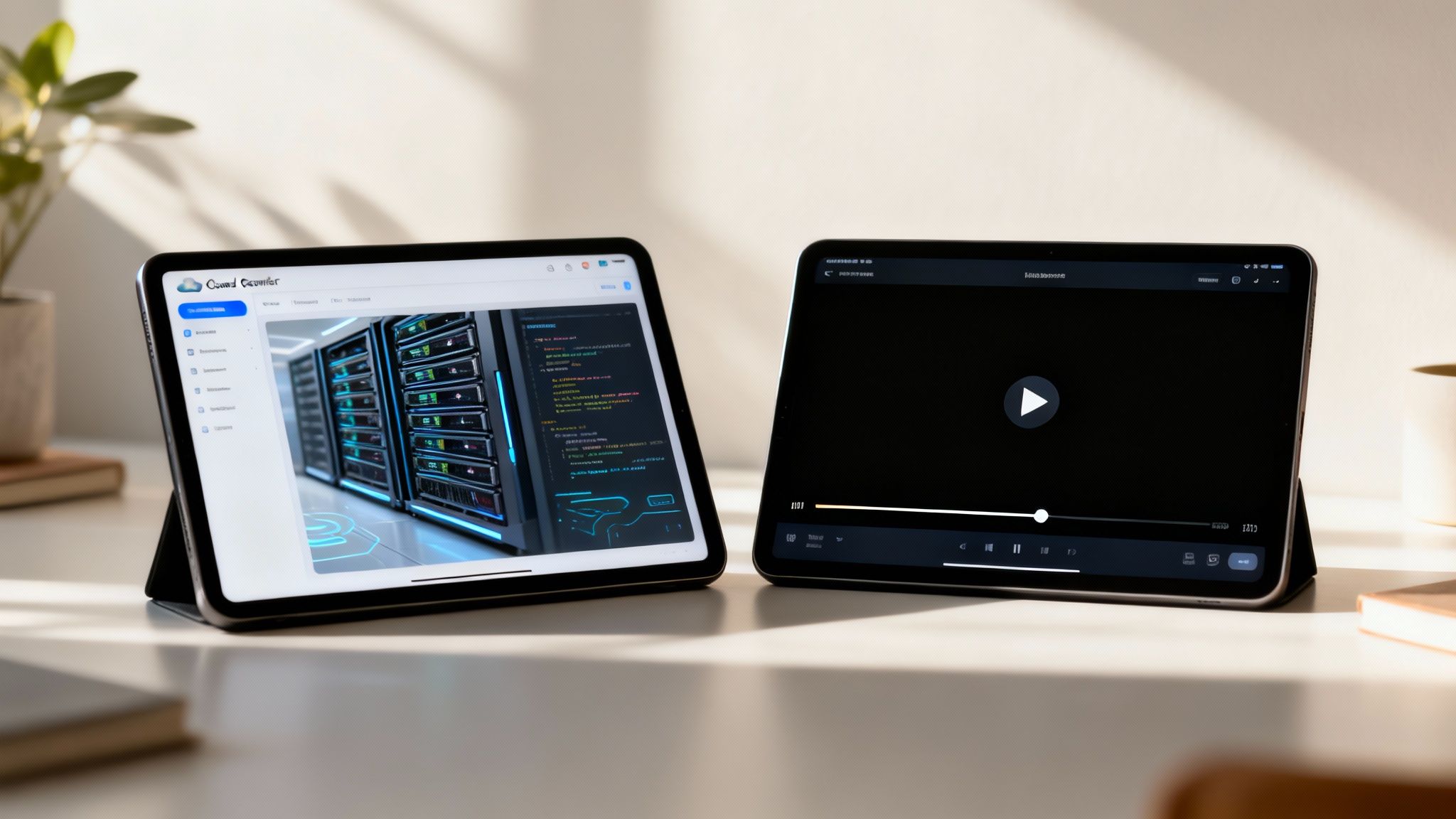
When you dig into an AI platforms comparison for communication, you’ll find the architecture is a major fork in the road. You can adapt a generic, all-purpose AI platform or choose a specialized, video-first AI tool. Each route comes with its own trade-offs on implementation speed, required expertise, and total cost.
Getting a handle on these differences is key to picking a solution that fits your company’s resources and goals. One path gives you massive flexibility but saddles you with complexity, while the other offers a straight shot to creating real communication assets, fast.
Generic vs Specialized AI Platforms
Think of a generic AI platform from a big cloud vendor as a massive box of high-tech LEGOs. You get a powerful, flexible foundation, but it’s completely on you to assemble those blocks into a working video generation system. This route demands serious internal resources—data scientists and engineers—to build, test, and maintain the solution.
A specialized, video-centric platform, on the other hand, is a purpose-built machine. It’s been engineered to solve one problem exceptionally well: turning data into video. For specific communication needs, these platforms give you a much quicker path to results because the heavy lifting for video rendering and personalization is already done. The global AI power struggle is also shaping these choices. While North America might lead the market in 2025, Asia-Pacific is on track to grab 47% of the market by 2030, with China as a major driver. You can get a deeper look into the shifting global AI market.
Key Business Decision Factors
Choosing between these two models comes down to an honest look at your organization’s strengths and priorities. Here’s a simple breakdown of the core factors to weigh in your AI platforms comparison.
| Decision Factor | Generic AI Platform (Build) | Specialized AI Platform (Buy) |
|---|---|---|
| Implementation Speed | Slow; months or even years of development and integration. | Fast; up and running in days or weeks with ready-made integrations. |
| Customization Level | Extremely high; build any workflow you can imagine from scratch. | Moderate; offers deep customization within the context of video creation. |
| Technical Expertise | High; requires a dedicated team of AI engineers and data scientists. | Low; designed for business users, marketers, and HR teams. |
| Total Cost of Ownership | High; includes development, ongoing maintenance, and infrastructure costs. | Lower and predictable; typically a straightforward subscription model. |
Finding the Right Fit for Your Organization
The best choice depends entirely on your situation. A large enterprise with a seasoned data science team might love the flexibility of a generic platform. They can stomach the high upfront costs and long development timelines to build a system perfectly molded to their operations.
But for most marketing, sales, or HR teams, the goal is to create high-impact communication, not to become a software development company. For these teams, a specialized tool like an AI video generator is the direct, efficient solution. It lets them automate personalized video outreach, training materials, or customer updates without writing a single line of code, delivering a faster and more predictable return.
The Takeaway: From Intelligence to Impact
When you’re comparing AI platforms, the real goal isn’t just finding the most powerful algorithm. It’s about finding the platform that closes the loop between getting an insight and doing something about it. The best tools are more than analytical powerhouses; they are communication engines that turn raw numbers into something people can see, understand, and feel.
A lot of platforms fall short at the finish line. They generate brilliant dashboards and insightful reports but still leave your team to manually create the content needed to act on that information. This creates a massive bottleneck, slowing everything down and watering down the impact of the intelligence you paid for.
Platforms that support automated video generation completely change the game. They don’t just point out an opportunity; they act on it by creating engaging visual communication.
The Takeaway: The best AI platforms are not the smartest—they’re the ones that turn intelligence into video people actually watch.
As you weigh your options, put a premium on platforms that bridge that critical gap between data and delivery. The goal isn’t just to know more; it’s to communicate better, faster, and with more personal impact than ever before. For an even deeper dive, explore topics like how to create personalized video content or the rise of AI-powered UGC advertising solutions.
Got Questions? We’ve Got Answers.
When you’re comparing AI platforms and getting ready to bring a new system into your workflow, a few key questions always pop up. Let’s tackle them head-on to clear things up and make sure you have a smooth path forward.
Here’s what people often ask about adopting and seeing the real impact of AI-powered video communication.
How Do I Actually Measure the ROI of an AI Video Platform?
To get a real sense of your return on investment (ROI), you have to look past the typical software stats and focus on what’s changing in your business. It’s all about tracking the key performance indicators (KPIs) that connect directly to your bottom line.
Here’s what you should be monitoring:
- A jump in engagement rates on videos you’re sending out, whether to customers or your own team.
- Higher conversion rates coming from your personalized video outreach campaigns.
- A serious drop in the time and money spent on creating content.
But don’t stop there. Think about the “softer” wins, too—like your teams being more aligned or people actually remembering what they learned from video training. When you can connect these improvements to making more money or saving costs, you’ve built a rock-solid case for the platform’s value.
Are AI Video Platforms Just for Big Companies?
Not a chance. While huge enterprises definitely put these platforms to work for their massive operations, a lot of modern AI video tools are built for everyone. They usually have flexible pricing and are surprisingly easy to use, making them a perfect fit for small and medium-sized businesses.
For smaller teams, the real magic is in automating all those repetitive communication tasks. Think about creating personalized welcome videos for new clients or automatically generating weekly project updates without lifting a finger. By taking over these jobs, the platform gives your team their time back to focus on what really matters: growth.
What’s the Best First Step for Integrating an Automated Video Platform?
The smartest way to start is to pick one single, high-impact use case that isn’t overly complicated. It’s tempting to try and automate everything at once, but that’s a surefire way to run into headaches. A great place to begin is by hooking the platform up to your CRM to automatically send a personalized thank-you video the moment a deal closes.
This kind of initial project lets you test the waters, measure results on a small scale, and build a powerful argument for rolling it out to other departments. A successful pilot project creates its own momentum and proves the concept to the people who need to see it.
Ready to turn your business intelligence into engaging video content? Wideo makes it easy to create, automate, and scale personalized video communications that drive real results. Discover how Wideo can transform your communication strategy today.
Related posts:
 A Practical Guide to AI Development for Modern Business
 Your AI Analytics Are Smart. But Are They Understood?
 AI Integration A Practical Guide for Business Growth
 Ai data processing: Practical strategies for pipelines, tools, and compliance
 Unlocking AI Performance in Modern Video Creation
 From Manual Handoffs to Automated Video: A Practical Guide to AI Workflows


