
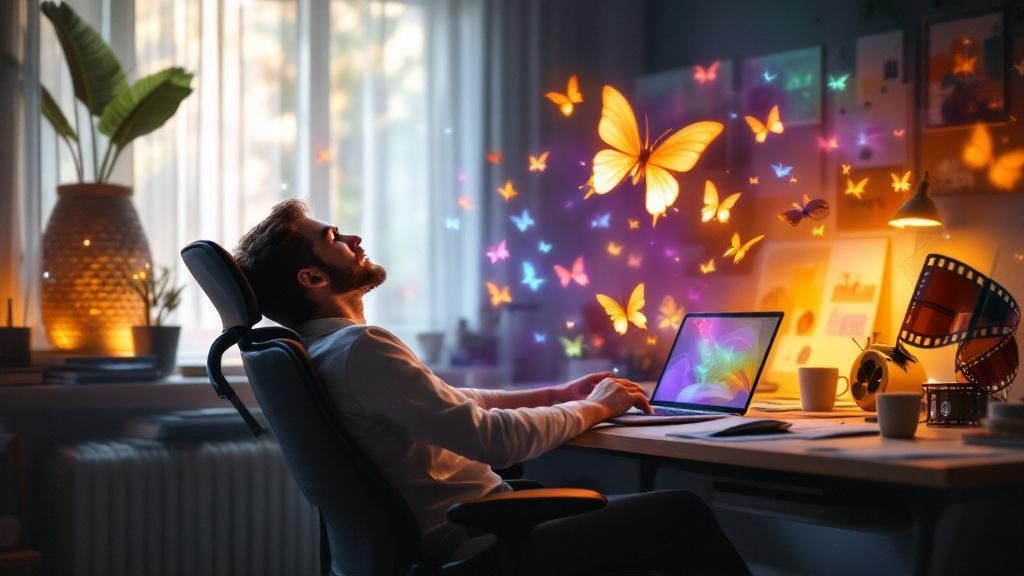
If you’re in media and entertainment, you know the feeling. It’s that low hum of pressure that never quite goes away. The constant, gnawing demand to feed the beast. More content, for more platforms, more often. We got into this world to tell stories, to create moments, to make people feel something. But somewhere along the way, the art started to feel like an assembly line.
The digital content treadmill is spinning faster than ever, and it’s leaving a trail of burnout and creative fatigue in its wake. It’s the quiet crisis happening behind the glowing screens of talented people everywhere. The passion that fueled our careers is getting buried under an avalanche of deliverables, resizing requests, and algorithm-chasing. We’re so busy keeping up that we’ve lost the space to create.
This isn’t a personal failure. It’s a systemic problem. We are creators in an industry that rewards relentless output, often at the expense of the very thing that makes our work matter: the human spark.
But what if we’re looking at it all wrong? What if the same technology driving this pressure could also be our way out?
A Manifesto for Creative Freedom

It’s time for a shift in perspective. For too long, we’ve been told a story of fear, that automation is the enemy of creativity, a threat that will make human talent obsolete. This narrative is a distraction.
The real story isn’t about us versus the machine. It’s about creators finding a powerful new partner. Creative automation, especially in video, isn’t about replacing the artist. It’s about liberating the artist from the tyranny of repetitive, soul-crushing tasks.
Think about the hours your team loses every week. The mind-numbing work of manually creating twenty different versions of a trailer for social media. The tedious process of localizing a campaign for ten different markets. The grunt work of updating recurring video assets. This isn’t creativity. It’s friction. It’s the stuff that drains our energy and keeps us from focusing on what we do best: ideation, narrative, and strategy.
This is a rallying cry for every creator, producer, and marketer who feels the strain. We can reclaim our craft. We can use technology not as a shortcut, but as a tool to carve out space for deep, meaningful work.
Imagine a world where your team’s brilliance is no longer spent on resizing videos, but on crafting the next groundbreaking story. Where you can automate the production of a hundred localized ad variations, freeing up your team to brainstorm the core creative concept that will connect with millions. This isn’t a distant future; it’s a choice we can make today.
Trading Tedium for Time
Let’s be practical. Automation in the creative space is not about handing over the reins. It’s about identifying the tasks that are systematic, rule-based, and repeatable, and letting a machine handle them with perfect precision and speed.
Think of it as having an infinitely patient and fast production assistant.
- Producing Trailer Variations: Your team perfects one killer master trailer. The automation system then generates every single social media cut, aspect ratio, and format variation in minutes, not days.
- Localizing Global Content: You launch a campaign across 20 countries simultaneously. Instead of weeks of manual edits, the system automatically swaps out language tracks, on-screen text, and regional legal disclaimers from a single data source.
- Creating Recurring Video Assets: That weekly market recap or news summary video? It can be put on autopilot. An automated workflow pulls in the latest data, clips, and branding to assemble a fresh video without an editor touching a single frame.
When you offload these tasks, you’re not just saving hours; you’re creating space. The mental and creative bandwidth that was once consumed by repetitive production is now free. Free for strategic thinking. Free for experimenting with new story formats. Free for rediscovering the joy of making something that truly connects. For teams ready to explore this new way of working, platforms like Wideo’s automation service are designed to be that creative partner, helping you scale with intention.
It’s a fundamental shift from a mindset of mass production to one of intelligent creation. Automation doesn’t diminish the human touch; it amplifies it by focusing our energy where it matters most.
Scaling with Soul
The goal was never to become content machines. The goal was, and still is, to move people. The media and entertainment industry will only get more demanding, but we don’t have to let the pace dictate the quality of our work or our lives.
Embracing automation isn’t a concession. It’s a strategic choice to protect our most valuable resource: human creativity. It’s how we stop choosing between volume and vision. It’s how we scale our output without sacrificing our souls.
Let’s stop talking about surviving the content explosion and start talking about thriving in it. Let’s automate the predictable so we can create the exceptional. It’s time to step off the treadmill and get back to the work we were born to do. It’s time to build a future where technology serves art, not the other way around.
This isn’t about working less. It’s about making the work matter more.
For creative teams in media and entertainment who are ready to trade burnout for brilliance, the next step is to explore a platform built for this new way of working. Wideo offers a service designed to help you automate your media and entertainment content creation, so you can scale with purpose.
Related posts:
 How to set up a Facebook Cover Video
 Free online resources to create digital content in quarantine
 The ultimate (ever-growing) list of content marketing video tools and resources for 2021
 How to create a Personalized Video
Top Content Marketing Tools
How to create a Personalized Video
Top Content Marketing Tools
 How to Choose the Perfect Video Template for Your Business Needs