Let’s be honest: your marketing is probably stuck in the past. If you’re still relying on broad audience segments and endless manual A/B tests to guess what customers want, you’re not just falling behind—you’re operating with a blindfold on.
Machine learning isn’t just another buzzword. It’s the engine driving a new era of marketing that is predictive, deeply personal, and infinitely scalable. It’s how data-driven systems now outperform manual creative workflows, turning guesswork into a competitive advantage.
From Guesswork to Predictive Power
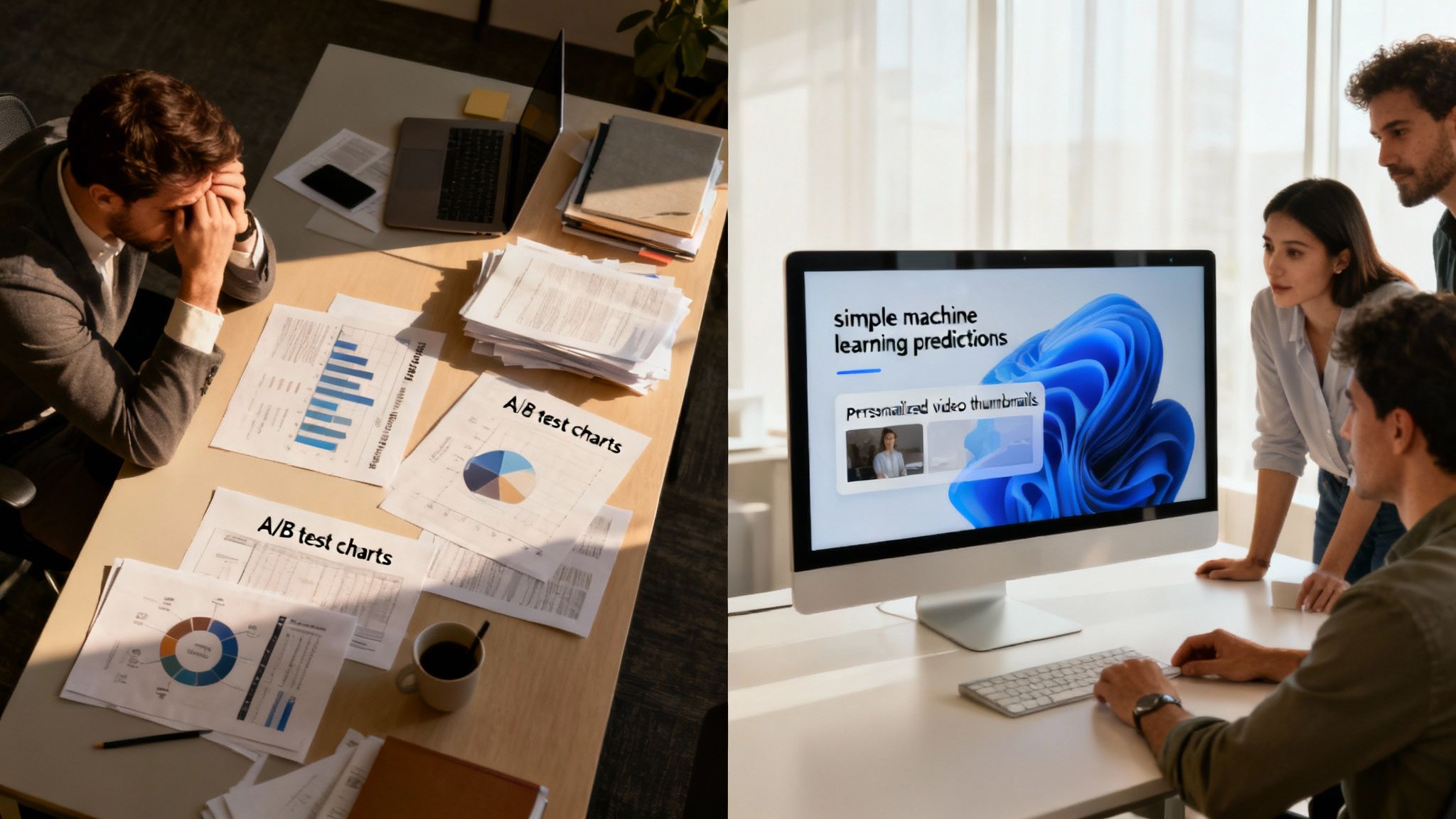
Think about the old way of doing things. You spend weeks creating a beautiful, one-size-fits-all onboarding video. Then you spend months A/B testing two slightly different calls-to-action, manually crunching the numbers to declare a “winner” that gives you a tiny lift. It’s slow, expensive, and completely reactive.
Now, imagine a different approach. A new user signs up, and a machine learning system analyzes their first few actions—which features they explore, what they ignore, and how their behavior compares to thousands of others. Within seconds, it predicts the user’s main goal and automatically generates a personalized onboarding video that speaks directly to that goal.
No guessing. No waiting for A/B test results. That’s the fundamental shift.
Outdated marketing relies on historical data and human intuition to make broad bets. Modern, data-driven marketing uses machine learning to find signals in customer data that are completely invisible to the human eye.
Making Personalization Possible at Scale
The core problem has always been scaling personalization in a meaningful way. It’s easy enough to write a personal email to one customer. It’s impossible to manually create a unique video for ten thousand. This is where machine learning doesn’t just improve old workflows; it makes them obsolete.
Instead of just looking at what a customer did, machine learning models predict what they will do next. This finally helps us answer the critical questions that traditional marketing never could:
- Which customers are about to churn, and what specific video message could bring them back?
- What is the perfect moment to introduce a premium feature to a free user?
- Which combination of visuals, messaging, and timing will resonate with a micro-segment of only 50 people?
This isn’t just better targeting. It’s a strategic shift from broadcasting messages to having predictive conversations with every single customer at scale.
The New Competitive Edge
This proactive approach changes the entire marketing function. Instead of just being creative order-takers, marketers become system architects who design intelligent, automated customer experiences. The real advantage no longer comes from having the biggest budget, but from having the smartest data strategy.
This is especially true as the digital world itself becomes more intelligent. Moving forward means understanding the shifting landscape, like optimizing for Google SGE and AI Overviews, which are quickly replacing traditional search results. Your ability to adapt is everything.
For teams exploring data-driven personalization at scale, tools like Wideo help automate entire video workflows. By connecting your customer data to a video automation engine, you can finally deliver on the promise of one-to-one marketing—turning insights into engaging, relevant video content in an instant.
How Machine Learning Predicts What Customers Want
Forget trying to piece together customer personas from dusty spreadsheets. Modern marketing has moved way past static profiles and into the world of real-time prediction, where algorithms can anticipate a customer’s next move before they even make it. This isn’t magic; it’s the practical application of machine learning.
This whole shift is powered by algorithms that learn from huge amounts of data—think transaction records, clicks, viewing habits, and even images. The more quality data they get, the better they become at making accurate predictions, all without someone needing to code new rules. You can get a deeper dive into how these models learn over on MIT Sloan’s website.
Instead of just reacting after a customer abandons their cart, machine learning models spot the subtle behavioral cues that mean they are likely to leave. This flips the script, letting marketers be proactive and deliver the right message at the perfect time.
Uncovering The Signals Hiding In Your Data
So, how does this actually work? A machine learning system connects the dots between data points from the entire customer journey, finding patterns far too complex for any human to ever spot on their own.
These signals can be anything, really:
- Browsing History: How long a user lingers on certain product pages.
- Content Engagement: Which blog posts they read or which videos they watch.
- Purchase Patterns: How often they buy and how much they spend.
- In-App Actions: Which features they use the most and which ones they ignore.
By weighing all these factors, the system doesn’t just create a static segment like “frequent buyers.” It builds a dynamic profile that’s constantly evolving, one that understands intent and predicts what someone will need next.
This means your audience segments are no longer rigid boxes you force people into. They are fluid, intelligent groupings that adapt in real-time as individual user behavior changes.
Turning Predictions Into Personalized Video
The real power of all this predictive work comes alive when it’s connected directly to your content, especially video. When an ML model flags a certain behavior, it can trigger an automated workflow to send a hyper-relevant video designed to nudge that customer toward a better outcome.
This takes the abstract idea of “predictive analytics” and makes it tangible and incredibly effective.
Mini-Scenario 1: Proactive Churn Reduction
An e-commerce brand’s model notices a loyal customer’s buying frequency has dropped off a cliff. Instead of a generic “We miss you!” email, it triggers a personalized video. The video highlights their loyalty points, shows off new products similar to past purchases, and includes a unique offer—all generated and sent automatically to win them back before they’re gone for good.
Mini-Scenario 2: Smart Upselling for SaaS
A SaaS company’s model spots a user who has repeatedly hit the usage limit on a free feature. This is a huge signal they’re ready for an upgrade. The system automatically sends them a short, personalized explainer video. This video doesn’t just list premium features; it shows exactly how the upgrade solves the exact limitation they just ran into, making the value proposition immediate and compelling.
The New Standard For Engagement
This level of automation isn’t about getting rid of the human touch; it’s about focusing it where it matters most. Marketers are freed from the manual grind of segmenting lists and scheduling campaigns. Instead, they get to design intelligent systems that orchestrate personalized journeys at scale.
This approach works especially well for certain kinds of videos:
- Customer Journey Videos: Messages that adapt as a user moves from awareness to conversion.
- Onboarding and Explainer Flows: Tutorials tailored to the features a specific user actually uses.
- Retention and Win-Back Campaigns: Proactive messages triggered by churn indicators.
- Cross-Sell and Upsell Suggestions: Product recommendations delivered via video based on proven interest.
For teams exploring data-driven personalization at scale, tools like Wideo help automate entire video workflows, making it easier to deliver machine-learning-informed content without increasing production time. By connecting predictive insights to automated video creation, you can finally give every single customer a unique experience.
Making Personalized Video At Scale A Reality
For years, “personalization” in video marketing was a bit of a gimmick. It usually meant just dropping a customer’s first name into a generic template. True one-to-one video communication felt like a distant dream, blocked by a huge, immovable obstacle: the sheer impossibility of manually creating unique videos for thousands of individual users.
The predictive power of machine learning is incredible, but insights are useless if you can’t act on them. A model might tell you that 5,000 different customers each need a slightly different message, but your creative team can’t possibly produce 5,000 video variations. This production bottleneck has always forced marketers to settle for broad segments, watering down the very promise of personalization.
That era is officially over. ML-driven automation smashes through the manual barrier, directly connecting predictive insights to content creation. It finally allows marketers to deliver a bespoke video experience to every single customer—without hiring a massive team of editors.
From Manual Edits to Automated Storytelling
Imagine a system where data points from your CRM or product analytics actually become creative inputs. Instead of a video editor manually swapping out clips and text, a machine learning workflow assembles personalized videos on the fly, perfectly tailored to each viewer’s profile and behavior.
This is where the real potential is unlocked. You move from a static, one-to-many broadcast model to a dynamic, one-to-one conversational approach.
The key insight is that your customer data is no longer just for analytics reports; it becomes the script for a personalized video story, unique to each individual.
Pulling this off at scale is often done with the help of advanced AI video tools that are built to streamline both creation and distribution. These systems are designed from the ground up to handle the complexity of generating thousands of unique assets based on dynamic data feeds.
Real-World Examples of Video Personalization at Scale
This isn’t some futuristic concept; it’s happening right now. Brands are using machine learning to generate video content that feels like it was handcrafted for each and every viewer.
-
For a travel company: A loyalty member gets a personalized video summary at the end of the year. The video automatically pulls data to show off their loyalty points balance, recaps past trips with dynamic maps, and even presents tailored “dream destination” ideas based on their browsing history.
-
For a retail brand: A shopper viewed three specific products but left without buying. A little later, they see a dynamic video ad on social media featuring those exact three products, maybe even with a limited-time discount. It’s a powerfully relevant retargeting message that a generic ad could never hope to match.
-
For a non-profit organization: A donor receives a personalized “thank you” video. It uses their name, mentions the specific campaign they gave to, and shows dynamic footage of the impact their exact donation amount can make. This creates a much stronger, more personal connection to the cause.
Video Types Perfectly Suited for Automation
While you can personalize just about any video, certain types give you the highest return on investment when automated with machine learning. These are usually the touchpoints where relevance and timeliness are absolutely critical for moving a customer along their journey.
This is the perfect place to start if you are just beginning to explore the benefits of a personalized video strategy.
Key video types include:
- Onboarding Sequences: Instead of one generic welcome video, new users get a version tailored to their initial actions or stated goals, helping them find value in your product way faster.
- Customer Journey Touchpoints: Think videos triggered by specific behaviors, like celebrating a milestone, re-engaging an inactive user, or confirming a big purchase.
- Re-engagement Messages: Proactively send personalized content to users whose behavior flags them as a high risk for churn, reminding them of the value they’re missing out on.
- Upselling and Cross-selling Campaigns: Suggest relevant products or plan upgrades through video, using their purchase and browsing history to make sure the offer is genuinely helpful, not just spammy.
For teams exploring data-driven personalization at scale, tools like Wideo help automate entire video workflows, making it easier to deliver machine-learning-informed content without increasing production time. By linking predictive analytics to a powerful video generation engine, what was once a creative bottleneck becomes your greatest competitive advantage.
Automating The Entire Customer Journey With Video
Predictive insights are powerful. Automated video generation is a game-changer. But when you put them together? That’s when you can orchestrate entire customer journeys from start to finish.
We’re talking about moving beyond one-off videos and into fully automated, adaptive sequences for everything from onboarding to retention and upselling. This is the point where machine learning stops being just another tool and becomes the very core of your marketing strategy.
Forget about building rigid, one-path-fits-all drip campaigns. The new approach is to design intelligent systems that react to what users actually do in real time. The customer journey is no longer a straight line you push people down; it’s a living, breathing experience that evolves with each individual.
This isn’t just a niche idea; it’s a massive market shift. The global machine learning market is set to explode from an estimated $91.31 billion in 2025 to an incredible $1.88 trillion by 2035. That growth is fueled by its profound ability to reshape how businesses operate. You can dig into the numbers in this machine learning market report.
A Fitness App That Learns And Adapts
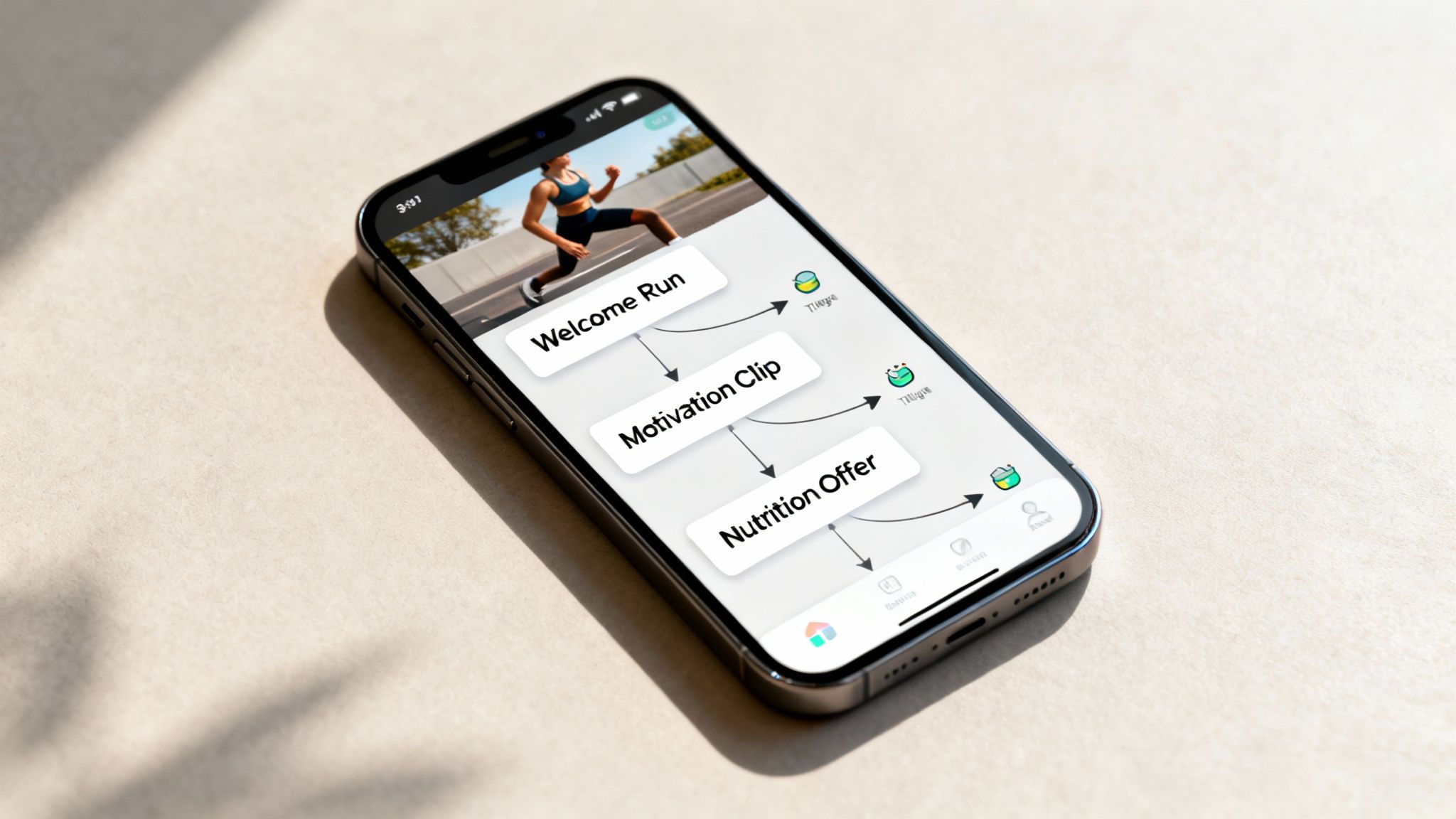
Let’s walk through a quick scenario to see how this plays out. A new user, Sarah, downloads a fitness app. A traditional campaign would send her the same generic “Welcome!” video everyone else gets. An ML-powered system, however, does something much smarter.
- Initial Action: The very first thing Sarah does is log a 3-mile run. The machine learning model sees this instantly. It compares her action to thousands of other new users and predicts she’s a running enthusiast, not someone focused on yoga or weightlifting.
- Triggered Video 1 (Onboarding): Minutes later, Sarah gets a personalized welcome video. It doesn’t just say “Hi, Sarah.” It immediately highlights the app’s run-tracking features, route planners, and running communities. It’s relevant from the first second.
But the system doesn’t stop there. It keeps learning from her behavior, crafting an experience that continuously evolves.
- Ongoing Behavior: Over the next two weeks, Sarah consistently logs morning runs but never touches the nutrition-tracking feature. The model flags this pattern as a perfect opportunity for a gentle cross-sell.
- Triggered Video 2 (Upsell): The system automatically generates and sends a new video. This one explains how pairing her running routine with smart nutrition can boost performance. It even includes testimonials from other runners and offers a free trial of the premium nutrition plan.
This is a world away from a fixed drip campaign, which would have blindly sent Sarah a generic nutrition email on Day 7, whether she ran a marathon or never opened the app again. The ML-powered journey is hyper-relevant, perfectly timed, and far more likely to get a “yes.”
This table breaks down just how different the two approaches are:
Manual Marketing vs Machine Learning Driven Marketing
| Aspect | Traditional Manual Marketing | Machine Learning-Driven Marketing |
|---|---|---|
| Strategy | Pre-planned, linear funnels | Dynamic, adaptive user journeys |
| Timing | Based on a fixed schedule (e.g., Day 1, Day 7) | Triggered by real-time user behavior |
| Content | Generic, one-size-fits-all messages | Hyper-personalized and context-aware |
| Optimization | Manual A/B testing, periodic reviews | Continuous, automated learning and refinement |
| Scalability | Labor-intensive, difficult to scale personalization | Manages thousands of unique journeys simultaneously |
| Outcome | General engagement, high drop-off rates | Higher conversion, retention, and customer LTV |
The difference is clear. One approach is about broadcasting a message; the other is about having a conversation.
Why Adaptive Journeys Outperform Static Campaigns
This adaptive approach creates a customer experience that’s simply impossible to replicate with manual workflows. It runs circles around traditional marketing because it is:
- Behavior-Driven: Every message is a direct response to something a user actually did, not just a guess based on a schedule.
- Continuously Optimized: The system learns from every single interaction, constantly getting better at predicting what content will resonate with each person.
- Infinitely Scalable: It can manage thousands of unique, simultaneous customer journeys without adding a single minute of manual work for your team.
This is the end of the one-size-fits-all funnel. Machine learning lets you build a living, breathing marketing ecosystem that nurtures each customer based on their unique needs and timing.
For teams exploring data-driven personalization at scale, tools like Wideo are designed to automate entire video workflows. This makes it much easier to deliver machine-learning-informed content without bogging down your production team. By using video automation, you can turn behavioral insights into personalized, journey-based video sequences that guide, retain, and grow your customer base more effectively than ever before. You’re no longer just creating campaigns; you’re designing intelligent experiences.
Winning With Intelligent Creative Optimization
Let’s be honest: marketers have been sold a lie that A/B testing is a fast way to learn. It’s not. The old way—manually creating two versions of an ad, running a test for weeks, crunching the numbers, and finally declaring a minor winner—is painfully slow and incredibly limited.
In the time it takes you to test one headline, a competitor using machine learning has already tested hundreds of creative combinations. Not only that, they’ve already pushed their budget to the winners.
This is the new competitive edge. It’s not just about making smarter predictions; it’s about learning and iterating at a speed that’s simply impossible for a human team to match. So forget about those simple A/B tests. The future is all about intelligent, automated creative optimization.
Moving Beyond Simple A/B Tests
Imagine a system that’s testing hundreds of video ad variations at the same time. This isn’t just video A against video B. It’s a full-blown multivariate analysis, exploring countless combinations in real-time.
A machine learning model can test elements like:
- Different Hooks: Which of five opening scenes actually grabs attention?
- Varied Calls-to-Action: Does “Learn More” or “Get Started” convert better for this specific audience?
- Music and Tone: Does an upbeat soundtrack outperform a serious one for ads shown on weekends?
- Voiceovers: Which tone—energetic or calm—resonates most with users who have already visited your pricing page?
The system doesn’t just find one “winning ad.” It finds winning combinations for hyper-specific audience segments, uncovering patterns you’d never have even thought to test. This ability to automatically generate and evaluate creative variations is a core benefit of using an AI video generator that’s plugged into a larger marketing system.
The goal is no longer to find the single best ad for everyone. It’s to find the perfect ad for each micro-audience and deliver it at the ideal moment.
The Power of Automated Budget Allocation
Figuring out the winning creative is only half the battle. The real magic of machine learning is its ability to act on those insights instantly. As the system gathers performance data, it automatically shifts ad spend away from the underperformers and funnels it toward the top creative—all in real time.
This creates a powerful feedback loop where your campaigns are constantly getting smarter and more efficient on their own. While a traditional marketing team is waiting for a weekly report, an ML-driven system has already made thousands of micro-adjustments, making sure every dollar is spent as effectively as possible. This isn’t just a small improvement; it’s a complete shift in how campaigns are managed.
This market transformation is reflected in some staggering growth projections. Statistical forecasts show the machine learning market is on an extraordinary trajectory. In 2024, the global ML market valuation was around USD 69.54 billion, but it’s expected to jump to an estimated USD 93.95 billion in 2025. This trend just keeps climbing, with projections hitting around USD 1.4 trillion by 2034. That’s a CAGR of about 35% over the decade. You can dive deeper into this incredible growth in this detailed industry report.
Building an Unbeatable Learning Engine
When you embrace intelligent creative optimization, you stop making bets based on gut feelings and start making decisions based on data. You’re building a learning engine that gets smarter with every single ad impression, click, and conversion. This creates an ever-widening gap between you and the competitors stuck in the slow lane of manual testing.
Your team is freed from the tedious cycle of setting up and analyzing endless tests. Instead, they can focus on what really matters: high-level strategy. They can interpret the insights the machine uncovers and come up with even better creative ideas for the system to test next.
For teams exploring data-driven personalization at scale, tools like Wideo help automate entire video workflows, making it easier to deliver machine-learning-informed content without increasing production time. It allows you to connect powerful testing insights directly to your content creation process, closing the loop between learning and doing. The speed you gain isn’t just a convenience; it’s how you win.
Common Questions About AI In Video Marketing
Diving into machine learning can feel like learning a new language—it often sparks more questions than answers. As marketers start thinking about moving from theory to practice, a few common uncertainties tend to pop up. Let’s clear the air on what people usually ask about applying machine learning to a video strategy.
Do I Need a Data Science Team to Use Machine Learning in Marketing?
Not anymore. While building a custom model from the ground up is still a job for specialists, today’s marketing platforms have those machine learning capabilities baked right in. These tools handle all the complex modeling behind the scenes, letting you tap into predictive insights and content automation through a simple interface.
Your focus shifts from building algorithms to actually applying what they uncover. You don’t need to be a data scientist, but you do need to be data-literate. Your job is to understand the “what” and “why” behind the data so you can guide the strategy the machine executes.
What Kind of Data is Needed for Personalized Video Marketing?
Machine learning models thrive on behavioral and transactional data. Think of it as the trail of digital breadcrumbs your customers leave behind. The more high-quality, relevant data you feed the system, the sharper its predictions will be.
Key data sources usually include things like:
- Website or App Actions: Clicks, pages viewed, features used, and time spent on specific content.
- Purchase History: What they bought, when they bought it, and how often they come back for more.
- Support Interactions: Tickets they’ve submitted, help articles they’ve read, or live chat conversations.
- Email and Campaign Engagement: Opens, clicks, and responses to your past marketing efforts.
The goal is to connect these dots into a complete, living picture of the customer journey. This unified profile is what tells the system which personalized video is most relevant at any given moment, turning raw data into a powerful storytelling tool.
How is Machine Learning Different From Standard Automation?
This is a crucial distinction. Standard automation is all about rigid “if-this-then-that” rules you set up by hand. For example: “IF a user signs up, THEN send welcome video A.” It’s a static, one-size-fits-all command that doesn’t think for itself.
Machine learning, on the other hand, is dynamic and predictive. An ML system analyzes a new user’s behavior and compares it to data from thousands of others to decide which welcome video—A, B, or C—is most likely to get them to activate. It learns from outcomes and gets smarter over time.
In short, standard automation just follows pre-programmed commands. Machine learning makes intelligent, data-driven decisions that improve on their own.
Can Machine Learning Understand Creative Nuances in Video?
An algorithm doesn’t “understand” creativity the way a human director does, but it’s brilliant at spotting which creative elements correlate with business goals. This makes it an incredibly powerful partner in the creative process.
For instance, an ML model can analyze thousands of video variations to discover that a certain voiceover tone, a specific background color, or a particular call-to-action drives way more engagement for a certain audience. It can’t invent a new campaign concept out of thin air, but it can tell you exactly which of your ideas works best, for whom, and why. It gives human creators the data-backed insights they need to make more effective and resonant content.
This partnership between human creativity and machine intelligence is at the heart of modern marketing. For teams exploring data-driven personalization at scale, tools like Wideo help automate entire video workflows, making it easier to deliver machine-learning-informed content without bogging down your production pipeline.
Ready to stop guessing and start predicting? With Wideo, you can connect your customer data to an automated video engine and deliver personalized experiences that drive results. Learn more about Wideo’s automation capabilities and see how easy it is to bring intelligent video marketing to your team.