

AI software is the catalyst shifting modern teams from reactive execution to proactive strategy. It’s not just about doing tasks faster; it’s about eliminating them entirely, freeing marketing, sales, and creative professionals to focus on what humans do best: understanding customers, innovating, and driving growth. This is the strategic upgrade from being busy to being impactful.
From Execution Overload to Strategic Headspace
For decades, the daily grind for marketers and creatives was a cycle of manual labor. Endless asset resizing, tedious A/B testing, and days lost compiling performance reports. This was execution mode—a state where the “how” consistently overshadowed the “why.”
Today, AI software is architecting a profound cultural shift. It’s not another tool for marginal gains; it’s an operational model that reallocates a team’s most valuable asset: its collective brainpower.
The New Operational Mindset
The magic of AI software lies in its ability to automate the predictable, freeing human talent for complex, strategic challenges. This shift materializes in three key areas:
- Smarter Decision-Making: Instead of relying on gut feelings, teams leverage AI-powered analytics to spot hidden patterns and predict outcomes, making every strategic choice more intelligent.
- Accelerated Content Creation: AI tools generate initial drafts, scripts, and design variations, allowing creatives to bypass the blank page and jump directly to refining the narrative and ensuring brand alignment.
- Automated Communication: AI triggers and personalizes messages based on user behavior, transforming static campaigns into dynamic, responsive conversations that feel one-to-one.
This transition allows teams to evolve from being asset factories into architects of the customer experience. The focus pivots from production timelines to building brand narratives that resonate deeply.
A team that spends less time creating assets has more time to think. This is the core cultural change AI software delivers—permission to innovate.
Reallocating Cognitive Capital
Imagine a marketing manager spending her week analyzing emerging audience trends instead of building another slide deck. Or a sales leader strategizing market entry instead of manually tracking follow-ups. This is the reality AI software enables.
The cultural shift is undeniable: less time doing, more time thinking. Teams move from pushing out campaigns to building “ongoing adaptive experiences” that evolve with customer needs. For a deeper look at how AI is driving similar transformations, consider the insights on AI-Powered Solutions and the Future of Web Accessibility.
Ultimately, adopting AI software is less about technology and more about ambition. It’s a deliberate choice to move beyond the limitations of manual work and empower your team to focus on the strategic plays that drive lasting growth.
Rewriting the Rules of Content and Communication
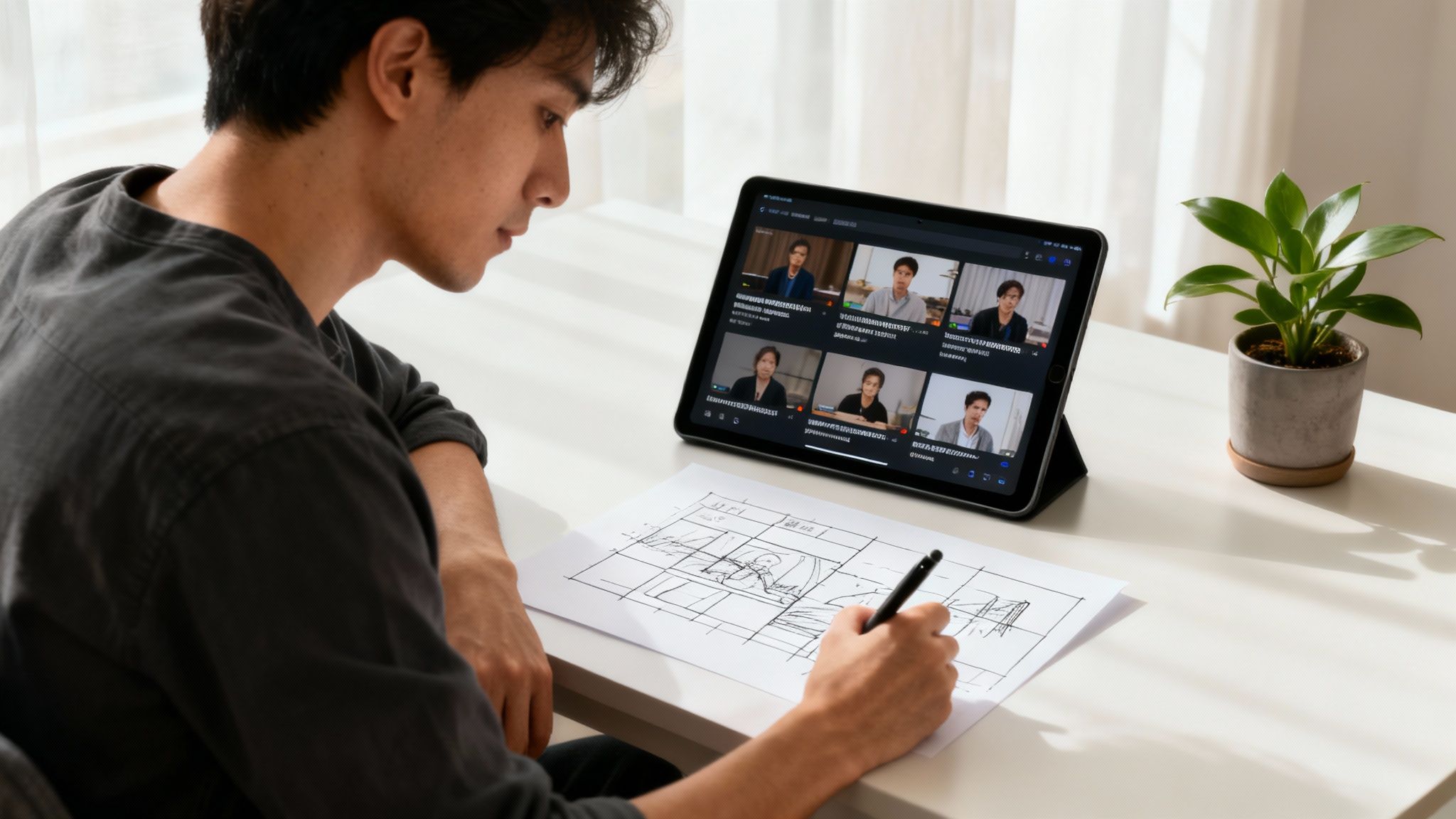
The old content creation model was linear: brainstorm, draft, review, publish. Rinse, repeat. It was a process built on human effort, which meant it was also constrained by human speed. Now, AI software is rewriting that entire script, acting less like a tool and more like a creative co-pilot operating at machine speed.
This isn’t about replacing human creativity; it’s about amplifying it. AI empowers teams to test more ideas, learn from audiences faster, and operate with an agility that was previously impossible, closing the gap between insight and execution.
From Static Campaigns to Adaptive Experiences
The most significant change is the move away from the traditional “campaign”—a fixed, one-size-fits-all broadcast—and toward what can be called “ongoing adaptive experiences.” AI software is the engine driving this, creating dynamic communication that responds to individual user actions in real time.
Instead of one message for everyone, you can now have one message for each one. These systems learn and optimize on the fly, making the brand experience feel less like a megaphone and more like a conversation. This isn’t just a tech upgrade; it’s a strategic imperative. The AI software market’s explosive growth, projected to reach hundreds of billions by 2030, is fueled by businesses recognizing its competitive edge.
Real-World AI Use Cases in Marketing
Hyper-personalization was always the goal, but scaling it was the nightmare. AI software shatters that barrier. Interested in the mechanics? Resources on automating content creation with AI offer a great starting point.
Here’s what this looks like in practice:
- Auto-Generated Scripts Tailored to Segments: Need unique video scripts for every industry you serve? An AI Script Generator can produce hundreds of targeted versions in minutes, each fine-tuned for a specific audience.
- Automated Social Media Calendars: Instead of guessing what will resonate, an AI Social Media Calendar analyzes real-time behavior and trends to schedule posts primed for engagement.
- Hyper-Personalized Video Journeys: Connect AI software to your CRM to trigger a personalized video the moment a customer hits a milestone. Timely, relevant, and automated.
The new creative workflow isn’t about producing a single, perfect asset. It’s about building an intelligent system that produces thousands of personalized assets on demand.
AI is also a game-changer for video, a traditionally resource-intensive medium. For those curious about getting started, our guide on how to make videos using AI is an excellent primer. By offloading repetitive work to AI, teams reclaim time to focus on what matters: brand strategy, narrative craft, and big-picture thinking.
Why AI-Driven Video Workflows Win
Let’s be blunt: traditional video production is slow, expensive, and rigid. It’s a model built for an era of infrequent, high-stakes projects, but it breaks down completely in today’s always-on world where audiences demand constant, relevant content.
Every marketing team knows this pain. Production cycles are so long that a video can feel dated on launch day. The costs make personalization at scale a fantasy. Video often remains a one-size-fits-all broadcast instead of the personal, engaging dialogue it could be.
AI-driven workflows don’t just improve this process; they reinvent it. Smart AI software transforms video from a cumbersome, one-off project into a scalable, automated engine for communication.
The Power of Automated Personalization
Imagine your CRM flags a new customer who just completed onboarding. Instantly, an automated workflow generates a personalized welcome video. It pulls their name, company, and goals into a dynamic template, creating a message that feels handcrafted.
This isn’t a future concept; it’s happening now with Video Automation. Instead of one generic welcome video, you can deliver thousands, each uniquely tailored. You stop thinking about making a video and start building an engine that produces endless videos.
This intelligent system can be woven across the customer journey:
- Onboarding: A custom video walks a new user through features relevant to their role.
- Milestone Achievements: An automated congratulatory video celebrates a customer’s success.
- Renewal Reminders: A personalized message highlights the value a customer has received, nudging them toward renewal.
Connecting data directly to creation builds a communication machine with precision and scale. A look into no-code video automation reveals how accessible these powerful workflows have become.
AI transforms video from a static asset into a dynamic experience that adapts to every customer. It’s the difference between a billboard and a conversation.
Redefining the Production Cycle
The contrast between old and new video creation is stark. One is a slow, linear march; the other is a fast, continuous loop.
Traditional Video Production vs. AI-Driven Video Workflows
| Attribute | Traditional Video Production | AI-Driven Video Workflow |
|---|---|---|
| Process | Manual, project-based, and linear, with distinct pre-production, production, and post-production phases. | Automated, data-driven, and cyclical, with content generated in real-time based on triggers and data inputs. |
| Scalability | Extremely limited. Personalizing for individuals or segments is prohibitively expensive and slow. | Infinitely scalable. Produces thousands of unique, personalized videos automatically and cost-effectively. |
| Strategic Impact | Serves as a top-of-funnel brand asset or a one-off communication tool. | Functions as an integrated, dynamic part of the entire customer journey, from acquisition to advocacy. |
Furthermore, the rise of AI Avatars for business adds another layer of efficiency. Teams can now produce consistent training modules, product updates, or internal announcements without filming a person each time. This frees up real people for the high-touch conversations where a human presence truly matters.
Ultimately, AI software makes intelligent video creation a competitive advantage, enabling communication with a personalization and speed that builds stronger relationships and drives superior results.
From Campaigns to Continuous Conversations

The word “campaign” has long defined marketing and sales—a project with a distinct beginning, middle, and end. A seasonal ad push, a quarterly email blast. These are static, one-way broadcasts hoping to capture attention.
But what if engagement wasn’t a series of disconnected projects? What if it was an ongoing, adaptive conversation? This is the strategic pivot that modern AI software makes possible. It helps teams escape the rigid campaign model and build “ongoing adaptive experiences” that are personal, responsive, and intelligent.
The Engine of Adaptive Engagement
At its core, an adaptive system connects customer data to communication channels, orchestrating a fluid brand experience. Instead of a marketer manually scheduling a generic email, the AI software monitors user behavior, ready to trigger the right message at the perfect moment.
This unlocks a level of personalization once confined to science fiction. A system learns from every click, purchase, and interaction, constantly refining its approach. The entire brand experience becomes a living entity that grows with each customer.
The goal is no longer to launch the perfect campaign. It is to build an intelligent system that orchestrates a million perfect, individualized moments—automatically and at scale.
This represents a monumental shift in strategy. The focus moves from creating assets to designing engagement systems—frameworks that build lasting relationships, not just short-term interest.
Real-World Examples of Adaptive Experiences
This transition from campaigns to conversations manifests in tangible ways for marketing, sales, and creative teams.
- Automated Performance Recap Videos: Instead of manually compiling reports, imagine a system that automatically generates a concise video summary of weekly sales performance for leadership. These AI-driven Video Reports turn raw data into an actionable narrative, saving hours and improving communication.
- AI Avatar Videos for Customer Updates: Need to inform customers about a new feature? An AI Avatar can deliver a consistent, professional message to thousands of users simultaneously, without booking a studio.
- Hyper-Personalized Video Journeys: A system connected to your CRM can use Video Automation to instantly generate a unique video when a customer hits a milestone, celebrating their achievement and strengthening loyalty.
This constant feedback loop means every interaction is a chance to learn and improve. The sophistication of AI-driven tools, such as modern text-to-speech technology, ensures that even automated content feels natural and engaging.
This adaptive model isn’t just about smarter marketing; it’s about building a smarter business. By automating personalized conversations, teams are freed from the relentless campaign cycle. They spend less time producing assets and more time thinking strategically about the entire customer journey, building a competitive edge one intelligent interaction at a time.
Frequently Asked Questions About AI Software
Adopting AI software sparks curiosity and questions. Teams want to understand the real-world impact on their roles, workflows, and budgets. Here are practical answers to the most common concerns.
Will AI Software Replace Creative Jobs in Marketing?
No. The consensus is that AI software will transform, not replace, creative roles. It excels at automating repetitive, predictable tasks that once consumed a creative professional’s day.
Think of it as the ultimate creative assistant. It handles first drafts, data analysis, and asset variations, freeing humans to focus on what they do best:
- Developing high-level brand strategy.
- Crafting compelling, emotionally resonant stories.
- Solving complex business problems with human intuition.
AI is a partner that augments our skills, clearing the path for deeper, more strategic thinking.
How Can Small Teams Afford to Implement AI Software?
The idea that AI is only for large enterprises is outdated. The rise of scalable Software as a Service (SaaS) models has made powerful AI tools accessible to teams of all sizes.
The key is to start small and target a specific, high-impact bottleneck.
The smartest way to adopt AI is to find your biggest pain point and solve it. Don’t try to boil the ocean; automate the one task that would give your team the most time back.
For example, a marketing team struggling with content velocity could start with a tool like an AI Script Generator or an AI Social Media Calendar. The return on investment in hours saved and output increased often justifies the cost and paves the way for further adoption.
What Is the Biggest Challenge When Adopting AI in a Creative Workflow?
The primary challenge is rarely technical; it’s cultural. It requires a mindset shift—from being the “doers” of every task to becoming the strategic “overseers” of intelligent, automated systems.
This transition involves:
- Building Trust: Learning to rely on the technology for routine tasks.
- Developing New Skills: Shifting from manual execution to prompt engineering, automation design, and interpreting AI-driven insights.
- Refocusing on Strategy: Redirecting energy toward analysis, creative direction, and orchestrating the customer experience.
Fostering a culture of experimentation is the most critical step. Success with AI software is about empowering your team to rethink how they create value.
Can AI Truly Understand Our Brand Voice and Style?
This is a valid concern. While early AI was generic, modern tools have become adept at learning and mimicking specific brand guidelines. The secret is human-AI collaboration.
AI generates the first draft or a wide array of options based on your inputs. The creative professional then refines, edits, and injects the final layer of brand personality and nuance. You provide the brand’s soul; the AI provides the scale. Using AI Avatars for business, for instance, ensures every training or update video maintains a consistent visual and tonal style.
How Does AI Help Measure the ROI of Creative Efforts?
Measuring creative impact has always been difficult. AI software helps bridge this gap by connecting creative output directly to performance data.
Instead of just tracking surface-level metrics, AI can analyze complex datasets to reveal how specific creative elements—a video’s script, an ad’s headline—influence user behavior and conversions.
Furthermore, AI automates reporting. Tools that create automated Video Reports can distill thousands of data points into a concise summary for stakeholders. This turns reporting from a time-consuming chore into a powerful strategic asset, allowing teams to prove their value and make smarter, data-backed decisions.
Ready to see how intelligent video workflows can transform your team’s impact? At Wideo, we build AI-powered tools that automate content creation and help you scale personalized communication. Discover Wideo’s AI solutions and start building smarter today.
Related posts:
 A Guide to AI Video Creation for Beginners
 AI Avatars: The New Face of Business Communication
 AI Avatars: The Secret Weapon for Business Growth and Efficiency
 12 Powerful AI Tools for Video Creators in 2025
 Artificial Intelligence Is Now the Operating System for Modern Life
 Machine Learning Ends Generic Video Marketing