A lot of teams still buy streaming tools the wrong way. They compare player skins, upload limits, and pricing pages, then realize too late that the problem is ownership, who controls the brand, the audience relationship, and the distribution path from production to playback.
That’s the procurement mistake this buyer’s guide is built to prevent. White-label video streaming is not just a hosting choice, it’s a business system for customer acquisition, sales enablement, onboarding, training, and internal communication, all delivered under your own name instead of a vendor’s interface. When that system is designed well, the viewer sees your domain, your player, your controls, and your data. When it isn’t, you’re renting visibility from a third party that can dilute your brand every time someone clicks play.
The Business Case for White-Label Video
A mid-sized media company can do everything right on the content side and still lose authority in the last mile. Its CEO may appear in a playlist on a third-party site, yet the viewer still remembers the host platform more clearly than the brand that paid for production. That’s what generic video hosts do best, they keep attention inside their own product while your content does the work.
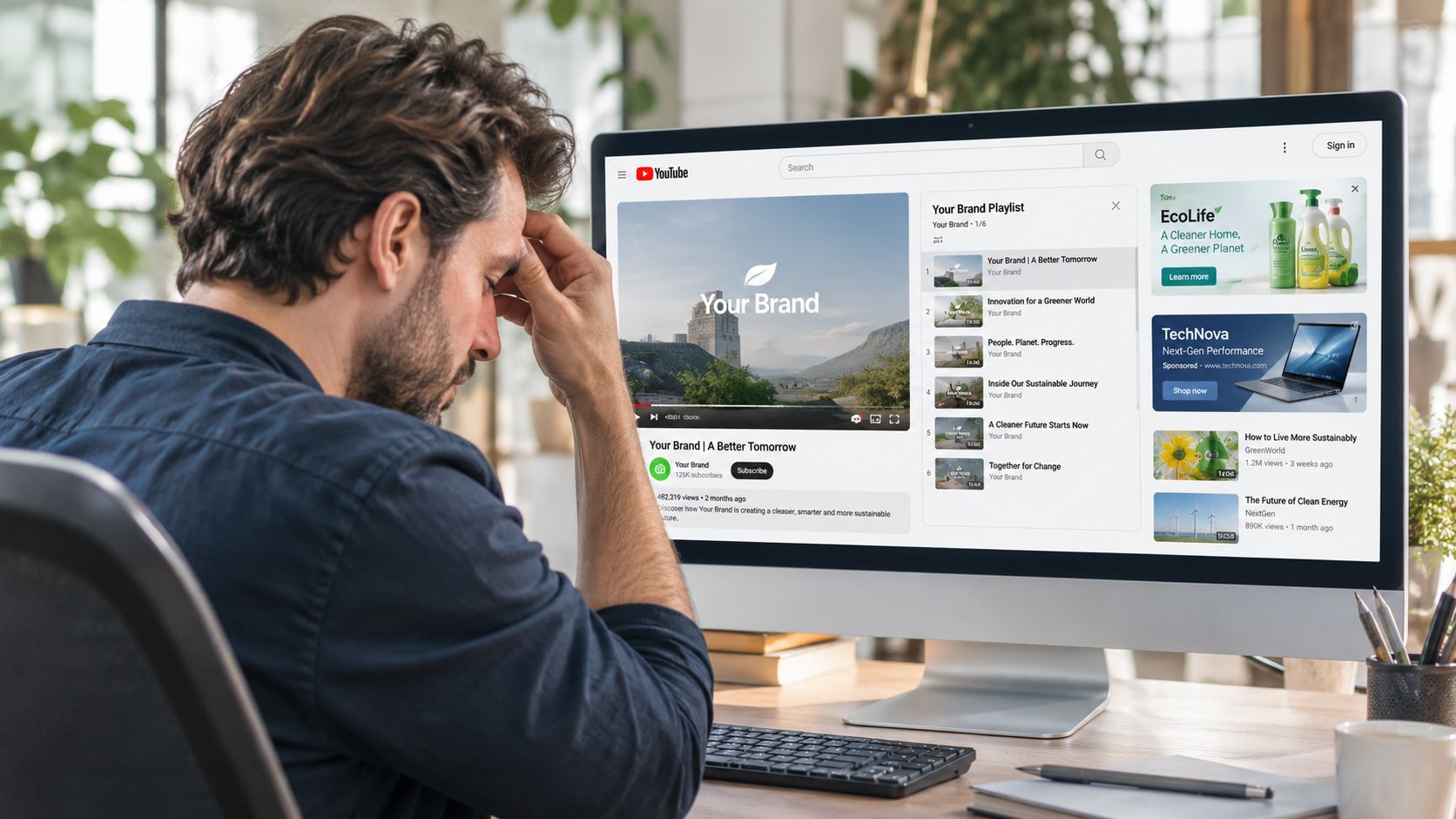
Owning the surface matters
The strongest case for white-label video streaming is simple. Your brand recall improves when every playback surface looks and feels like yours, not like a rented player inside someone else’s ecosystem. Your audience churn drops when viewers stay inside owned channels rather than drifting into a platform that promotes other content. Your lifetime value improves when first-party engagement data stays in your stack and supports follow-up, segmentation, and lifecycle communication.
That matters across industries. An ecommerce team can send branded product demos after a cart abandonment event. A finance firm can distribute advisor updates under a controlled domain. A SaaS company can use recorded messages for sales enablement and onboarding without sending prospects to a generic video page. An insurance group can keep claims education and policy communication in one controlled environment.
Practical rule: if the viewer’s next click can take them away from your business, you don’t own the system yet.
The market context supports that shift from rented visibility to owned delivery. The global video streaming market is estimated at USD 277.25 billion in 2026 and projected to reach USD 885.95 billion by 2036, with a 12.3% CAGR over the decade, while subscription video-on-demand holds 48% of market share and entertainment accounts for about 55% of content share, according to the forecast in Yahoo Finance’s market report. That scale says the infrastructure layer is no longer niche. It’s a core channel.
Why generic hosting is not enough
A generic host gives you playback. A white-label system gives you control over the relationship around playback. That difference changes procurement decisions for agencies, media companies, and enterprise teams, because the business outcome isn’t “can it play?” The question is whether every watch event stays attached to your domain, your workflow, and your reporting.
A vendor that owns the audience surface can always move the goalposts. A vendor that lets you own the surface gives you a more durable operating model.
How White-Label Video Streaming Works
A lot of buyers assume they need a full OTT application because they want branded playback. That’s usually too much platform for the job. The actual operating chain is more practical and more useful to procurement teams.
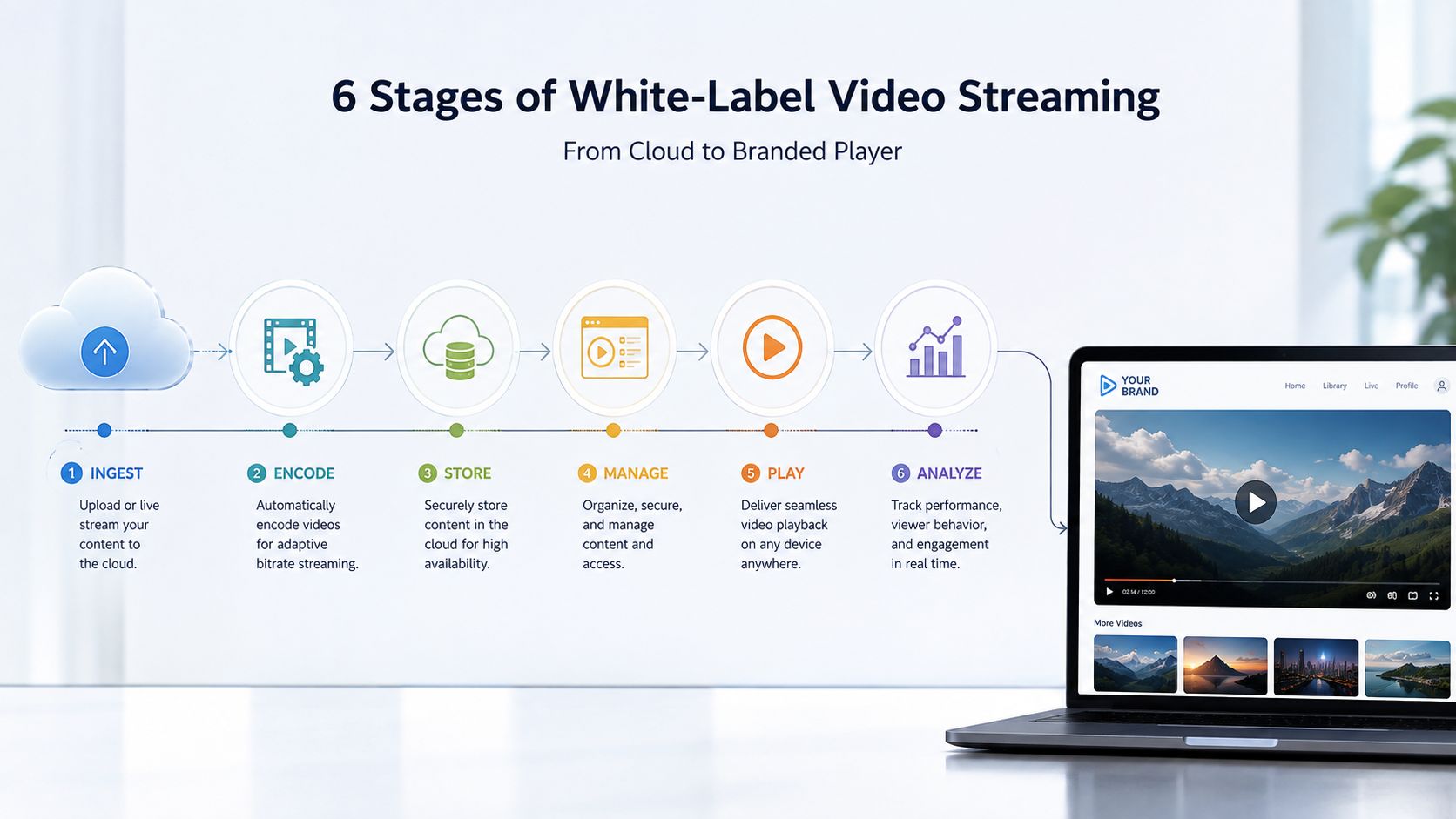
The operating chain that matters
The first stage is ingest and encode, where raw footage enters the system in a format the platform can work with. If this step is fragile, your teams waste time fixing files instead of publishing content for sales, onboarding, or internal updates. The second stage is secure storage, which matters because customer recordings, training content, and premium assets should not live in a loose folder structure with unclear access.
The third stage is transcoding for adaptive delivery. White-label platforms typically rely on adaptive bitrate packaging, where the stream is split into short segments and multiple renditions let the player switch quality as network conditions change. Industry guidance notes that optimized HLS and DASH workflows can reach about 4 seconds of latency, while 5-second live latency is already feasible in current deployments, according to AWS Elemental’s low-latency guidance. That’s not a vanity metric. It affects live town halls, webinar delivery, and any customer-facing event where delay weakens trust.
A platform that can’t deliver stable playback under variable network conditions is a business risk, not a media problem.
Where white-label ends and full OTT begins
The fourth stage is DRM and access control, followed by branded playback on owned domains, then analytics that feed the business. The model splits here. A creation-led white-label platform focuses on branded delivery, access control, and content operations. A full OTT suite goes further with subscription billing, app-store distribution, live linear channels, and broader consumer monetization.
The online video platforms market was estimated at USD 1.39 billion in 2026 and projected to grow to USD 2.57 billion by 2031, at a 13.1% CAGR, while the U.S. video streaming services industry was valued at USD 102.8 billion in 2026, based on the market statistics summarized by Quantumrun Consulting. That maturity is exactly why buyers need to match the layer they buy to the problem they have.
If your goal is branded creation plus delivery, don’t buy subscriber infrastructure you won’t use.
Capabilities Buyers Should Evaluate
Branding, operations, access, and data
Start with the surface the viewer sees. Ask whether the player can carry your logo, colors, and domain, and whether branding is fully removed from the end-user experience. A white-label promise means nothing if the vendor watermark still appears in embeds, email previews, or fallback pages. That’s the difference between an owned asset and a disguised referral funnel.
Content operations deserve the next pass. Look at upload flow, transcoding, captions, search, playlists, and how updates happen when a file changes. If a sales team needs to swap a product walkthrough or an HR lead needs to refresh onboarding footage, the platform should support repeatable publishing without manual file handling.
Access control is where revenue and compliance live. Paywalls, geo-rules, SSO, login gating, and tokenized URLs each answer a different risk. Paywalls protect monetization, geo-rules protect rights, SSO supports enterprise access, and tokenized links prevent easy forwarding of sensitive content.
For teams that need a deeper feature map, Wideo’s feature overview is a useful benchmark for how branded creation and delivery can sit inside one workflow.
Buyer rule: if the vendor can’t explain how access is scoped by audience, team, or client, the platform isn’t enterprise-ready.
Decision matrix
| Capability Area | Buyer Question Answered | Acceptance Signal |
|---|---|---|
| Branding | Does the viewer see our brand or the vendor’s? | Custom domain, clean player, branding removal |
| Content operations | Can teams update assets without friction? | Upload, captions, search, playlists, version control |
| Access control | Who can view what, and where? | SSO, tokenized URLs, geo-rules, paywalls |
| APIs and workflows | Can the platform connect to our stack? | Upload, playback, metadata, and webhook support |
| Analytics | Can we act on viewing behavior? | Engagement, completion, conversion, CRM export |
| Delivery scale | Will it hold up under demand? | Regional delivery, concurrency support, SLA clarity |
APIs matter because white-label video is rarely isolated. It needs to connect to CMS, CRM, LMS, and marketing automation systems, or it becomes another manual island. Analytics matter because completion rates, drop-off points, and conversion events should feed follow-up, not sit in a dashboard that nobody opens.
Technical Requirements for Enterprise Delivery
Enterprise buyers should evaluate the plumbing before they evaluate the demo reel. Adaptive bitrate streaming is only useful if the delivery network can serve your actual audience geography and peak concurrency. If your viewers sit across multiple regions, a weak CDN strategy will turn a clean product into a buffering complaint.
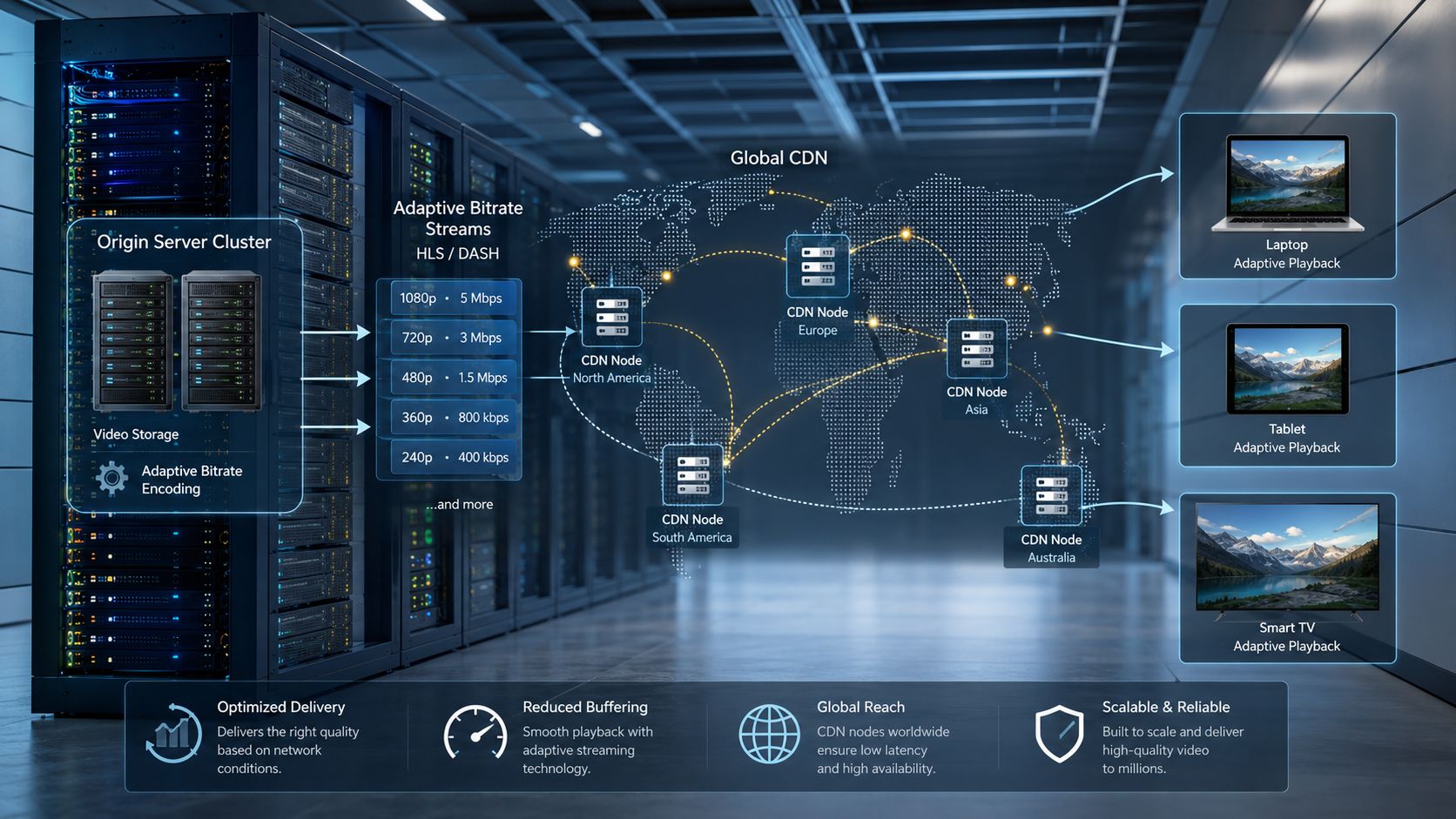
Security and identity come first
DRM choices such as Widevine, FairPlay, and PlayReady matter when content windows, contractual rights, or premium libraries are involved. Token-based authentication protects links that travel by email, chat, or embedded distribution. Custom domains and SSL aren’t cosmetic, they protect link integrity and brand trust in customer communication.
Multi-tenant architecture is essential for agencies and enterprise teams that serve multiple clients or business units. Role-based access controls keep teams segmented so one client’s content, analytics, and publishing rights don’t leak into another’s environment. For regulated use cases, that separation is the difference between a clean audit and a procurement escalation.
Integrations and operating discipline
REST and GraphQL APIs should connect with CMS, CRM, LMS, and marketing automation systems. Webhooks and SDKs should trigger publishing, distribution, and reporting without manual intervention. If a vendor can’t show how a template becomes a live asset from a data source, it’s not a system, it’s storage.
A practical resource for adjacent performance discipline is the website speed improvement checklist, because a slow page can sabotage an otherwise clean playback journey. If the landing page, asset page, or embed environment drags, viewers blame the brand, not the network.
For workflow depth, Wideo’s API documentation is the kind of reference buyers should expect from a platform that wants to sit inside a real operations stack.
Content operations also need closed captions, transcoding pipelines, and support for ad insertion where monetization requires it. Don’t ignore SLA terms either. Uptime, support response, and disaster recovery are procurement terms, not technical footnotes.
Business Models and Monetization
The right platform model depends on who gets paid. Agencies often bill clients with retainers or markup, so they need multi-tenant control and branded delivery more than consumer subscription tools. Media companies and content owners may want SVOD, AVOD, TVOD, or hybrid monetization, which means paywalls, ad insertion, entitlements, and revenue reporting matter more than design flourishes.
Enterprise teams usually buy a flat platform fee or a per-seat license. They care about SSO, access control, procurement-friendly contracts, and integration depth. SaaS providers often sit between those worlds, since they may resell dynamic content as part of a larger product and need usage-based packaging that doesn’t break their own margins.
| Buyer Type | Revenue Model | Key Platform Requirements |
|---|---|---|
| Agency | Retainer, markup, bundled service | Multi-tenant billing, branding, client segmentation |
| Media company | Subscription, ads, transactions, hybrid | Paywalls, entitlements, ad workflows, analytics |
| SaaS provider | Bundled feature, tiered pricing, usage pass-through | APIs, webhooks, embedded delivery, reporting |
| Enterprise team | Internal budget, seat licensing, flat fee | SSO, security, governance, admin control |
Pricing also shapes the decision. Usage-based models can fit variable traffic, while tiered subscriptions are easier to forecast. Custom enterprise packages make sense when security, compliance, and integration scope matter more than the lowest monthly line item.
If you want a vendor pricing map that forces these questions early, Wideo’s pricing guide is a useful reference point for comparing commercial structure before the sales call turns abstract.
Industry Applications and Outcomes
A car dealership uses branded recorded messages very differently from an airline or a university. Dealers send vehicle walkarounds, service updates, and recall communications through local teams, so the platform has to support multi-tenant control and CRM integration. Airlines care about destination content, branded passenger communication, and tight delivery control inside the travel journey.

One system, different outcomes
A nonprofit uses the same system for donor storytelling and event distribution, but low-friction sharing matters more than complex monetization. A SaaS provider may turn the same model into a customer education layer that lives inside its product. Financial advisors need context-aware client updates with audit trails and strict access control, while real estate teams need listing tours that can be updated without sending every property change through a production queue.
Education providers need LMS integration, captions, and progress tracking. Insurance teams need policy explainers, claim updates, and internal training that can be distributed by role. Media businesses need branded channels, while enterprise operations may care most about reporting and stakeholder updates that don’t require a full broadcast crew.
The market signal is clear. A 2025 industry report from Omdia says global streaming revenue is projected at $214.6 billion in 2025, with premium advertising revenue reaching $42.1 billion worldwide. That’s a crowded, monetized market, which is exactly why vague, generic hosting is not enough.
Match the platform to the operating model, not the other way around.
Choosing the Right Platform Model
Agencies and SaaS teams usually need creation-led white-label platforms. Media companies and consumer brands usually need full OTT platforms with subscription billing, multi-app distribution, and live channels. Treat that choice as a business model decision, because the wrong stack adds cost without improving delivery.
| Requirement | Creation-Led White-Label | Full OTT Platform |
|---|---|---|
| Acquisition | Branded links, embeds, lead forms | App distribution, subscriber onboarding |
| Security | Domain control, role-based access, tokenized links | DRM at scale, entitlements, broader rights management |
| Operations | Template-based publishing, content updates | Library management, subscriber lifecycle tooling |
| Growth | Sales, onboarding, internal communication, client delivery | Consumer retention, subscriptions, ad inventory |
| Best fit | Agencies, SaaS teams, enterprise communications | Media businesses and consumer streaming brands |
Read the warning signs
Paying for subscriber lifecycle tooling when you only need event-based delivery means you are buying the wrong layer. Agency work breaks when a platform cannot isolate multiple client domains cleanly. If the vendor cannot show how creation connects to branded distribution, your team will keep routing work through manual steps.
For teams that need branded creation and delivery without building separate streaming infrastructure, Wideo’s video automation supports that workflow, and its enterprise contact page is the place to start if you want to confirm fit. That profile suits a white-label platform built for business communication, while a full OTT stack serves a different buyer.
Choose the model that matches the operating system behind the video. Branded delivery serves agencies, SaaS providers, and internal communications. Full OTT serves subscriber businesses that need a broader media product.
Implementation Roadmap and Next Steps
Start with a review of current assets, distribution channels, and stakeholder needs. Lock down branding rules, domain requirements, data ownership, and integrations before vendor talks begin. Then shortlist two platforms from the matrix, not ten, and run a pilot around one real workflow, such as onboarding, sales follow-up, or internal training.
Use the pilot to test access control, API behavior, publishing speed, and whether the player still reflects your brand after content changes. Pricing should map to usage tiers, support boundaries, and clear exit terms if performance slips. A platform that cannot show how creation flows into branded distribution will add manual work instead of removing it.
Check viewer-data handling, pricing growth, and contract fit in the demo. If the answers are vague, walk away. If they are clean, move forward with a platform that fits the business system behind your video. For teams comparing white-label video delivery with a broader OTT build, start with Wideo’s enterprise contact page and confirm whether the model matches the workflow you need.