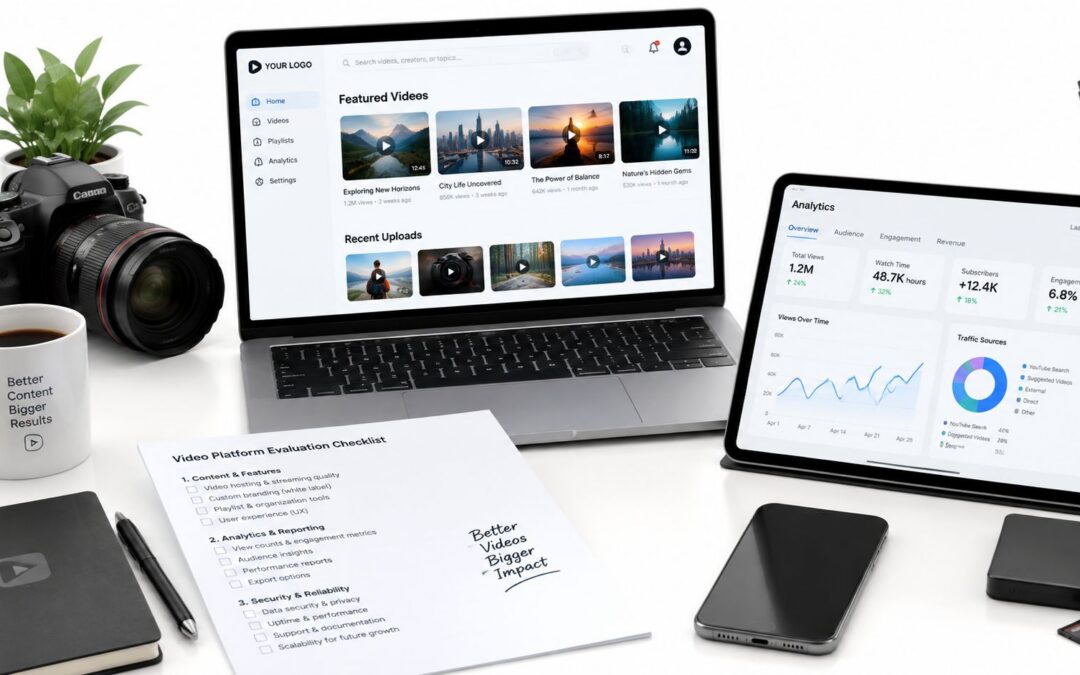
You’re probably already doing the worst version of video work, the one-off kind that lands in Slack, gets assigned to a freelancer, and never turns into a service line. That’s the reason white label video platform for agencies matters. It’s not about adding another tool to the stack, it’s about turning a leaky production habit into a branded recurring offer your agency can own.
The Video Work You Keep Turning Away
A twelve-person agency gets the same request every month, a client wants three short cuts for paid social, then a version for the landing page, then a follow-up clip for onboarding. The account lead says yes in principle, then routes it to a freelance editor who invoices separately, misses context, and sends back files with no agency branding at all. The agency keeps the relationship, but the recurring revenue walks out the door with the handoff.
That’s the business mistake. Video breaks flat-rate retainers because revisions, versioning, rendering, and delivery don’t behave like static design tasks. They’re closer to a production line than a service hour, and if your pricing still treats them like generic creative time, your margin gets chewed up fast.
A white label video platform for agencies changes the offer structure. Instead of selling isolated edits, you sell a branded monthly service with clear deliverables, a visible workflow, and renewal potential. The client sees one agency, one portal, one experience, which matters more than most owners admit because inconsistency is what pushes buyers back toward “just use the freelancer.”
Practical rule: if the work can repeat every month, it shouldn’t live in a one-off project bucket.
For marketing, SaaS, ecommerce, insurance, real estate, education, travel, media, and internal communications, the question isn’t whether teams need recorded message production. They do. The question is whether your agency wants to keep donating the workflow to other vendors or package it under its own name. See the agency use case here.
What a White Label Video Platform Actually Replaces
A white-label system is simple in concept and ruthless in practice. One company builds the infrastructure, another company rebrands it, prices it, and delivers it as its own service. In agency terms, that means the vendor disappears from the client-facing experience, while your logo, domain, palette, and client portal do the selling.
What disappears from the workflow
You stop stitching together freelance editors, separate hosting accounts, email chains, and manual download links. You also stop explaining to clients why their branded asset lives in someone else’s interface. The platform becomes the production layer, not just the place where files are parked.
A real agency workflow looks cleaner fast. Intake comes in through your branded portal, the work is assigned against a template, review happens in a client space that carries your name, and delivery uses your domain rather than a vendor subpage. That is a different business model, not a cosmetic tweak.
The backend matters just as much as the surface. The best white label video platform for agencies gives you tenant separation, usage tiers, render credits, API access, and branded assets that load dynamically at runtime. That’s what lets one core system serve many client accounts without building separate codebases every time a new retainer lands. This automation overview shows the workflow side.
A platform replaces production friction. A logo alone does not.
If you’re serving ecommerce product drops, onboarding sequences, insurance explainers, or real estate listings, the point is repeatability. You want the same client-facing process every month, not a reinvention every time a brief lands.
Where the Margin Actually Lives in Branded Video
Most agencies obsess over the wrong number. They look at the tool fee and ignore the labor trail, where profit either survives or gets shredded. The unit you should track is cost per delivered minute, not seat count.
Compare the production paths
| Cost Line | Freelance Production | In-House Production | White-Label Platform |
|---|---|---|---|
| Intake and coordination | Agency time plus back-and-forth | Agency time plus internal scheduling | Branded form and routing |
| Editing labor | External freelancer fees | Staff editor hours | Mostly template setup |
| Revisions | Extra rounds, extra delay | Internal rework | Template-driven changes |
| Hosting and delivery | Separate platform or manual links | Separate platform or manual links | Included in one branded workflow |
| Client reporting | Manual screenshots or exports | Manual screenshots or exports | Built into the client space |
The margin lives in the spread between what you charge for a monthly service and what the render costs you to deliver. If a branded cut is sold as part of a retainer, the agency keeps the markup by making the process repeatable, not by hoping an editor works faster that week. That’s why a white label video platform for agencies is more like a product stack than a vendor.
Revenue-share models can make sense when the platform handles monetized client delivery or membership-style services. Flat platform fees win when you want predictable overhead and you’re packaging branded production for retainers. Use the model that protects the margin on the service you sell, not the one that sounds nicer in a demo.
For feature depth and workflow fit, review the platform capabilities here. Then ask the harder question, can this support your margin at volume, or does it just create prettier invoices?
The Operational Checklist Before You Launch a Branded Video Service
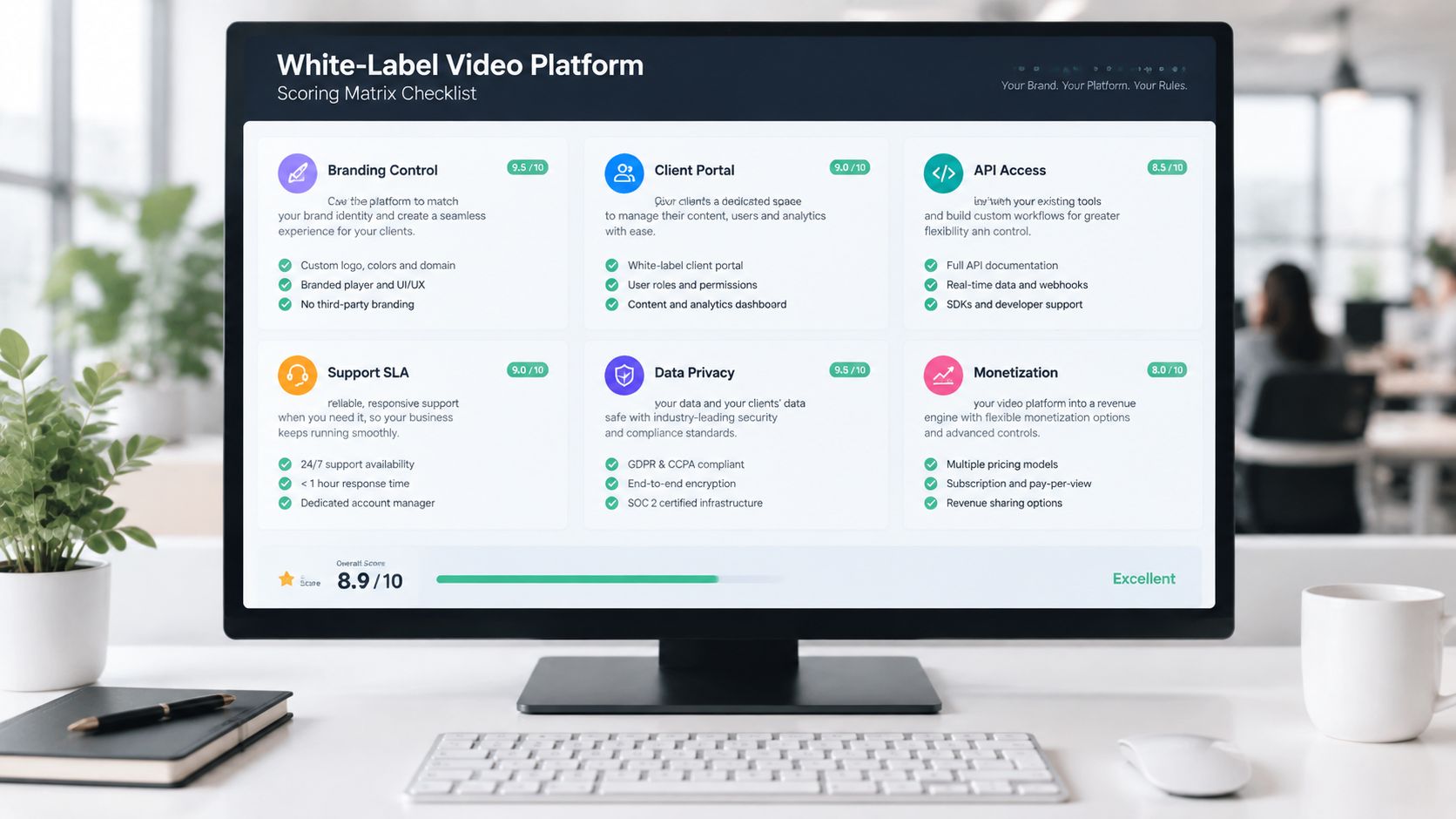
Before you sign anything, score your setup against six pass-fail tests. If a vendor can’t pass the test, it’s not ready for a recurring service line.
What must be true
- Branding control: Can you remove vendor marks from the player, portal, emails, exports, and domain?
- Access tiers: Can each client only see its own assets, approvals, and reporting?
- Template delivery: Can you trigger renders from structured inputs without manual rebuilding?
- Billing flow: Can the service map cleanly to retainers, overages, or usage-based pricing?
- Security posture: Can you keep permissions, authentication, and account separation tight enough for enterprise buyers?
- Analytics export: Can you move performance data into the reporting stack your team already uses?
That list is blunt on purpose. A lot of tools fail not because they can’t make a branded player, but because they can’t keep the vendor out of the client journey. If a footer email still points to someone else’s domain, you haven’t white-labeled the service, you’ve only painted the front door.
A second test is internal, not client-facing. Can your team run the service without depending on a developer for every new template or route? If the answer is no, you’ve bought another bottleneck. That’s the point where a white label video platform for agencies starts to matter as infrastructure, not software fluff.
How a Real Agency Runs a Branded Video Service in Practice
A mid-size performance agency starts the month with twelve active clients and one branded intake form. A client drops a campaign brief into the portal, the account manager tags it by use case, and the team assigns a template for the top three ad cuts. The editor only touches the creative that really needs human judgment, not every version of every clip.
The review happens in a branded workspace, so the client comments, approves, and downloads without ever seeing the underlying vendor. That matters more than people think, because trust gets built through continuity. If the client sees the same agency name at every step, the service feels owned rather than rented.
The output then rolls into monthly billing and, when the account performs, into upsells for onboarding pieces, training clips, or longer-form explainers. That’s how the service line compounds. The agency is no longer chasing project scraps, it’s running a repeatable production system tied to retention, sales enablement, and internal communication.
A company in ecommerce can use the same workflow for product launches, while a finance team can use it for onboarding and compliance updates, and a real estate group can turn listings and neighborhood tours into a recurring content stream. The mechanics don’t change much. The client problem does.
The agency that owns the workflow owns the relationship longer.
Why Branding Removal Goes Deeper Than a Logo Swap
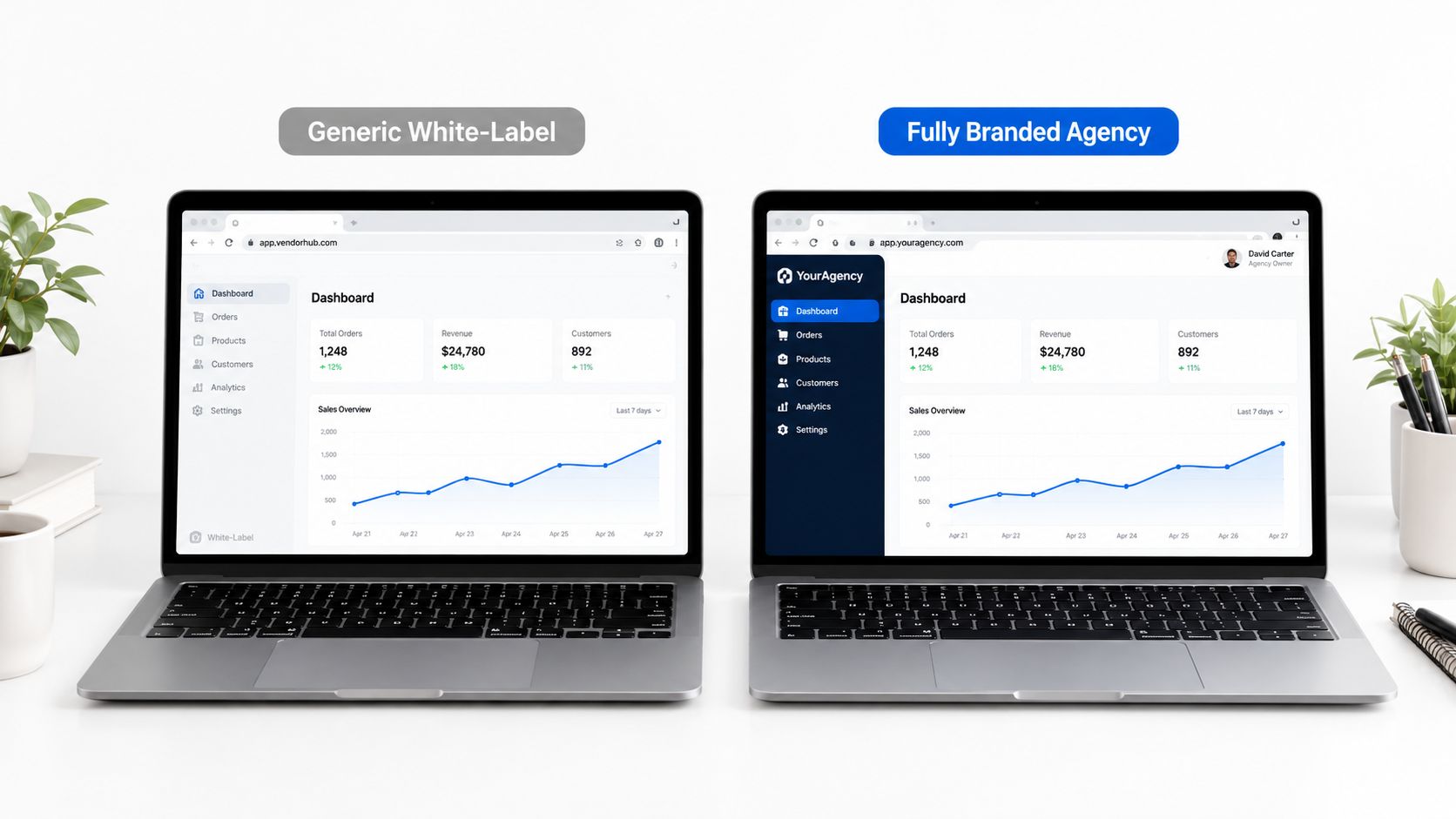
A real white-label setup removes every cue that says “someone else built this.” That includes watermarks, vendor URLs in share links, footer text in notifications, support portals, and billing statements that should carry only your agency name. If a client searches a footer and lands on a platform they never hired, your margin is leaking through trust.
The deeper issue is operational control. Vendor support shouldn’t sit in your client calls, roadmap decisions shouldn’t be exposed as somebody else’s product updates, and permissions shouldn’t force your team to explain another company’s logic. When a white label video platform for agencies is done right, the vendor becomes invisible in the workflow and your agency becomes the product owner in the client’s eyes.
That’s the line that separates a resale arrangement from a real service business. The API layer sits under that control, but the client should never need to think about it.
Launching the Service Line and Scaling It Without a Dev Team
The cleanest rollout is boring, and that’s a compliment. Pick three to five pilot clients, define a narrow menu of deliverables, and price the offer as a monthly retainer with overages for extra renders. Then ship the first batch inside one billing cycle so the team can see what slows them down.
A small team can run a lot with the right structure, because the work becomes a loop. Intake form, template assignment, render queue, approval workspace, invoice. That’s enough to handle ongoing social cuts, ad variants, landing-page loops, onboarding clips, and internal training snippets without hiring an engineering team or rebuilding your stack.
What usually breaks first is not the creative, it’s the handoff discipline. Once output grows, you need better template families, tighter approval rules, and fewer custom exceptions. That’s where a white label video platform for agencies helps you stay repeatable instead of slipping back into ad hoc production.
For teams that want no-code production routing, this no-code automation path is worth studying. If your agency is still subcontracting branded delivery, the obvious first product is the one you already sell informally, but haven’t packaged yet.
Wideo gives agencies a white-label video platform they can brand with their own logo, domain, and colors, so the service feels native to the agency instead of outsourced. If you want to turn recurring video requests into a branded offer without dev cost or infrastructure work, visit Wideo and compare it against the way you’re handling those requests today. How much video work are you turning away, or outsourcing, that could be a branded service instead?