
Your agency doesn’t have a video problem. It has a scale problem.
Creating one polished explainer isn’t hard anymore. The hard part is producing dozens of videos across clients, departments, campaigns, and funnels without turning your team into a content factory that spends all week resizing scenes, swapping logos, rewriting intros, and chasing approvals. That’s where most agencies break. Not on creativity, but on throughput.
A lot of agencies start with Synthesia because AI avatar videos look like a shortcut. For a simple presenter-led explainer, it works. But the model is narrow. Synthesia is built around talking-head delivery, and agencies rarely live in one format for long. You need ads, onboarding videos, client reports, sales follow-ups, product updates, social clips, internal comms, and training assets. One avatar format won’t carry that load.
That mismatch is why the usual advice around the best synthesia alternative for agencies misses the point. The question isn’t which avatar tool looks a little better. The question is which platform helps your agency build repeatable video systems across accounts and use cases.
If you’re still comparing avatar libraries, you’re solving the wrong problem.
A smarter place to start is exploring AI video tools through the lens agencies care about: scale, repeatability, personalization, and operational control.
1. Wideo

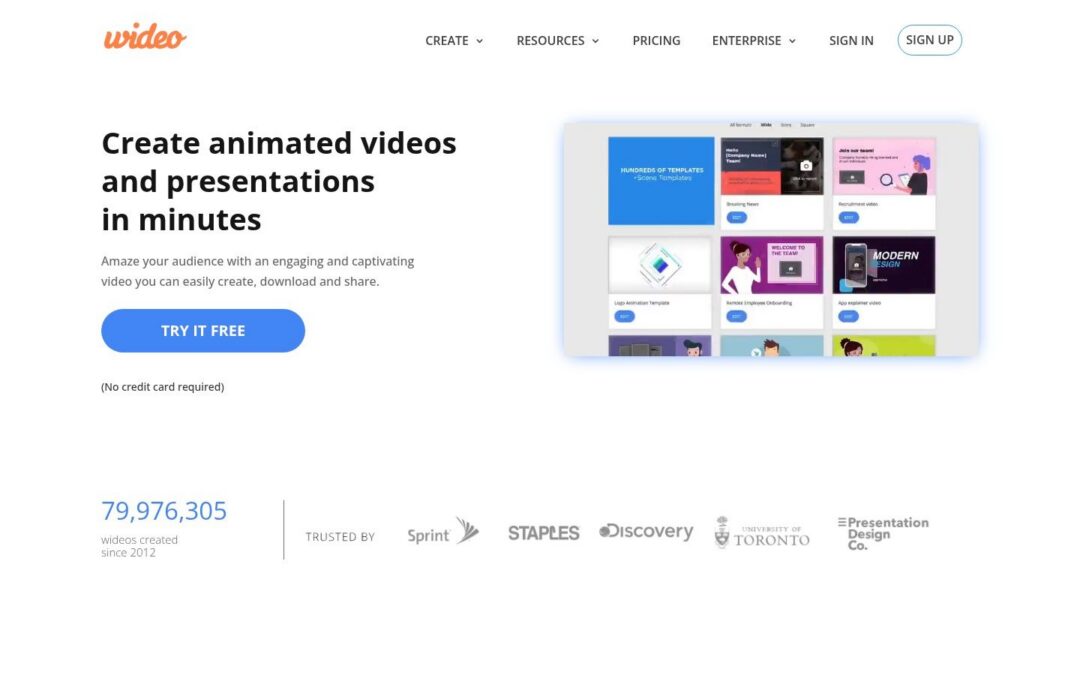
Wideo is the best synthesia alternative for agencies because it isn’t trying to be a slightly better avatar tool. It’s built around a different operating model. Instead of asking your team to create each video from scratch, it lets you build template-driven production systems that can serve multiple clients, departments, and campaign types.
That’s the upgrade. Agencies don’t need more digital presenters. They need fewer manual steps.
For a SaaS client, that could mean automated onboarding videos tied to plan type or user segment. For an e-commerce brand, it could mean product promos generated from repeatable templates. For an insurance client, it could mean policy update explainers, sales follow-ups, and internal training assets built from one system instead of three separate tools.
Why agencies choose systems over avatars
Avatar platforms are useful when the final output is always a presenter on screen. Agency work rarely stays that clean. Clients ask for variation. They want brand consistency without copy-paste sameness. They want social content, sales content, lifecycle content, and internal content, often at the same time.
Wideo fits that reality better because it supports:
- White-label delivery: Agencies can present a more polished service model without forcing clients into a visibly third-party workflow.
- Automation logic: API access and enterprise workflows make it practical to generate recurring or personalized video at volume.
- Template-based production: Teams can standardize output for ads, reporting, onboarding, internal updates, and more.
- Broader content formats: You’re not boxed into avatar-led scenes when the project needs animation, presentation-style video, or branded visual storytelling.
Wideo also comes with a publisher-backed track record of nearly 80 million videos created since 2012, which matters because agencies shouldn’t bet operations on tools that feel like experiments. That context comes from Wideo’s platform overview.
Operational rule: If your team keeps rebuilding the same video in slightly different client versions, you don’t have a creative workflow. You have a production bottleneck.
This matters beyond marketing. Agencies serving HR teams can standardize training videos. Agencies working with airlines or travel brands can automate customer update content. Agencies supporting fintech or telecom clients can create repeatable stakeholder recaps and internal briefings without dragging every request through an editor.
A practical next step is using Wideo’s AI video generator as the front end of a scalable production process, not as a novelty feature.
Where Wideo changes the economics
The trap with avatar tools is that they feel efficient at first because they remove filming. But filming usually isn’t the bottleneck for agencies. Revision loops, formatting changes, client-by-client customization, and repetitive assembly work are the bottleneck.
Wideo attacks that layer of waste.
Its drag-and-drop workflow, template library, AI-assisted creation, personalization options, stock assets, and enterprise automation make it better suited for agencies that sell ongoing video programs rather than one-off avatar clips. That’s why Wideo is the strongest recommendation here. It’s not just a replacement for Synthesia. It’s the platform agencies graduate to when they stop treating video as a single deliverable and start treating it as infrastructure.
2. HeyGen

If you insist on staying in the avatar category, HeyGen is the strongest direct competitor.
It has real momentum. In August 2025, HeyGen recorded 12.2 million monthly website visits, ahead of other Synthesia competitors in the same Semrush view, alongside a domain authority score of 54 and a bounce rate of 38.84%, according to Semrush competitor data for Synthesia. That tells you the market is paying attention.
It also gives agencies a practical toolkit for customer-facing avatar videos. The platform offers over 400 pre-made templates, custom photo avatars, and pricing that starts at $24 per month with enterprise plans at $120 per month, as described in Fiverr’s 2026 comparison of Synthesia alternatives.
Where HeyGen works
HeyGen is a good fit when the client deliverable is still presenter-led content:
- Sales outreach: Personalized intros for outbound or account-based campaigns
- Marketing explainers: Branded spokesperson videos for landing pages and promos
- Training rollouts: Quick how-to or onboarding content with a consistent presenter
- Multilingual campaigns: Avatar localization without filming multiple versions
The reason I don’t rank it above Wideo is simple. HeyGen is still centered on the avatar as the product. That’s useful, but narrow.
Agencies report faster creation with HeyGen, but speed inside the wrong format still leaves you boxed in.
If your agency mostly produces spokesperson-style videos, HeyGen is a solid pick. If you’re trying to build a broader client delivery system across marketing, onboarding, sales, customer success, and internal communication, it’s still a step sideways from Synthesia, not a step up in operating model.
3. Colossyan

Colossyan is the best option on this list for agencies that serve enterprise learning and development teams. If your clients need onboarding modules, compliance training, HR education, or structured internal comms, Colossyan is more focused than Synthesia in that lane.
Its positioning is clear. The platform supports scenario branching, SCORM and xAPI exports, AI translation, role-based permissions, LMS and CRM integrations, and API access. It also serves enterprise clients including DHL, Novartis, and Heineken, with pricing starting at $21 per month, according to Relevance AI’s comparison of Synthesia alternatives.
When Colossyan is the right call
Colossyan makes sense for agencies building repeatable training operations for large organizations.
Think about a real use case. An agency working with a global insurance firm could create compliance videos in multiple languages, export them into an LMS, and reuse templates across regions. An agency serving a healthcare or legal client could build policy training libraries with tighter permissions and clearer internal governance than a generic avatar tool usually provides.
Its enterprise focus is backed by the same source, which states that Colossyan has been adopted by over 1,000 enterprises and supports more than 100 languages.
Still, the limitation is strategic. Colossyan is stronger than Synthesia for L&D, but it remains tied to the presenter-video model. For agencies with mixed client work, that means you may still need a second platform for social ads, campaign creative, executive recaps, and non-avatar formats.
- Best for: Corporate training retainers and internal education programs
- Less ideal for: Agencies that need one system for both training and campaign production
Colossyan is a specialist. That’s a strength if your agency is built around enterprise enablement. It’s a constraint if you need broad creative flexibility.
4. D-ID

D-ID is for agencies that care more about programmatic avatar generation than polished end-to-end campaign production.
That’s not a criticism. It’s a category distinction. If your team has developers, needs API-first workflows, or wants to plug talking-head generation into another system, D-ID is worth serious consideration. It gives you a mature technical foundation for automated presenter output.
Best use inside an agency
D-ID is strongest when video is a generated component inside a larger workflow.
For example, a real estate or fintech agency might use it to create personalized update videos from CRM triggers. A customer success team could build recurring account-review messages. A product-led SaaS agency could generate tutorial intros tied to product events or user actions.
Its appeal is technical advantage:
- API-centered workflow: Useful for batch creation and platform integration
- Translation support: Helpful when one message needs multiple language versions
- Enterprise trust posture: Important for larger client accounts with governance requirements
The trade-off is obvious once you step outside avatar content. D-ID doesn’t solve the broader agency challenge of managing multi-format output across social, paid, onboarding, and internal communications. It handles one slice of the stack well.
That makes it a strong tactical tool, not a complete agency video system.
5. Elai.io

Elai.io sits in the middle of the market. It’s more practical than flashy, which many agencies will appreciate.
You get avatars, language support, blog or URL to video workflows, brand asset support, and higher-tier 4K output. That combination makes it useful for agencies producing straightforward explainers, product education, and basic multilingual content without overcomplicating the stack.
The realistic fit
Elai.io works best when clients need functional volume, not premium creative range.
A B2B SaaS agency could use it to convert help content into simple onboarding videos. An education client could turn presentation materials into lesson-style videos. A marketplace brand could create repeatable product explainers from templated inputs.
Don’t confuse usable with scalable. A tool can help you ship more avatar videos and still leave your broader production model messy.
The issue is the same one that keeps showing up in this category. Elai.io is still organized around avatar output. That’s useful when the brief is narrow. It becomes limiting when clients want mixed formats, campaign variation, or one unified workflow for customer acquisition, customer education, and internal operations.
For agencies with a light need for AI presenters, Elai.io is reasonable. For agencies trying to standardize video delivery across multiple business functions, it won’t replace a true automation platform.
6. Hour One
Hour One is built for business communication. That matters.
A lot of AI video tools pitch themselves as creative platforms, then end up better suited to novelty demos than operational content. Hour One is more disciplined. It leans into virtual presenters for enablement, L&D, and internal communication. Agencies serving enterprise accounts will recognize the appeal immediately.
Where it fits in client work
Hour One makes sense for agencies handling formal communication streams:
- Internal rollout videos: Policy updates, leadership communication, operational changes
- Enablement content: Sales training, support education, channel partner materials
- Structured onboarding: Standardized business communication with a consistent presenter
It also appears more enterprise-aware in how it handles workspaces, support structures, and buyer operations. That makes it easier to sell into organizations that care about procurement and reliability, not just output speed.
The drawback is familiar by now. It’s still a presenter-led platform first. If your agency’s work expands into campaign creative, social adaptation, executive reporting, or personalized client lifecycle communication outside that format, you’ll hit the same wall you hit with Synthesia. Just with a different vendor.
Hour One is a better fit than Synthesia for some business communication teams. It still isn’t the best synthesia alternative for agencies that need one platform to support many kinds of video work.
7. DeepBrain AI AI Studios

DeepBrain AI’s AI Studios is one of the stronger enterprise-grade avatar platforms in the market. If your clients care about realistic AI humans, broad language coverage, and governance, it deserves a look.
That said, agencies need to be ruthless about separating enterprise polish from agency fit. Those aren’t the same thing.
Strong for regulated and formal use cases
DeepBrain AI is most useful when your agency supports clients in sectors where presentation quality and formal communication matter more than creative flexibility. Finance, healthcare, insurance, education, and enterprise operations fit that pattern well.
A practical application could look like this:
- A financial services agency creates multilingual service explainers
- A healthcare client uses it for patient education or internal process updates
- An enterprise operations team standardizes executive and stakeholder communication
Its strengths are clear. Realistic presenters, translation, dubbing, multiple output options, and enterprise governance create a stable environment for business messaging.
The problem is category lock-in. It still assumes the avatar is the center of the workflow. Agencies that need to repurpose a message into ads, social cuts, lifecycle video, visual recaps, and presentation-style outputs will still need another layer in the stack.
DeepBrain AI is a capable vendor. It just doesn’t solve the full agency production model.
8. Synthesys

Synthesys appeals to agencies that want a lot of voice and avatar options under one roof. On paper, it looks generous. Large avatar library, broad language and dialect support, dubbing, translation, team options, and a business tier built around heavier use.
That’s attractive if your operation is volume-heavy and your deliverables stay close to AI presenter content.
Why agencies still outgrow it
The issue isn’t whether Synthesys has enough features. It probably has more than enough for many teams. The issue is whether those features move your agency toward a scalable delivery system or just give you a larger avatar toolbox.
Those are different outcomes.
For a media buying agency, more avatars won’t solve the need to generate ad variants fast. For a customer success agency, dubbing won’t replace a repeatable lifecycle-video system. For a multi-service firm, voice features won’t unify reporting videos, onboarding assets, internal comms, and campaign content.
- Good choice: Agencies with high-volume presenter and voiceover needs
- Poor choice: Agencies trying to centralize all client video operations in one system
Synthesys is useful. It isn’t transformative.
9. Tavus
Tavus is specialized, and that specialization is either a huge advantage or a dead end.
If your agency sells personalized video at scale for sales, customer experience, or account management, Tavus is one of the more interesting platforms in this market. It isn’t trying to be a broad creative suite. It’s built around personalized presenter experiences, API workflows, and interactive video capabilities.
A niche with real agency value
There are agencies that can build an entire service line around this.
A SaaS growth agency could create personalized outbound video campaigns for target accounts. A customer marketing team could use it for renewal messaging or executive business reviews. A recruiting or education client could use it for customized follow-up communication.
Tavus stands out because it treats personalization as infrastructure, not just a cosmetic feature. That’s useful when video is tied directly to pipeline, retention, or account expansion.
The narrower the platform, the more disciplined you need to be about where you deploy it.
That’s the key warning. Tavus is excellent for one-to-one or one-to-many personalized communication. It is not the center of an agency-wide video operating model. If you try to make it your primary system, you’ll end up layering more tools around it very quickly.
Use Tavus for a specialized service. Don’t mistake it for a full replacement for agency production operations.
10. Fliki

Fliki is better than many agencies expect, especially for content repurposing.
It combines avatars, text-to-video workflows, blog and URL conversion, auto-subtitles, stock media, and a large voice library. That makes it useful for agencies turning written content into lightweight videos for social, SEO distribution, or top-of-funnel campaigns.
Best for content engines, not full systems
If your agency runs content programs, Fliki can help move faster. A SaaS agency can repurpose blog posts into short educational videos. An e-commerce brand can create simple promo clips. A travel or nonprofit team can turn updates into easy-to-distribute visual content.
Its market visibility is meaningful too. In August 2025, Fliki.ai recorded 2.2 million visits in the same Semrush competitor snapshot that showed stronger traction for HeyGen, which helps frame where it sits in the category as a more lightweight alternative rather than a dominant agency platform, per the earlier Semrush dataset.
The reason it lands last here isn’t quality. It’s fit.
Fliki is useful when your input starts with text and your output needs to be simple. It isn’t built as the core production system for an agency managing multiple clients, brands, departments, and workflow types. For that, you need a platform designed around repeatability and operational control, not just content conversion.
Top 10 Synthesia Alternatives: Agency Comparison
| Product | Core Features | Best For | UX / Output Quality | Value / Pricing Notes |
|---|---|---|---|---|
| Wideo: The Scalable Video Platform for Agencies | Template-driven drag‑and‑drop editor, white‑labeling, API, AI voice/blog‑to‑video, stock library | Agencies & enterprises needing multi-format automation and high-volume personalized campaigns | Fast template-based workflows; MP4/ social exports; Chromebook-optimized | Scalable plans for teams/enterprise; advanced features likely paid; cloud-only |
| HeyGen | AI avatars, dubbing/translate, brand presets, team workspaces, API | Agencies focused on presenter-led marketing & training | High-quality avatars and lip‑sync; collaboration features | Clear Business tier; watch billing/credit terms for high volume |
| Colossyan | 80+ avatars, PPT/PDF→video, translation, script assistant, API | L&D and corporate training agencies | Clean UI for e-learning; PPT/PDF conversion optimized | Minutes model on lower tiers; Business requires sales for large scale |
| D‑ID (Creative Reality Studio) | Face animation API, lip‑sync translation, HD outputs, web studio | Developer teams and automation-heavy agencies using talking-head videos | Professional-looking presenter videos up to ~5 min; HD on paid plans | Strong API and compliance; pricing/details mainly in-app; trial watermarks |
| Elai.io | 80+ avatars, 75+ languages, 4K output, selfie avatars, blog→video | Agencies needing avatar videos with high-res exports | 4K option; collaborative team seats; brand asset support | Minutes allotments per billing cycle; add‑on top‑ups; monitor usage |
| Hour One | Avatar library, multi‑language voices, templates, workspace billing | Business communications and enterprise L&D teams | Template-driven presenter content; enterprise SLAs | Enterprise-focused billing (ACH/wire); pricing via sales |
| DeepBrain AI – AI Studios | Realistic AI humans, TTS, dubbing, translation, governance tools | Regulated industries and enterprise deployments | High-fidelity avatar outputs; broad language support | Enterprise pricing varies; “unlimited” plans negotiated with sales |
| Synthesys | 200+ avatars, 175+ dialect voices, dubbing, 4K, Business Unlimited tier | Teams needing broad avatar/voice/dubbing capabilities | Robust avatar and voice quality; 4K on Business | Business “unlimited” subject to fair‑use; confirm caps for high volume |
| Tavus | Replica API, personalized presenter videos, CVI streaming, compliance | 1:1 sales, CX, interactive personalized campaigns | Purpose-built for hyper-personalization and streaming | Transparent per-minute pricing; higher cost unless scaled |
| Fliki | 2,000+ voices, avatars, blog/URL/PPT→video, auto-subtitles, stock media | Scaling social/blog content into simple videos | Strong TTS quality; 1080p exports; easy social workflows | Credit-based pricing; free tier available; avatar credit rules vary |
From Video Tool to Video System The Agency Flywheel
Most agencies search for the best synthesia alternative for agencies when they’re already feeling the pain. Turnaround times are slipping. Clients want more video in more places. The team is spending too much time rebuilding assets that should already exist as templates, systems, or automated workflows.
That’s the signal.
Synthesia solved an early problem for a lot of teams. It made avatar-based video easy to produce. But agencies don’t win by producing one kind of video more easily. They win by building delivery systems that can support acquisition, sales enablement, onboarding, retention, internal communication, training, and reporting without reinventing the process every time.
Most comparisons often miss the point. They stay too close to the original category. They compare avatar quality, voice realism, and presenter styles when the bigger issue is operational design. If your agency needs to support a car dealership group, a nonprofit, a fintech team, and an enterprise HR client, you can’t build your service around one talking-head format and call it scale.
You need a platform that helps your team standardize production while still letting each client feel distinct.
That’s why Wideo is the right recommendation. It supports the shift from handcrafted video requests to repeatable video systems. That matters in practice:
- Marketing teams can create recurring ads, social content, and campaign explainers from reusable templates.
- Sales teams can deploy personalized video outreach without custom editing every time.
- Customer success and onboarding teams can trigger lifecycle communication at scale.
- HR and training teams can build standardized learning and internal communication libraries.
- Operations and leadership teams can turn recurring updates, reports, and recaps into a repeatable format instead of a last-minute scramble.
For agencies, that changes the commercial model too. You stop selling isolated videos and start selling systems, workflows, and ongoing video infrastructure. That’s more defensible. It’s easier to scale. It’s harder for low-cost competitors to copy because the value isn’t just the final asset. The value is the engine behind it.
If you only need a better avatar, HeyGen or Colossyan can work depending on whether your center of gravity is marketing or training. But if you’ve outgrown Synthesia, don’t buy another version of the same limitation. Move into a platform that matches how agencies really operate.
That’s the difference between using video as a tactic and building it into the business.
If your agency is tired of producing videos one request at a time, take a serious look at Wideo. It’s the clearest path from avatar-first output to a scalable video system your team can use across clients, campaigns, onboarding, sales, internal communication, and automation-heavy workflows.
Related posts:
 Generative AI Tools: The Ultimate Guide to AI Video Creation
 Text to Video AI: The Ultimate Guide to Scalable Content Creation
 Large Language Models: The Brain Behind Scalable Video Creation
 Beyond Automation: Why Video is the Future of AI Marketing Tools
 AI Integration: The Bridge Between Your Data and Scalable Video Creation
 How Agents AI Are Building the Future of Autonomous Video


